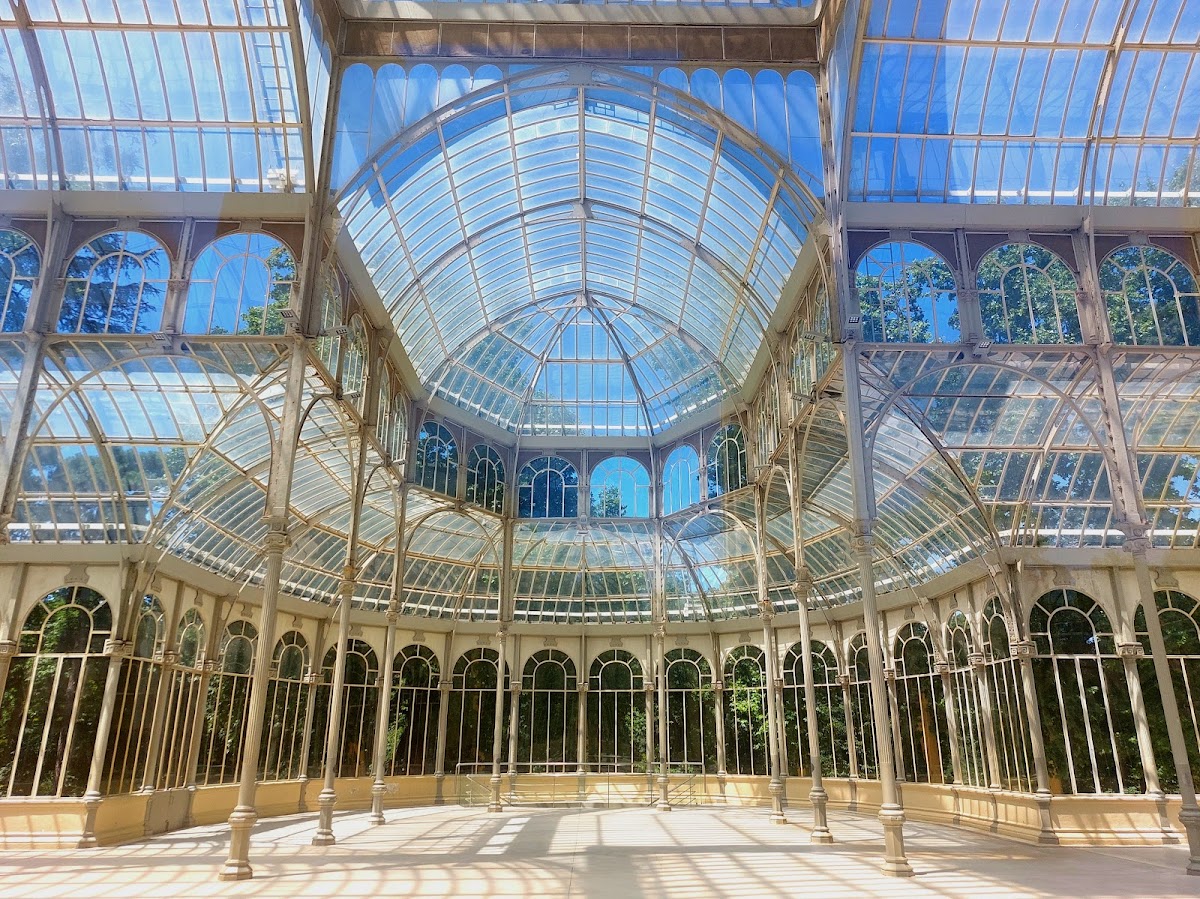
The Crystal Palace of Retiro Park, Madrid — A Dazzling Blend of Sunlight and Art
The Crystal Palace of Retiro Park, Madrid — A Dazzling Blend of Sunlight and Art
The Crystal Palace of Retiro Park — A Dazzling Blend of Sunlight and Art
The Crystal Palace, or Palacio de Cristal, is an iconic glass and iron structure located within Madrid's Retiro Park. Situated at P.º de Cuba, 4, Retiro, 28009 Madrid, it is easily accessible from major art institutions like the Prado Museum and Reina Sofía Museum. This architectural marvel, reflecting beautifully on the adjacent pond, offers a unique interplay of light, nature, and art.
Built in 1887 for the Philippine Exhibition to house tropical plants, the palace was a testament to 19th-century advancements in iron and glass construction. Today, it serves as a special exhibition space for the Reina Sofía Museum, showcasing contemporary art installations that interact with its transparent structure and the surrounding natural environment of Retiro Park.
Museo del Prado — A Journey Through Spain's Golden Age
The Museo del Prado, located at C. de Ruiz de Alarcón, 23, Retiro, 28014 Madrid, is one of Europe's premier art museums, boasting over 200 years of history. Its grand Neoclassical architecture houses an extensive collection of over 8,000 masterpieces, primarily focusing on Spanish Golden Age artists.
Key highlights include Diego Velázquez's 'Las Meninas,' a complex work exploring perspective and reality, Francisco Goya's 'The Third of May 1808,' a powerful depiction of wartime brutality, and El Greco's 'The Disrobing of Christ,' known for its distinctive elongated figures and intense spirituality. The Prado offers an unparalleled journey into the heart of Spanish art history.
Museo Reina Sofía — Modernity and 'Guernica'
The Museo Reina Sofía, situated at C. de Sta. Isabel, 52, Centro, 28012 Madrid, is Madrid's principal museum for 20th-century Spanish art. Originally an 18th-century hospital, it was transformed into a modern art museum and opened in 1992, conveniently located next to Atocha train station.
The museum's most celebrated work is Pablo Picasso's monumental 'Guernica,' a stark black-and-white portrayal of the horrors of the Spanish Civil War, serving as a powerful anti-war statement. The collection also features significant works by Surrealist Salvador Dalí and Abstract artist Joan Miró, offering a comprehensive overview of modern Spanish artistic movements.
Madrid's Art Triangle — The Paseo del Arte
Madrid's three major art institutions—the Prado Museum, the Reina Sofía Museum, and the Thyssen-Bornemisza Museum—form what is known as the 'Paseo del Arte' (Art Walk). These museums are located within walking distance of each other, offering a diverse range of art from classical to contemporary periods.
Visitors planning to explore all three can consider purchasing the 'Paseo del Arte Card,' which provides discounted admission and allows for skip-the-line entry. This art triangle represents the vibrant cultural heart of Madrid, offering a rich and comprehensive artistic experience.
Visitor Information for Madrid's Art Museums
Prado Museum
- Admission: General 15€, free for EU citizens under 26. Free entry Mon-Sat 18:00-20:00, Sun 17:00-19:00.
- Opening Hours: Mon-Sat 10:00-20:00 / Sun 10:00-19:00.
- Transport: Metro Banco de España (5 min walk) / Atocha (10 min walk).
- Visit Duration: 3-4 hours.
Reina Sofía Museum
- Admission: General 12€. Free entry Mon, Wed-Sat 19:00-21:00, Sun 12:30-14:30.
- Opening Hours: Mon 10:00-21:00 / Tue Closed / Wed-Sat 10:00-21:00 / Sun 10:00-14:30.
- Transport: Metro Atocha (3 min walk).
- Visit Duration: 2-3 hours.
Crystal Palace, Retiro Park
- Admission: Free.
- Opening Hours: 10:00-22:00 (April-October). Hours vary by season and exhibition schedule; checking the official website is recommended.
- Location: P.º de Cuba, 4, Retiro, 28009 Madrid, Spain.
- Transport: Metro Retiro, Banco de España, or Ibiza stations, then walk.
- Visit Duration: 1-2 hours (including exhibition and park stroll).
Visitor Info
| Admission | Translating |
| Hours | Translating |
| Location | Paseo de la República de Cuba, 4, 28009 Madrid, Spain |
| Getting There | Translating |
| Estimated Visit | Translating |