Florence: Where the Heart of Renaissance Originals Beats, Walking Through Time
Florence: Where the Heart of Renaissance Originals Beats, Walking Through Time
Galleria dell'Accademia: A Renaissance Heart in Florence
The Galleria dell'Accademia, located at Via Ricasoli 105 R in central Florence, Italy, stands as a pivotal institution for Renaissance art. Situated approximately a 10-minute walk east of Florence's Santa Maria Novella (SMN) station, the museum is nestled amidst narrow alleys and historic buildings, embodying the timeless spirit of the city. This location places it at the core of Florence's artistic and cultural landscape.
Establishment and Evolution of the Accademia
Founded in 1784 by Grand Duke Leopold I of Lorraine, the Accademia initially served as an educational hub for students of the Florence Art Academy. It primarily displayed plaster casts and models, providing aspiring artists with direct access to classical forms. This commitment to art education laid the groundwork for its future significance.
A transformative moment occurred in 1873 when Michelangelo's iconic 'David' statue was relocated here from the Piazza della Signoria. This move was crucial for protecting the marble masterpiece from environmental damage and simultaneously elevated the Accademia's status, opening it to the wider public. The museum thus transitioned from a purely academic institution to a major public art gallery, becoming a global beacon for Renaissance art.
Michelangelo's David: A Monumental Presence
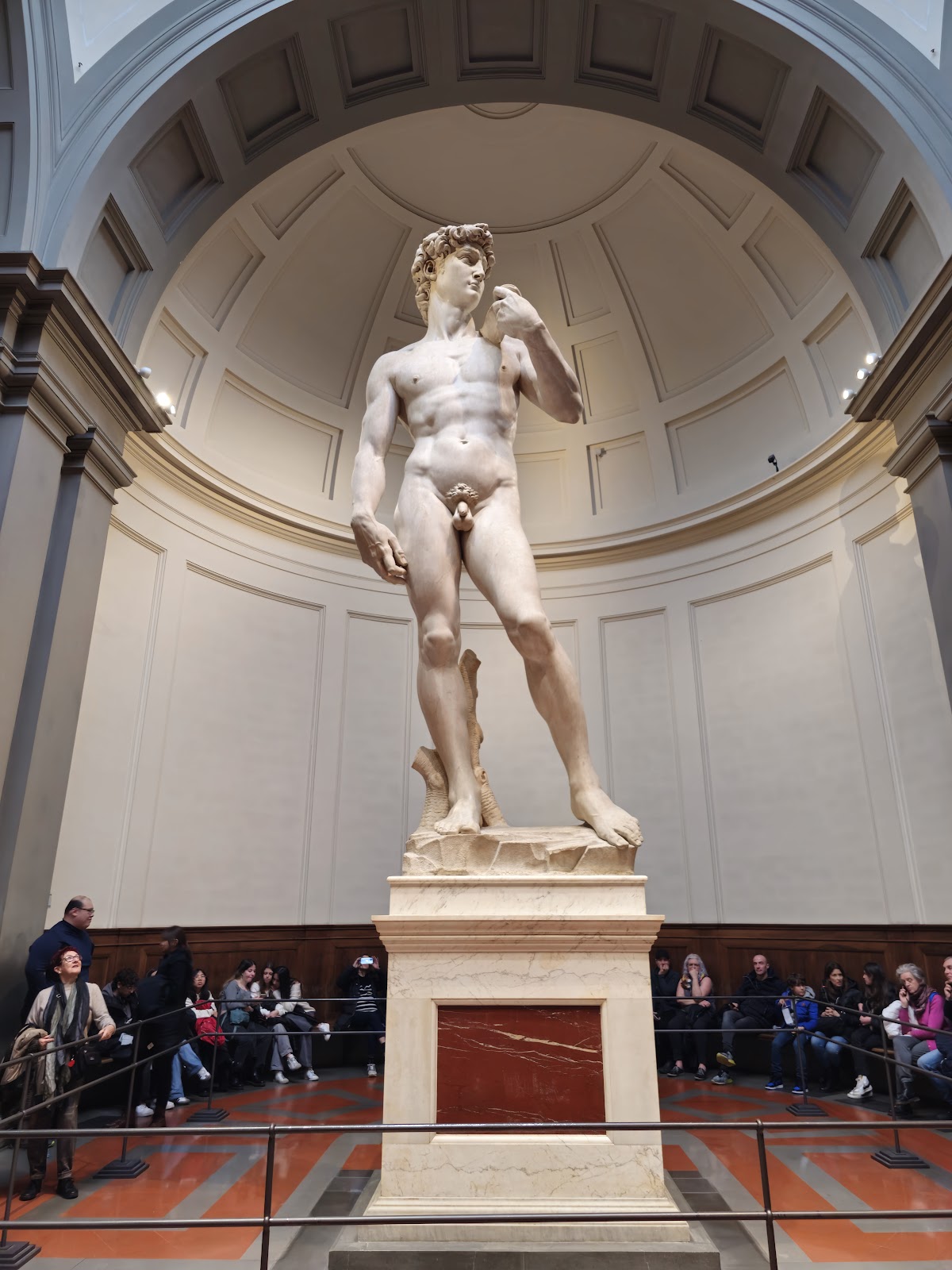
At the heart of the Galleria dell'Accademia resides Michelangelo's 'David,' a masterpiece of Renaissance sculpture. Standing at an imposing 5.17 meters, this marble statue commands the central hall with its powerful presence. It captures David not after his victory, but in the tense moments preceding his confrontation with Goliath, conveying a profound sense of resolve and concentration.
Michelangelo's meticulous anatomical understanding is evident in every detail, from the taut musculature to the expressive facial features. The statue's proportions, with slightly enlarged head and hands, were deliberately crafted to compensate for the viewer's upward gaze when it was originally displayed in the Piazza della Signoria. The 'Contrapposto' pose further enhances its dynamic balance, embodying the humanistic ideals of the Renaissance.
The Unfinished Slaves: Glimpses into the Artist's Process
Beyond David, the museum houses Michelangelo's 'Unfinished Slaves' (Prigioni) series. These sculptures, originally intended for Pope Julius II's tomb, offer a unique insight into the artist's creative process. Michelangelo believed that the form already existed within the stone, and his task was to liberate it by carving away the excess material. Their unfinished state, due to changes in papal commissions and Michelangelo's other commitments, reveals the raw struggle and artistic methodology of the master.
Each 'Slave' figure appears to be emerging from the marble, conveying a powerful sense of struggle and aspiration. This series provides a compelling contrast to the perfected form of David, showcasing the depth of Michelangelo's artistic exploration and his profound understanding of the human condition, even in incompleteness.
Diverse Collections and Florence's Artistic Tapestry
In addition to Michelangelo's sculptures, the Galleria dell'Accademia features a significant collection of Florentine paintings from the 13th to the 16th centuries. These works, by artists such as Giotto, Botticelli, and Ghirlandaio, illustrate the evolution of Renaissance art from its early stages to its zenith, providing a comprehensive view of the period's artistic, religious, and social contexts.
The museum is an integral part of Florence's broader artistic landscape. The city itself functions as a vast open-air museum, where the historical and cultural context of works within the Accademia can be fully appreciated. Other key institutions like the Uffizi Gallery and Bargello Museum, along with landmarks such as the Duomo and Piazza della Signoria (where a replica of David stands), collectively weave the rich tapestry of Renaissance art that defines Florence.
Visitor Information and Recommended Itinerary
For visitors, a recommended itinerary begins with an immersive experience of 'David' in the central hall, followed by a journey through the 'Unfinished Slaves' to understand Michelangelo's creative struggles. Conclude with the Florentine painting collection to grasp the broader sweep of Renaissance art. A typical visit lasts between 1 to 1.5 hours.
The museum is closed on Mondays and operates from 8:15 AM to 6:50 PM from Tuesday to Sunday. General admission is 12 Euros, with free entry on the first Sunday of each month. Its central location, a 10-minute walk from Florence SMN station, makes it easily accessible. Visitors are encouraged to check the official website (https://www.galleriaaccademiafirenze.it/en/) for the most current information before planning their visit.
Visitor Info
| Estimated Visit | Translating |
| Translating | Translating |
| Recommended Route | Translating |