Beauty Etched by a Millennial Empire: Walking Through the Artistic Heart of Rome and Vatican
Beauty Etched by a Millennial Empire: Walking Through the Artistic Heart of Rome and Vatican
Rome and Vatican City: A 2026 Field Study of Art and Empire
From June 16th to 20th, 2026, a comprehensive field study was conducted across the major art museums and historical sites of Rome and Vatican City. The objective was to examine the core currents of Western art history, from the Ancient Roman Empire through the Renaissance and Baroque periods, directly at their sites of origin. This report details the history, architecture, collections, and visitor flow of the Vatican Museums, Borghese Gallery, and Capitoline Museums, which were the primary focus of the study. The total visit duration for these institutions was approximately 3 to 4 days, prioritizing art museum itineraries.
Rome, as the heart of the Ancient Roman Empire and a cradle of Western civilization, functions as a vast open-air museum. Vatican City, an independent state located within Rome, serves as the center of the Catholic Church. These two areas collectively embody millennia of human artistic and religious achievement, housing masterpieces by luminaries such as Michelangelo, Bernini, and Raphael. Each museum possesses a unique history and collection, offering critical insights into significant periods of Western art.
The Borghese Gallery: A 17th-Century Villa in Borghese Park
The Borghese Gallery is situated within the expansive Borghese Park (Villa Borghese Pinciana) in central Rome, Italy. Its address is Piazzale Scipione Borghese, 5, 00197 Roma RM, Italy. The gallery is approximately a 15-minute walk from Spagna Station on Rome's Metro A line, and is also accessible by city bus routes such as the 910. Its location within the park provides a serene environment, surrounded by lush greenery and picturesque landscapes.
The museum building itself was constructed in the early 17th century as the private residence of Cardinal Scipione Borghese (1577-1633). This villa is recognized as a fine example of Baroque architecture. Currently, it houses approximately 400 artworks displayed across 20 rooms. The gallery operates on a timed entry system, allowing visitors a dedicated two-hour period to experience the collection.
Founding and Collection of the Borghese Gallery: A Cardinal's Legacy
The Borghese Gallery was established based on the extensive private collection of Cardinal Scipione Borghese in the early 17th century. He was a prominent patron of the arts, actively collecting works by leading artists of his time, with a particular focus on Gian Lorenzo Bernini (1598-1680) and Michelangelo Merisi da Caravaggio (1571-1610). This collection serves as a crucial resource for understanding the zenith of late Renaissance and Baroque art.
The primary holdings of the museum consist of sculptures by Bernini and paintings by Caravaggio. Additionally, works by other Renaissance masters such as Raffaello Sanzio (1483-1520) and Tiziano Vecellio (c. 1488/1490-1576) are also part of the collection. The approximately 400 artworks are distributed across 20 exhibition rooms, offering visitors a comprehensive view. The depth and quality of the collection are considered among the finest in Rome.
Masterpieces of the Borghese Gallery: Bernini's Sculptures
Gian Lorenzo Bernini's sculptures form the core of the Borghese Gallery's collection. 'Apollo and Daphne' depicts the mythological moment when Daphne, pursued by Apollo, transforms into a laurel tree. The sculpture captures the precise instant Apollo's hand touches Daphne's body, as her fingers morph into branches, her feet into roots, and her skin into bark, creating a dramatic narrative in marble. Daphne's scream, Apollo's desperate expression, and the flowing hair and drapery are rendered with a vitality that imbues the marble with movement.
'The Rape of Proserpina' illustrates Pluto, god of the underworld, abducting Proserpina. The indentations left by Pluto's fingers on Proserpina's thigh create the illusion of soft, yielding flesh. The intense struggle of Proserpina, her despairing expression, and Pluto's muscular physique generate a tension that transcends the material of the marble. Bernini infused such dramatic moments into his stone, bringing his works to life.
Masterpieces of the Borghese Gallery: Caravaggio's Paintings
Caravaggio's paintings are characterized by their intense chiaroscuro (contrast of light and shadow) and stark realism. 'David with the Head of Goliath' exemplifies his profound psychological insight and dramatic staging. David's expression conveys both triumph and a degree of pity, while Goliath's severed head is depicted with unflinching realism.
'Sick Bacchus' is believed to be an early self-portrait of Caravaggio. The sickly appearance of Bacchus deviates from the idealized image of a god, revealing a more human vulnerability. Other notable works, such as 'Boy with a Basket of Fruit,' are also on display. Caravaggio's contributions marked a new direction in Baroque painting, and his works constitute a vital part of the Borghese Gallery's collection.
The Capitoline Museums: At the Heart of Rome on Capitoline Hill
The Capitoline Museums are situated on Capitoline Hill, one of Rome's seven historic hills. The address is Piazza del Campidoglio, 4, 00186 Roma RM, Italy. Located in the city center, it is close to the Roman Forum and the Colosseum. Accessibility is good, with Colosseo Station on Metro B line approximately a 10-minute walk away.
The museum complex consists of two main palaces, Palazzo dei Conservatori and Palazzo Nuovo, centered around the Piazza del Campidoglio. This square and its surrounding buildings were designed by Michelangelo Buonarroti (1475-1564) in the 16th century, possessing both architectural beauty and historical significance. A replica of the equestrian statue of Emperor Marcus Aurelius stands at the center of the square.
Founding and History of the Capitoline Museums: The World's Oldest Public Museum
The Capitoline Museums trace their origins to 1471, when Pope Sixtus IV donated a collection of bronze sculptures to the citizens of Rome. This act is recognized as the beginning of the world's oldest public museum. The Pope's donations, consisting of ancient Roman artifacts, were crucial symbols of Rome's glory. The collection has since expanded steadily to its current extensive scale.
The museum plays a significant role in the study of ancient Roman history and culture. The Palazzo dei Conservatori served as a municipal administrative building for Rome, while the Palazzo Nuovo was primarily built for displaying sculptures. The two buildings are connected by an underground passage, allowing visitors to journey through ancient Roman artifacts. This unique structure demonstrates how architecture itself can embody the flow of history and artistic vision.
Architecture of the Capitoline Museums: Michelangelo's Piazza del Campidoglio
The ascent to Capitoline Hill begins with the Cordonata, a gently sloping staircase designed by Michelangelo. As one climbs past monumental sculptures, the grandeur of the Piazza del Campidoglio unfolds. Michelangelo arranged the Palazzo dei Conservatori, Palazzo Nuovo, and the Palazzo Senatorio (located between them) to create a harmonious and balanced composition.
The rhomboidal pattern of the square's pavement and the equestrian statue of Emperor Marcus Aurelius (a replica) at its center establish a visual focal point. The trapezoidal shape of the square, formed by the surrounding buildings, creates a unique perspective. Michelangelo intended this piazza to achieve perfect proportion and optical illusion. The two main buildings, Palazzo dei Conservatori and Palazzo Nuovo, appear symmetrical externally, but in reality, Michelangelo redesigned previously existing structures to achieve a unified style.
Key Collections of the Capitoline Museums: The Glory of Ancient Rome
The Capitoline Museums house masterpieces that embody the glory of ancient Rome. The Palazzo dei Conservatori displays a colossal head and arm of Emperor Constantine the Great, along with the bronze 'Capitoline Wolf.' The Capitoline Wolf depicts the she-wolf suckling Romulus and Remus, figures from Rome's founding myth, and is one of Rome's iconic symbols.
The Palazzo Nuovo features delicate marble sculptures by renowned artists, such as 'Dying Gaul' and 'Capitoline Venus.' 'Dying Gaul' expresses the pain and dignity of a defeated warrior, while 'Capitoline Venus' represents the idealized beauty of ancient Greek sculpture. These artifacts, integrated within Michelangelo's designed spaces, vividly convey the history of Rome.
The Vatican Museums: A Repository of Human Art in Vatican City
The Vatican Museums are located within Vatican City. The address is WF43+9VH, 00120 Vatican City. It is approximately a 10-minute walk from Ottaviano-S. Pietro Station on Rome's Metro A line and is adjacent to St. Peter's Basilica. Vatican City, an independent state within Rome, serves as the spiritual center of the Catholic Church.
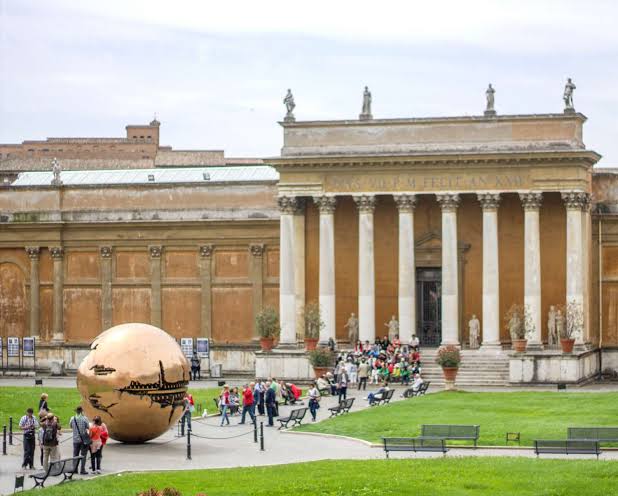
The museum is not a single building but a vast complex of interconnected palaces, galleries, and gardens. Tens of thousands of artworks are displayed along approximately 7 kilometers of corridors, representing a monumental repository of human art and faith accumulated over millennia. Millions of visitors frequent the site annually.
Founding and Scale of the Vatican Museums: A Millennium of Art and Faith
The Vatican Museums originated in the early 16th century when Pope Julius II opened his private sculpture collection to the public. Subsequently, an extensive array of artworks and artifacts collected by successive popes was added, leading to its current immense scale. It is regarded not merely as a museum but as a sacred site imbued with a millennium of art and faith. The collection spans various eras, from ancient Greek and Roman times to the Renaissance, Baroque, and contemporary periods.
The museum is divided into numerous sections, including the Egyptian Museum, Etruscan Museum, Pio-Clementine Museum, Raphael Rooms, and Gallery of Maps. Each section specializes in artworks from a specific era or culture, allowing visitors to experience distinct artistic worlds as they navigate the complex. The breadth and diversity of the collection are considered among the finest globally.
Key Collections of the Vatican Museums: From Antiquity to the Renaissance
The Vatican Museums house masterpieces of ancient Greek and Roman sculpture. The Pio-Clementine Museum displays ancient works such as the 'Laocoön Group' and 'Apollo Belvedere.' The 'Laocoön Group' depicts a scene from the Trojan War myth, dramatically expressing human suffering and agony. The 'Apollo Belvedere' is a prime example of the idealized beauty characteristic of ancient Greek sculpture.
The Raphael Rooms (Stanze di Raffaello) feature brilliant frescoes by Raffaello Sanzio. Among them, 'The School of Athens' depicts an imagined gathering of ancient Greek philosophers, embodying the essence of Renaissance humanism. In the Gallery of Maps (Galleria delle Carte Geografiche), 16th-century Italian maps are integrated with ceiling frescoes, creating an enchanting spatial experience.
The Core of the Vatican Museums: The Sistine Chapel
The Sistine Chapel is the culmination of the Vatican Museums' visitor itinerary. This sacred space is where papal conclaves are held for the election of new popes, and it is renowned for Michelangelo's ceiling frescoes and altar wall painting. After navigating long corridors, visitors entering the chapel are invariably overwhelmed by its monumental scale and artistic perfection. Silence is required within the chapel, and photography is prohibited.
Michelangelo's ceiling fresco 'Genesis' and the altar wall painting 'The Last Judgment' are considered pinnacles of human artistic achievement. In 'The Creation of Adam,' a segment of 'Genesis,' the almost touching fingers of God and Adam dramatically express the mysterious moment life is bestowed upon humanity. Michelangelo worked alone on the ceiling fresco for approximately four years (1508-1512) and on the altar wall painting for about six years (1536-1541).
Visitor Information: Notes for Rome and Vatican Museum Exploration
Vatican Museums
- Admission Fee: Adult 17€. Free admission on the last Sunday of each month (09:00-14:00).
- Operating Hours: Mon-Sat 08:00-20:00 (last entry 18:00). Closed on Sundays and some public holidays. Free admission days are 09:00-14:00 (last entry 12:30).
- Location: WF43+9VH, 00120 Vatican City.
- Transportation: 10-minute walk from Ottaviano Station (Metro A line).
- Recommended Viewing Time: 3-4 hours.
- Reservation: Online advance booking is strongly recommended. Long queues may occur without a reservation.
Borghese Gallery
- Admission Fee: Adult 15€ + 2€ (reservation required).
- Operating Hours: Tue-Sun 09:00-19:00 (last entry 17:00). Closed on Mondays.
- Location: Piazzale Scipione Borghese, 5, 00197 Roma RM, Italy.
- Transportation: 15-minute walk from Spagna Station (Metro A line). Bus 910 is also available.
- Recommended Viewing Time: 2 hours (timed entry).
- Reservation: Advance reservation is mandatory. Arriving on time for the scheduled slot is crucial.
Capitoline Museums
- Admission Fee: Adult 15€, reduced 13€. Free on the first Sunday of each month.
- Operating Hours: Daily 09:30-19:30 (last entry 18:30). Closed on January 1st, May 1st, and December 25th. Shortened hours on December 24th and 31st (09:30-14:00).
- Location: Piazza del Campidoglio, 4, 00186 Roma RM, Italy.
- Transportation: Bus stop Piazza Venezia. 10-minute walk from Colosseo Station (Metro B line).
- Recommended Viewing Time: 2-3 hours.
- Reservation: Not mandatory, but online booking during peak season can reduce waiting times.
General Rome Visit Notes
In Rome, the Trastevere district is identified as an area with numerous local eateries favored by residents. Traditional Roman pasta dishes such as 'Carbonara' and 'Amatriciana' are prominent menu items, and thin, crispy Roman-style pizza is also available. 'Pizza al Taglio' is a common street food, and gelato, a quintessential Italian dessert, is offered in a variety of flavors.
Visitor Info
| Estimated Visit | Translating |
| Translating | Translating |
| Recommended Route | Translating |