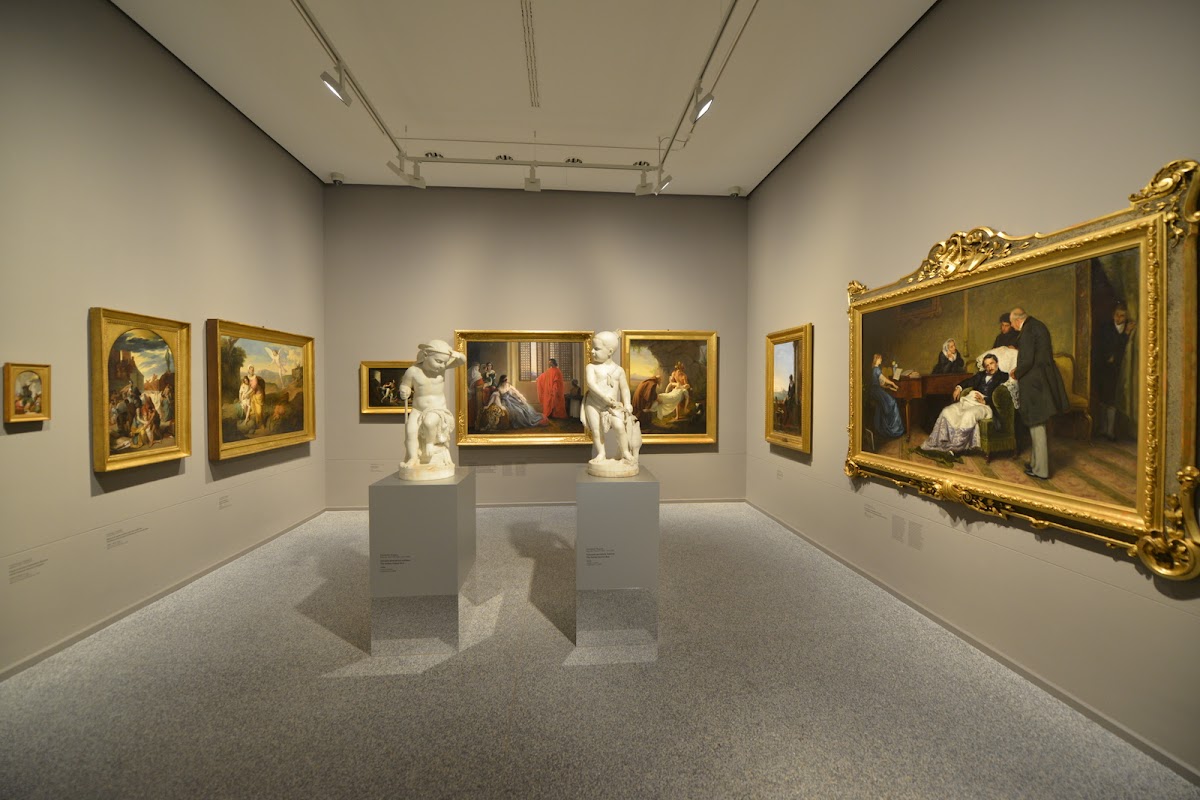
A Bergamask Trove of Renaissance Masters
A Bergamask Trove of Renaissance Masters
Accademia Carrara in Bergamo, Italy, is a distinguished fine arts museum located at Via San Tomaso, 80, within the historic Palazzo Piccinelli Doria Lamba. Situated at the edge of Città Bassa, just below the ancient walls of Città Alta, it is easily accessible from Bergamo's city center and a short walk from the Funicolare to Città Alta. Bergamo, a historic city at the foot of the Alps, serves as an ideal backdrop for this institution preserving centuries of artistic heritage.
From Count's Bequest to Public Museum
The museum's foundation dates back to 1796, when Count Giacomo Carrara, an enlightened nobleman, bequeathed his extensive art collection and wealth to his hometown. This act pioneered the concept of a public art institution in Italy, combining art education with public exhibition. Over two centuries, through continuous donations and acquisitions, the Accademia has grown to its current stature, showcasing significant artistic achievements from Lombardy and across Italy.
Neoclassical Building and 2015 Renovation
Housed in a Neoclassical building from the 1810s, the museum underwent an eight-year comprehensive renovation, reopening in 2015. This project meticulously preserved the building's historical value while integrating modern features like improved natural lighting and advanced conservation facilities. Crucially, the renovation maintained the museum's intimate scale, allowing for focused and deep engagement with individual artworks.
A Concentrated Collection of Italian Masters
Accademia Carrara holds approximately 1,800 paintings, spanning Italian art from the 15th to the 19th century, with a particular strength in Renaissance masterpieces. Despite its modest size compared to larger national museums, its collection is celebrated for its exceptional quality and depth, offering a profound exploration of pivotal moments in Italian art history.
Highlights of the Collection
- Giovanni Bellini — Madonna and Child series: Core to the museum's reputation, these works exemplify ideal Renaissance Madonna compositions.
- Andrea Mantegna — Madonna di Poggio: An early Renaissance masterpiece, notable for its sharp lines and sculptural quality.
- Raphael — Saint Sebastian: An early work by the young Raphael, showcasing his soft modeling and nascent genius.
- Pisanello — Portrait of Lionello d'Este: A prime example of International Gothic portraiture, admired for its intricate detail.
- Lorenzo Lotto: Numerous portraits and altarpieces by this artist, who spent significant time in Bergamo, offering unique insights into his psychological depth.
- Titian, Tiepolo, Canaletto: Works that trace the evolution of the Venetian school from the High Renaissance to the 18th century.
Visiting Information
The museum's exhibition is chronologically arranged across four floors and 28 galleries, covering approximately 1.5 km, allowing for a comfortable two-hour visit. This focused layout provides a rare opportunity to intimately experience works by Renaissance masters. Accademia Carrara is easily accessible from Bergamo train station (Bus 1) and is a convenient day trip from Milan (50-minute train ride) or Bergamo Airport (15-minute taxi). It operates Monday, Wednesday-Friday (9 AM-7 PM) and Saturday-Sunday (10 AM-7 PM), closed on Tuesdays. Admission is 12€ for adults. Visitors are encouraged to check the official website (lacarrara.it) for the latest information. A recommended itinerary combines a morning visit to the museum with an afternoon exploration of Bergamo's stunning Città Alta via the Funicolare.
Visitor Info
| Location | Palazzo Piccinelli Doria Lamba, Via San Tomaso, 80, 24121 Bergamo BG, Italy |
| Hours | Translating |
| Admission | Translating |
| Getting There | Translating |
| Estimated Visit | Translating |
Featured Works

조반니 벨리니 (Giovanni Bellini)
성모자 (Madonna and Child)
벨리니의 우아한 성모자상

산드로 보티첼리 (Sandro Botticelli)
줄리아노 데 메디치의 초상 (Portrait of Giuliano de' Medici)
보티첼리가 그린 줄리아노 데 메디치의 초상화

라파엘로 (Raphael)
성 세바스티아누스 (Saint Sebastian)
라파엘로 초기의 성 세바스티아누스