A White Art Fortress on LA's Hills
A White Art Fortress on LA's Hills
The Getty Center: A Hilltop Art Complex in Los Angeles
The Getty Center, located at 1200 Getty Center Drive, Los Angeles, CA 90049, is a sprawling art complex perched on a hill in the Brentwood area. Opened on December 16, 1997, it offers panoramic views of Los Angeles, the Pacific Ocean, and the San Gabriel Mountains. Visitors access the center via a dedicated tram, which itself provides scenic vistas of the city and the approaching architecture.
Designed by American architect Richard Meier, the Getty Center is renowned for its use of white travertine stone, sourced from Tivoli, Italy. The buildings feature geometric forms and an masterful integration of natural light, enhancing the art within and framing the surrounding landscape. The complex houses the J. Paul Getty Museum, research institutes, libraries, and the iconic Central Garden designed by artist Robert Irwin.
J. Paul Getty's Legacy and Collections
The Getty Center is a legacy of J. Paul Getty (1892-1976), an oil magnate and passionate art collector. His vast collection forms the core of the museum, focusing primarily on European paintings, sculptures, and decorative arts created before 1700. The collection also includes 18th and 19th-century French decorative arts, and an extensive photography collection from the late 19th century to the present. Notable artists like Rembrandt, Rubens, and Monet are represented among the over one million objects.
The J. Paul Getty Trust, established in 1953, operates the center, dedicating itself to art conservation, research, and education. The Central Garden, with its diverse flora and circular maze, serves as a living artwork and a space for contemplation, contrasting with the geometric precision of Meier's architecture.
The Getty Villa: Ancient Art on the Malibu Coast
Located at 17985 Pacific Coast Hwy, Pacific Palisades, CA 90272, the Getty Villa is dedicated to the art and culture of ancient Greece, Rome, and Etruria. It is a meticulous recreation of the Villa dei Papiri, an ancient Roman country house buried by the eruption of Mount Vesuvius in 79 AD. Opened in 1974 and extensively renovated, the Villa provides an immersive experience into the ancient world.
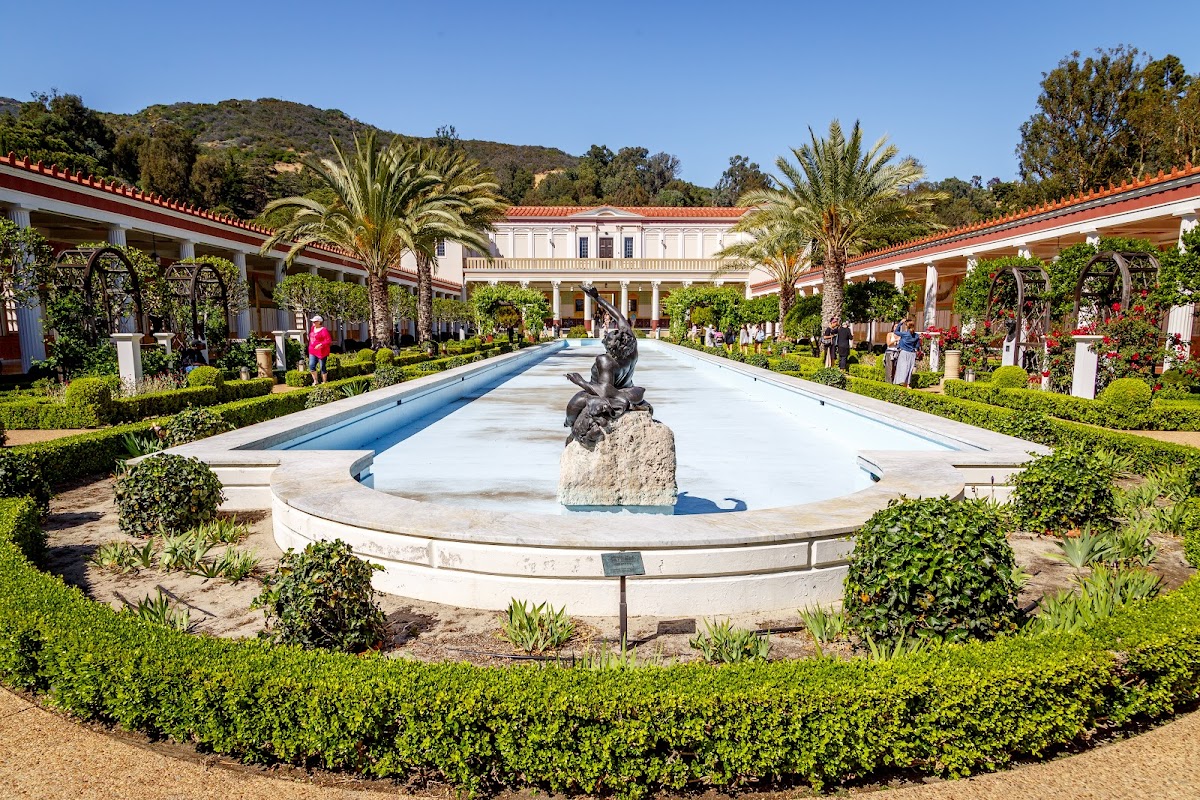
The architecture features terracotta roofs, frescoed walls, and intricate statues, surrounded by four themed gardens, including the grand Outer Peristyle with its long reflecting pool. The interior houses thousands of antiquities, including sculptures, pottery, jewelry, and coins, showcasing the artistic and technical prowess of classical civilizations.
LACMA: Modern Art in the Heart of LA
The Los Angeles County Museum of Art (LACMA), situated at 5905 Wilshire Blvd, Los Angeles, CA 90036, is a prominent cultural institution in the Mid-Wilshire area. Opened in 1965, LACMA is one of the largest art museums on the West Coast, boasting a diverse collection that spans ancient artifacts to contemporary global art.
LACMA's most recognizable landmark is Chris Burden's 'Urban Light,' an installation of 202 restored cast-iron street lamps from the 1920s and 30s. This iconic piece transforms from a grand sculpture by day to a dazzling light display at night, symbolizing the city's dynamic energy. The museum's extensive collection includes European paintings by masters like Monet and Van Gogh, Latin American art by Frida Kahlo and Diego Rivera, and a significant Asian art collection, notably featuring one of the largest Korean art collections in the United States.
LACMA is currently undergoing a major redevelopment, with a new main building, the Geffen Galleries, designed by Swiss architect Peter Zumthor, under construction to unify and enhance the visitor experience.
Visitor Information for Getty Center, Getty Villa, and LACMA
- Getty Center: Free admission, $20 parking (reservations recommended). Open Tue-Fri, Sun 10:00-17:30; Sat 10:00-21:00. Closed Mon. Allow 2-4 hours.
- Getty Villa: Free admission, $20 parking (online reservations required). Open Tue-Sun 10:00-17:30. Closed Mon. Allow 3-5 hours. Public transport access is limited.
- LACMA: Adult admission $25 (LA County residents free after 3 PM weekdays). Open Mon, Tue, Thu 11:00-18:00; Fri 11:00-20:00; Sat, Sun 10:00-19:00. Closed Wed. Allow 2-3 hours. Metro D Line (Wilshire/Fairfax station) provides access.
Visitor Info
| Admission | Translating |
| Hours | Translating |
| Location | 1200 Getty Center Drive, Los Angeles, CA 90049 |
| Getting There | Translating |
| Estimated Visit | Translating |
| Tips | Translating |
Featured Works

Vincent van Gogh
Irises
반 고흐가 생레미 드 프로방스의 정신병원에 입원한 직후 그린 작품입니다. 정원에 핀 보라색 붓꽃들을 강렬한 색채와 역동적인 붓질로 묘사했습니다. 일본 판화의 영향이 느껴지는 구도와 윤곽선이 특징이며, 반 고흐가 가장 빛나는 순간에 그린 걸작 중 하나입니다. 게티 센터의 대표 소장품으로, 1990년 약 5,390만 달러에 구입되었습니다.