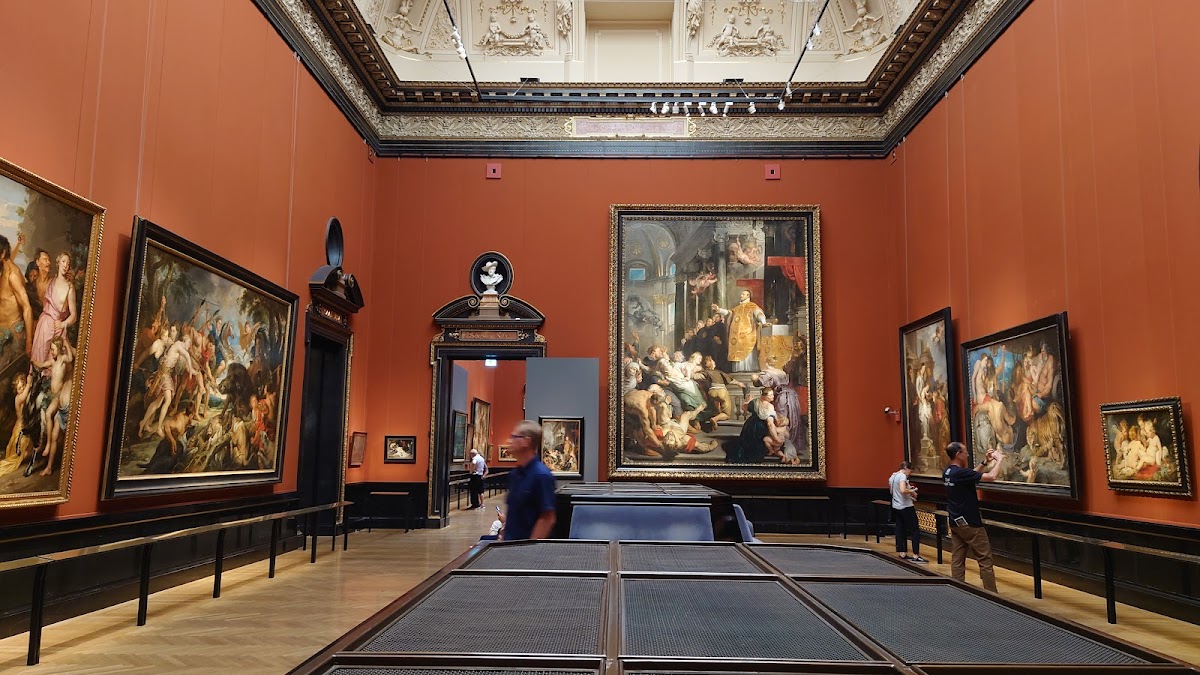
An Emperor's Collection, Europe's Finest
An Emperor's Collection, Europe's Finest
Kunsthistorisches Museum Vienna — A Habsburg Legacy on Maria-Theresien-Platz
The Kunsthistorisches Museum (Museum of Art History) stands majestically at Maria-Theresien-Platz 1, 1010 Vienna. It is one of two identical, imposing structures, mirroring the Natural History Museum across the square. These twin buildings were designed in the late 19th century to house the vast collections of the Habsburg dynasty. The museum is conveniently located within a 3-minute walk from U2 Museumsquartier station and a 5-minute walk from U2 or U3 Volkstheater station. Its proximity to the Ringstrasse and Hofburg Palace positions it as a central cultural landmark in Vienna.
Opened in 1891 — Architects Semper and Hasenauer
The Kunsthistorisches Museum officially opened its doors in 1891. Its construction was commissioned by Emperor Franz Joseph I to systematically display and preserve the immense art collection amassed by the Habsburgs over centuries. Architects Gottfried Semper and Carl von Hasenauer were responsible for its design, creating a grand Renaissance Revival edifice that reflects the power and artistic passion of the empire. The museum's opulent exterior, adorned with sculptures and a majestic dome, sets the stage for the artistic treasures within.
Architectural Grandeur — Klimt's Frescoes and the Grand Staircase
Upon entering, visitors are greeted by a magnificent central hall, where natural light streams through the dome, illuminating marble floors and grand columns. The arched ceilings and walls are adorned with frescoes and decorative paintings by leading artists of the era, including early works by Gustav Klimt. Klimt's pieces, with their symbolic elements and vibrant colors, are a highlight. A grand staircase, itself an artwork, leads to the Picture Gallery on the second floor, with its ceiling paintings and sculptures further emphasizing the Habsburgs' dedication to art.
The Habsburg Collection — Centuries of Imperial Patronage
The museum's collection is a testament to the Habsburg dynasty's profound love for art and their status as rulers of Europe for centuries. Starting with Duke Leopold III's treasures in the 15th century, emperors like Frederick III, Maximilian I, and especially Rudolph II, continuously acquired precious artworks from across Europe. This vast collection, encompassing paintings, sculptures, decorative arts, and ancient artifacts, served to showcase the family's wealth and prestige. In the late 18th century, Empress Maria Theresia and Emperor Joseph II began to open these collections to the public, laying the groundwork for the museum's establishment.
Masterpieces of European Painting — Bruegel, Raphael, Rubens
The Picture Gallery houses an unparalleled collection of European masterpieces from the Renaissance to the Baroque period. Works by Flemish, Italian, and Spanish masters such as Bruegel, Raphael, Rubens, Vermeer, Velázquez, Titian, and Tintoretto are prominently displayed. The museum boasts the world's largest collection of Pieter Bruegel the Elder's works, offering an immersive experience into his unique world. Highlights include "Hunters in the Snow," "The Tower of Babel," "The Peasant Wedding," and "The Peasant Dance," which vividly depict 16th-century Flemish life.
The Kunstkammer — A Cabinet of Curiosities
Located on the museum's lower level, the Kunstkammer, or 'Chamber of Art and Wonders,' is a fascinating collection of rare artworks, craft objects, and natural curiosities amassed by Renaissance and Baroque monarchs. Thousands of artifacts, crafted from precious materials like gold, silver, ivory, emeralds, and pearls, showcase the exceptional skill of contemporary artisans. A standout piece is Benvenuto Cellini's golden salt cellar, the 'Saliera,' depicting Neptune and Tellus, an exquisite example of royal opulence and artistic mastery. This chamber offers insight into the worldview and intellectual curiosity of European nobility.
Visitor Information — Planning Your Visit
Admission: €21 for adults, free for visitors under 19. Vienna Pass holders enjoy free entry. Check the official website for current prices and special exhibition inclusions.
Opening Hours: Tuesday to Sunday, 10:00 AM - 6:00 PM. Thursdays, the museum extends its hours until 9:00 PM. Closed on Mondays, January 1st, and December 25th.
Transportation: The museum is easily accessible by public transport. Take U2 or U3 to Volkstheater station (5-minute walk), or Tram lines 1, 2, D, 71 to Ring/Volkstheater stop (2-minute walk).
Tips: Online advance booking is recommended, especially during peak season or for special exhibitions, to reduce waiting times. The Bruegel room can be crowded, so an morning visit is advisable. The museum's central dome hall houses 'Cafe Gerstner,' offering a pleasant spot for a break with traditional Viennese cakes and coffee. Allow 2-3 hours for a general visit, or 3-4 hours if including the Kunstkammer.
Visitor Info
| Admission | Translating |
| Hours | Translating |
| Location | Maria-Theresien-Platz, 1010 Wien |
| Getting There | Translating |
| Estimated Visit | Translating |
| Tips | Translating |
Featured Works

Pieter Bruegel the Elder
The Tower of Babel
브뤼겔의 대표작으로, 구약성경의 바벨탑 이야기를 놀라운 디테일로 묘사했습니다. 로마의 콜로세움에서 영감을 받은 나선형 탑은 수천 명의 노동자와 함께 하늘을 향해 솟아오릅니다. 인간의 교만과 야망을 풍자하면서도, 르네상스 시대 건축과 도시 풍경의 백과사전적 묘사를 보여주는 걸작입니다.

Johannes Vermeer
The Art of Painting
베르메르가 자신의 작품 중 가장 야심 찬 것으로 여긴 대작입니다. 화가가 모델을 그리는 장면 자체를 그린 메타 회화로, 왼쪽의 커튼이 무대처럼 장면을 열어줍니다. 빛의 섬세한 처리, 화려한 직물의 질감 표현, 그리고 그림 속 지도까지 베르메르의 모든 기량이 집약되었습니다.

Pieter Bruegel the Elder
Hunters in the Snow
브뤼겔의 "달의 연작" 중 가장 유명한 작품으로, 겨울 풍경 속 귀환하는 사냥꾼들을 그렸습니다. 눈 덮인 언덕에서 내려다보는 파노라마적 구도는 서양 풍경화의 이정표입니다. 스케이트를 타는 사람들, 불을 피우는 사람들 등 일상의 세밀한 묘사와 서사적 풍경이 어우러져 계절의 서정을 완벽하게 포착했습니다.