구겐하임 뮤지엄 뉴욕 — 나선형 건축과 현대미술의 만남, 맨해튼 5번가
A Sanctuary of Art in the Heart of New York: The Solomon R. Guggenheim Museum on 5th Avenue
As you approach the vibrant 5th Avenue in Manhattan, touching the green breath of Central Park's eastern edge, an immaculate white edifice commands attention. Like an organic flower blossoming amidst the city's rigid rectangular grid, the Solomon R. Guggenheim Museum, completed in 1959, is a monumental sculpture in itself and the pinnacle of timeless architectural aesthetics. A masterpiece left by the living legend of architecture, Frank Lloyd Wright, at the end of his life, he perfectly embodied his philosophy that 'architecture should be a space for human living and, in itself, an art.' On a sunny afternoon, the white concrete exterior softly absorbs the light, casting subtle, ever-changing shadows, offering profound emotion and mystique to the beholder. Resembling a snail's shell or a colossal ceramic bowl, this spiral structure was conceived not merely as a 'vessel for art' but as an 'organic entity that breathes with art.'
This distinctive exterior simultaneously shocked and captivated New Yorkers of its time. Despite criticisms that it would 'cast shadows on the artworks' or that 'the building would overshadow the art,' Wright remained unwavering. He believed that a museum should transcend being a mere exhibition space, offering a miraculous experience where artwork, audience, and architecture form a trinity. The Guggenheim thus solidified its place as an iconic landmark representing New York and an immortal legacy gracing a significant page in the history of modern architecture.
An Artistic Feast Along a Spiral Ramp: The Guggenheim's Immersive Experience
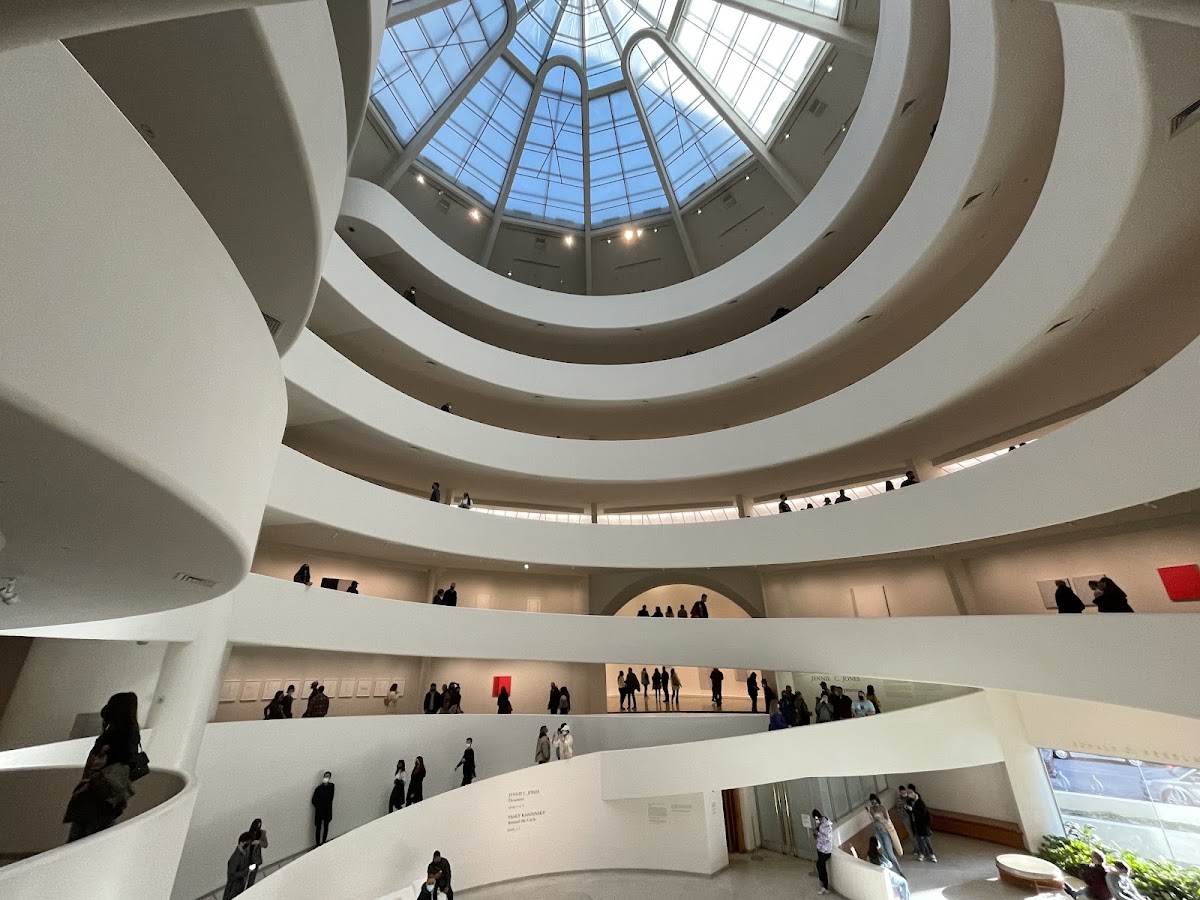
The moment you step inside the museum, visitors are drawn into the 'revolution of artistic experience' intended by Wright. The colossal central rotunda, open from the ground floor to the very top, offers a breathtaking sense of spaciousness, while natural light pouring in through the skylight softly bathes the entire interior. It feels as if one has entered a mysterious well of light. First, visitors take an elevator to the uppermost floor, and then slowly descend along a gently sloping spiral ramp to appreciate the artworks. This method was a revolutionary attempt, completely overturning the traditional museum viewing experience of moving through fixed rooms and corridors to encounter artworks in a linear fashion.
With every step, the changing vantage points and the continuous display of artworks along the curved walls unfold new scenes, much like film scrolls. Each artwork, while independent, is embedded within the overall flow, allowing visitors to discover their own narratives within. This ramp is not merely a passageway but an immersive stage for art appreciation, and at times, it even becomes part of a grand installation itself. The high ceilings and curved walls create a subtle echo, adding a serene yet mystical ambiance to the entire space, evoking a sense of awe as if standing in a sacred place of art transcending time and space. Wright called the building 'a machine for viewing art,' but this was not in a cold, functional sense; rather, it was closer to a living organism meticulously designed to allow visitors to engage with the artworks most perfectly. His vision forever changed the landscape of museum architecture.
A Treasure Trove of 20th-Century Modern Art: From Kandinsky to Innovative Exhibitions
At the heart of the Guggenheim Museum's collection is, unequivocally, the extensive body of work by Wassily Kandinsky, a pioneer of abstract art. Founder Solomon R. Guggenheim, advised by Hilla von Rebay, became fascinated by the new art movement of 'non-objective art' and actively collected works by various modern artists, including Kandinsky. The Guggenheim houses an astonishing 150 works by Kandinsky, making it the world's largest collection. It offers an extraordinary experience, illuminating every stage of Kandinsky's artistic journey, from his early expressionist endeavors to his development into geometric abstraction, and the spiritual resonance created by his colors and forms. His works, combining intense primary colors with fluid curves, or intricate geometric shapes, awaken the senses of the viewer and deliver a thrill that resonates deep within. Audio guides allow for a deeper immersion into his artistic world through detailed explanations of the works.
Beyond Kandinsky, the Guggenheim boasts a vast collection encompassing masters of 20th-century modern art history. From Pablo Picasso's revolutionary Cubist works that shook the Parisian art scene, Marc Chagall's dreamlike colors and surreal narratives, Fernand Léger's mechanical aesthetics and powerful compositions, to Piet Mondrian's strict and pure geometric abstraction, one can survey the main currents of modern art at a glance. Furthermore, Jackson Pollock's passionate action paintings exemplify the essence of American Abstract Expressionism, delivering an unforgettable visual impact to visitors.
The Guggenheim Museum does not confine itself to exhibiting fixed collections; it consistently presents innovative and challenging special exhibitions, staying at the forefront of contemporary art. More than 20 special exhibitions are held annually, and the unique spiral structure enables groundbreaking experiments that are difficult to implement in traditional exhibition spaces, such as large-scale installations, sound art, or performance art. The building itself becomes part of the exhibition device, offering boundless inspiration to artists. Moreover, touring exhibitions organized in conjunction with the global Guggenheim network, spanning Bilbao, Abu Dhabi, and Venice, provide crucial opportunities to grasp global art trends. Art enthusiasts should not miss the chance to explore exhibitions from sister museums, each with distinct charms, such as Frank Gehry's impressive titanium-clad building in Bilbao or the Peggy Guggenheim Collection by the Grand Canal in Venice.
Practical Advice for Visiting the Guggenheim and Enjoying Museum Mile
Here are some tips to make the most of your visit to the Guggenheim in New York. First, for visiting hours, we recommend coming on a weekday morning. Crowds on weekends or afternoons can hinder your enjoyment of the artworks. Especially by arriving at opening time, you can fully appreciate the architecture and art in a quiet, peaceful atmosphere. For tickets, it's advisable to purchase them online in advance through the official website rather than buying on-site. This saves time waiting in long queues, and online discounts are often offered. While viewing time varies individually, allow about 2-3 hours for a leisurely visit. Renting an audio guide is also an excellent way to gain a deeper understanding of the artworks.
If you get hungry after your museum visit, there are various dining options around the Guggenheim. There's a casual café within the museum itself where you can enjoy a light meal or coffee. For a more special experience, consider the upscale restaurants located around 5th Avenue and Madison Avenue. Alternatively, with Central Park right next door, enjoying a picnic in the park while soaking in New York's relaxed atmosphere can create wonderful memories. We also recommend taking time to stroll through Central Park, reflecting on inspiration in its serenity.
5th Avenue, where the Guggenheim Museum is located, is known as 'Museum Mile,' an area densely packed with world-class art institutions. Just south of the Guggenheim is the vast Metropolitan Museum of Art, and further along are museums with distinct characters and appeals, such as the Cooper Hewitt, Smithsonian Design Museum, offering a glimpse into innovative design, and the Neue Galerie New York, which focuses on early 20th-century German and Austrian art. Beginning at the Guggenheim and slowly walking south along 5th Avenue to pilgrimage through these treasuries of art is considered one of the top cultural experience itineraries in New York. It's advisable to check the admission fees and operating hours for each museum in advance.
The Solomon R. Guggenheim Museum is more than just a building; it is a living organism where Wright's vision, Guggenheim's passion, and the souls of artists converge to continually offer new inspiration. We encourage you to experience the currents of modern art firsthand in this wondrous space, engage with the artworks, and discover a true artistic resonance amidst the city's vibrancy. This encounter between architecture and art in the heart of New York will undoubtedly leave a lasting and unforgettable impression in your memory.
Visitor Info
| Location | 미국 뉴욕 (1071 5th Ave, New York, NY 10128) |
| Opened | 1959년 |
| Architect | 프랭크 로이드 라이트 (Frank Lloyd Wright) |
| Admission | Adult $30 / Student·시니어 $18 / 12세 이하 Free / Sat요Sun 17:45~ Pay-What-You-Wish |
| Hours | Sun-Fri 11:00~18:00, Sat 11:00~20:00 (Tue요Closed Sun) |
| Getting There | Subway 4·5·6 Line 86th StStn from walk 5min |
| 공식 사이트 | https://www.guggenheim.org |
