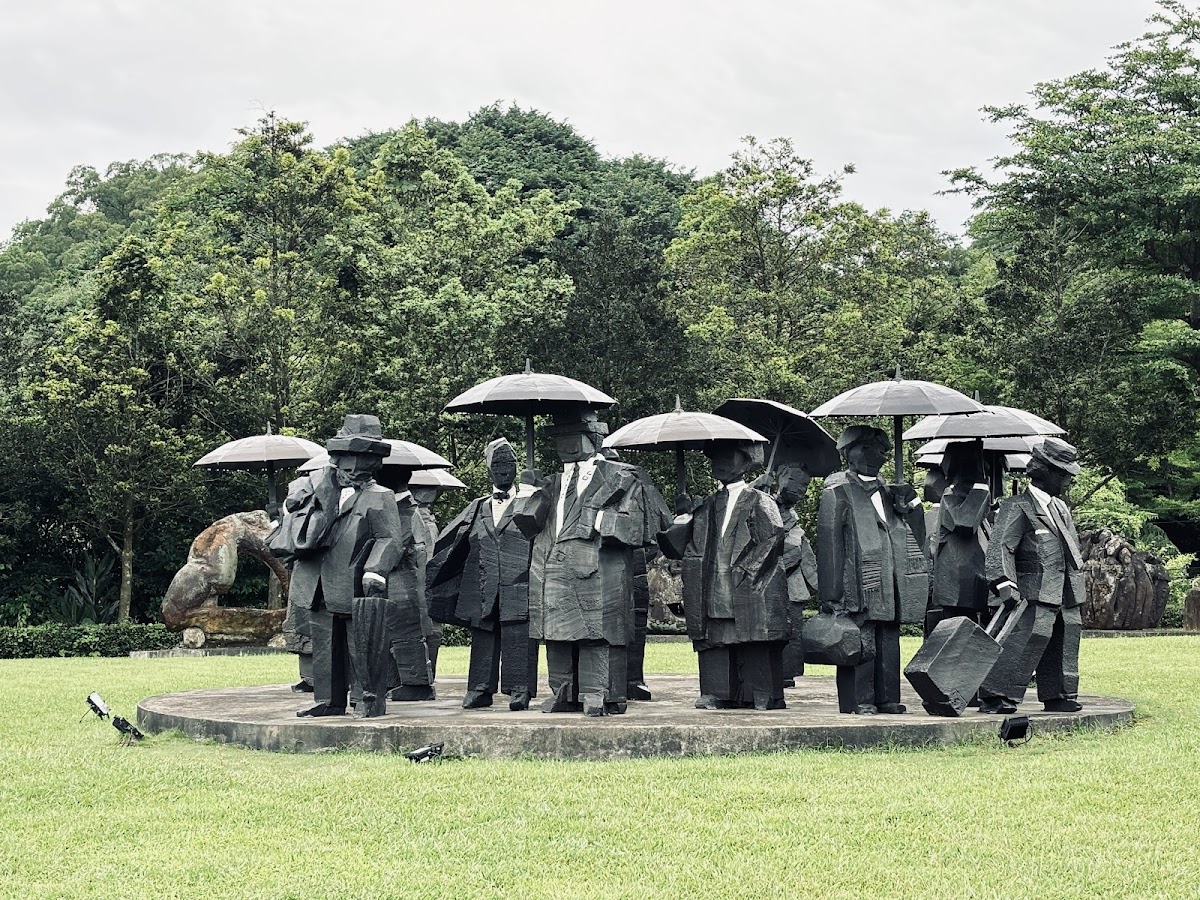
주밍 미술관 — 타이베이 근교, 산속 야외 조각의 천국
A Sanctuary of Sculpture in Nature, Embracing Taiwan's Soul: Strolling Through Juming Museum
Leaving behind the bustling urban core of Taipei and heading north for about an hour by bus, you'll arrive in Jinshan District, New Taipei City, where verdant mountain slopes and refreshing sea breezes greet you. Spread across 11 hectares (approximately 82 acres) on a gentle hill at an altitude of 100 meters, Juming Museum stands majestically, truly a grand sanctuary where nature and art breathe as one. Here, over 500 works imbued with the spirit of Juming (1938-2023), a world-renowned sculptor born in Taiwan, welcome visitors amidst vast green lawns and open skies. It is more than just an exhibition space; it offers a profound resonance that prompts contemplation on life and philosophy.
As the urban scenery outside the window gradually transforms into quaint country roads and then into lush forest paths, a quiet anticipation builds deep within the heart. The moment you step into the museum entrance, you can feel the invigorating scent of the forest and fresh air filling your lungs. The emerald-green lawns that fill your vision, and the majestic sculptures standing upon them, seem like an integral part of nature, as if they have been there for ages. Master Juming was an artist who started with traditional wood carving, then explored various materials such as bronze and stainless steel, uniquely integrating Eastern philosophy with modern sculptural language. His works, beyond mere forms, carry deep spiritual and philosophical messages, offering viewers a time for contemplation.
An Artist's Journey: From Tradition to Modernity, Forging the Spirit of the East
Master Juming's artistic journey began with Taiwan's folk art traditions. In his teens, he mastered traditional Chinese wood carving techniques, laying the foundation for his sculptural career. His early works expressed a local sensibility along with a deep understanding of humanity, showcasing the craftsmanship inherited from his teacher, Li Jin-Chuan. However, Juming did not rest on tradition. He embraced Western modern sculptural techniques and constantly explored to create his own unique sculptural language.
In particular, he infused Taoist philosophy and the principles of Tai Chi into his sculptures, elevating Eastern spirituality into modern aesthetics. His ability to deeply understand the properties of materials like wood, stone, bronze, and stainless steel, and to maximize their characteristics to breathe life into his works, is unparalleled. Juming Museum is precisely a special place where one can witness this entire process of his artistic transformation and maturation. From the weighty presence emanating from the coarse texture of bronze to the mystery of smooth stainless steel mirroring the surrounding landscape, the diverse materials born from his fingertips whisper different stories.
Moving Meditation: The Tai Chi Series (太極系列)
One of the most profoundly impressive series at the museum is the Tai Chi Series (太極系列). Towering bronze sculptures standing majestically on the vast lawn abstractly express the fluid yet powerful movements of Tai Chi. As you approach each piece, its massive presence and overwhelming scale take your breath away. The roughly textured bronze surfaces bear the marks of time and the artist's contemplation, shimmering in the sunlight or casting shadows from clouds, creating the illusion that they are alive and moving.
These works are not merely static forms but express condensed energy and the continuous flow of circulating life. The forms, embodying the harmony of 'Yin' and 'Yang,' the balance of 'void' and 'substance,' and the movement of 'Qi' inherent in Tai Chi, blend perfectly with the surrounding nature. Facing the Tai Chi sculptures under a blue sky, or amidst a thick fog, transcends time and space, leading to deep contemplation on the laws of nature and the essence of humanity. Sometimes they gleam with a deep verdigris from the rain, and other times they shimmer golden under intense sunlight, offering a different emotional impact with each season and weather condition. Before these massive sculptures, visitors experience the spirit of Tai Chi in their own way, finding forgotten inner peace.
A Panorama of Life: The Living World Series (人間系列)
Another highlight of Master Juming's work is the Living World Series (人間系列). This is a large-scale installation work depicting various social strata—soldiers, common folk, merchants, and more—in life-sized bronze, wood, or steel. As you walk along the museum's winding paths, at an unexpected moment, you might suddenly find yourself standing before a group of dozens of soldiers charging in unison, or sitting among old people engrossed in conversation or a card game in a humble teahouse. Every expression and gesture in these figures encapsulates joy, anger, sorrow, and delight, making you feel as if you are sharing the space with living beings.
The figures in the artwork exist with their own stories and burdens of life, and visitors are prompted to imagine their narratives, reflecting on their own lives and those of others. Sometimes humorous, sometimes serious, sometimes poignant, their appearances offer deep empathy and comfort to viewers. Children, in particular, can often be seen running between the figures, playing together, or mimicking the sculptures' expressions with delight. Thus, the 'Living World Series' transcends simple sculptures to present a miniature version of our society and a grand panorama that reminds us of the inherent beauty of humanity and the value of life. Through these human figures, the artist explores the universal truths of life and the meaning of existence, providing viewers with an opportunity for self-reflection, much like a mirror.
Harmony with Nature: An Outdoor Sculpture Park Reflecting the Seasons
Juming Museum is not only exceptional for its artworks but also for its outdoor space design, which is a work of art in itself. Across the expansive 11-hectare site, vast lawns, serene ponds, lush forest paths, and charming walking trails naturally connect the sculptures, offering visitors an unforgettable experience. Nature, transforming with different faces throughout the four seasons, serves as both the backdrop and an integral part of the sculptures, imparting new emotions with each visit.
In spring, bronze figures standing next to blooming rapeseed fields by the pond add vibrant vitality. When summer showers fall, raindrops trickle like beads over the smooth surfaces of stainless steel works, creating silver ripples. In autumn, Tai Chi sculptures set against the backdrop of fiery red foliage exude an even grander and deeper presence, while in the quietude of winter, snow-dusted sculptures offer a serene time for contemplation. Works that mysteriously emerge from the morning mist, or those that cast long shadows in the golden light of the setting sun, create entirely different atmospheres depending on the time of day you visit. This is more than just a place to appreciate sculptures; it is a true haven where one can breathe with art in nature, find inner peace, and recharge inspiration.
Indoor Museum and Archive: Feeling the Artist's Breath
In addition to the outdoor sculpture park, Juming Museum features a modern indoor museum and archive. Here, visitors can discover Master Juming's smaller early works, drawings, and various materials documenting his creative process. In particular, his well-worn tools, sketchbooks, and photographs vividly testify to the passion and contemplation of a great artist, offering profound emotional resonance. You can calmly trace the journey of his artistic world, evolving from delicate wood carvings to monumental bronze works, following the flow of time.
Furthermore, the indoor museum hosts annual special exhibitions on different themes, providing visitors with fresh artistic experiences. The café within the museum offers a place to relax while enjoying the green nature unfolding outside the window, and the gift shop offers a variety of art products inspired by Master Juming's works. This is not merely a place to view artworks; it is a holistic experiential space where one can deeply understand and feel Master Juming's artistic spirit and life philosophy.
Special Advice for Travelers: Enjoying Juming Museum to the Fullest
Juming Museum is an ideal destination for dedicating a full day to savoring art and nature near Taipei.
- Best Time to Visit: While beautiful year-round, spring (March-May) and autumn (September-November) are best for mild weather and clear skies. Visiting on weekday mornings, especially, allows for a more relaxed and tranquil atmosphere for appreciating the works. The soft light of morning or the late afternoon glow of sunset further enhances the three-dimensional quality of the sculptures.
- How to Get There: From Taipei MRT Tamsui (淡水) Station, you can conveniently reach the museum entrance by taking the Taiwan Tourist Shuttle (台灣好行) 716 Jinshan Old Street Line (金山老街線) bus. The journey takes about an hour, with scenic coastal views as a bonus. If you take a taxi, it will take approximately 40-50 minutes from downtown Taipei.
- Nearby Dining: While you can enjoy light refreshments at the museum's café, if you wish to experience true local cuisine, we recommend Jinshan Old Street (金山老街), about a 10-minute bus ride from the museum. Here, you can taste various street foods like the famous duck dishes (金山鴨肉), chewy taro cakes (芋粿巧), and sweet potato delicacies. It's a great option to fill up before returning to the museum or to conclude your day at the Old Street.
- What to Bring: Comfortable shoes are essential for leisurely walking through the expansive outdoor areas. As the sun can be strong, prepare a hat, sunglasses, and sunscreen. It's also wise to bring a small umbrella for unexpected rain. Don't forget plenty of water and a camera to capture beautiful moments.
- Connecting with Nearby Attractions: Near the museum, you can find Yehliu Geopark (野柳地質公園), famous for its unique rock formations, and the Jinshan Hot Spring Area (金山溫泉區), where you can enjoy warm springs. Combining these destinations will create an even richer day trip experience from Taipei.
Juming Museum is more than just a sculpture park; it is a special place that invites deep contemplation on art, nature, and the essence of humanity. The peaceful time you spend here will undoubtedly leave an unforgettable impression and profound inspiration on your soul. We wholeheartedly encourage you to experience your own artistic discovery in this hidden gem of Taiwan.
Visitor Info
| Location | 대만 신베이시 진산구 (新北市金山區西勢湖2號) |
| Opened | 1999년 |
| Admission | Adult NT$300 / Student NT$200 / 3세 이하 Free |
| Hours | Tue-Sun 10:00~18:00 (5~9Mon Sat·Sun 19:00까지 / Mon요Closed Sun) |
| Getting There | 타이베이 시정부(市政府)BusTerminal from 862번 Bus 약 1hr |
| 추천 | 봄(3~5Mon) 방문 시 유채꽃밭과 조각의 조Tue가 절경 / 반나절~하루 코스 |
| 공식 사이트 | https://www.juming.org.tw |
