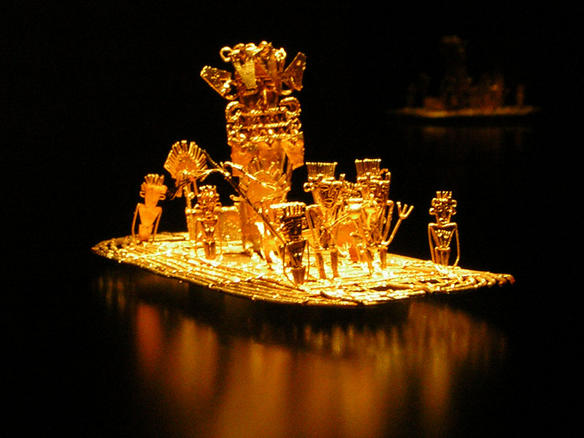
보고타, 엘도라도 신화의 진실이 담긴 황금의 방
보고타, 엘도라도 신화의 진실이 담긴 황금의 방
Museo del Oro: Bogotá's Golden Heart in La Candelaria
The Gold Museum (Museo del Oro) is situated in the heart of Bogotá, Colombia, at Cra. 6 #15-88. This prominent institution is easily accessible from the 'Museo del Oro' TransMilenio station and lies within walking distance of the historic La Candelaria district. It stands as a global beacon for the preservation and exhibition of pre-Columbian gold artifacts from the Andean region.
Established by the Bank of the Republic of Colombia in 1939, the museum's primary mission was to safeguard the nation's invaluable cultural heritage from illicit export and to foster national pride. It houses the world's largest collection of pre-Hispanic gold objects, offering profound insights into the artistic, religious, and social structures of ancient Colombian civilizations.
A Collection of 55,000 Gold Artifacts
The Museo del Oro boasts an extraordinary collection of approximately 55,000 pre-Columbian gold and tumbaga artifacts. This vast repository includes items from various indigenous cultures that flourished across Colombia, such as the Muisca, Quimbaya, Calima, Tayrona, Zenú, San Agustín, and Tierradentro. Beyond gold, the museum also exhibits around 30,000 other objects, including ceramics, stone carvings, and textiles.
These artifacts are not mere ornaments; they are sophisticated expressions of ancient cosmologies, spiritual beliefs, and social hierarchies. The intricate craftsmanship, utilizing techniques like filigree, repoussé, and lost-wax casting, reveals the advanced metallurgical skills and aesthetic sensibilities of these early civilizations. Each piece serves as a testament to their deep connection with nature and the cosmos.
El Dorado: Unveiling the Muisca Rituals
The legend of El Dorado, often associated with European quests for a mythical city of gold, finds its true origins within the sacred rituals of the Muisca people of ancient Colombia. The museum elucidates how the Muisca king, during his enthronement, would cover his body in gold dust and adorn himself with golden ornaments before offering gold to sacred lakes, such as Lake Guatavita.
This ritual underscores that gold held a profound spiritual significance for these cultures, representing divine power, status, and harmony with the natural world, rather than solely material wealth. The museum's exhibits effectively convey this spiritual dimension, challenging the colonial narrative of greed and revealing the rich inner world of the pre-Columbian inhabitants.
Key Artifacts and the Gold Room Experience
Among the museum's most iconic pieces is the 'Muisca Raft' (Balsa Muisca), a delicate gold figurine depicting the king and other figures on a raft, central to the El Dorado enthronement ceremony. Other notable artifacts include 'Poporos,' lime containers used during coca leaf chewing, which were often elaborately decorated and symbolized social status. Gold masks and pectorals, buried with the deceased, reflect beliefs about the afterlife and eternal rest.
A highlight of the museum visit is the 'Offering Room' (Sala de Ofrendas). This immersive space features thousands of gold artifacts dramatically illuminated in a darkened chamber. As lights gradually brighten and mystical music plays, visitors experience a sensory journey that evokes the ancient Muisca rituals, allowing for a deeper connection with the spiritual energy embedded in the gold. This experience transcends mere observation, offering a profound encounter with the ancient Colombian worldview.
Visitor Information
The Gold Museum operates from Tuesday to Saturday, 9:00 AM to 6:00 PM, and on Sundays from 10:00 AM to 4:30 PM. It is closed on Mondays. Visitors are advised to check the official website for the most current information before planning their visit.
Admission fees are COP 30,000 for foreign visitors and COP 4,000 for Colombian nationals. Entry is free for all visitors on Sundays. It is recommended to carry local currency (Colombian Pesos) as card payment options may be limited. The museum is easily accessible via the TransMilenio public transport system, with a dedicated 'Museo del Oro' station, and is a short walk from the historic La Candelaria district.
Visitor Info
| Location | Translating |
| Opened | Translating |
| Admission | Translating |
| Hours | Translating |
| Getting There | Translating |
| Highlights | Translating |
| Official Site | https://www.banrepcultural.org/museo-del-oro |