Dubai: A Future City Above the Desert
Dubai: A Future City Above the Desert
The Museum of the Future: An Icon on Sheikh Zayed Road
Located on Sheikh Zayed Road in Dubai's Trade Centre district, the Museum of the Future stands as a striking architectural marvel. Opened on February 22, 2022, this institution transcends the traditional science museum, aiming to be an innovative space that explores and inspires humanity's future. Its unique toroidal shape and gleaming stainless steel facade make it an unmistakable landmark in Dubai's futuristic skyline.
The museum's strategic location provides easy access via the Emirates Towers Metro Station, connected by a pedestrian bridge. Surrounded by upscale hotels, restaurants, and shopping centers, it embodies Dubai's vision as a city built on innovation and forward-thinking design. The museum itself is a physical manifestation of this ambition, inviting visitors to contemplate the possibilities of tomorrow.
A Vision Unveiled: Designing and Understanding the Future
The Museum of the Future was established with a clear mission: to "design, inspire, and understand the future." This objective reflects Dubai's commitment to positioning itself as a global hub for technological advancement and futuristic thinking. The museum strives to present a positive vision for the future, empowering current generations to actively shape what is to come.
Across its seven floors and five exhibition halls, the museum delves into various facets of future society, including artificial intelligence, space exploration, and sustainable living. Through cutting-edge technology and immersive experiences, it offers visitors a profound journey into potential future scenarios, solidifying its role as a leading attraction and a center for future studies worldwide.
Architectural Grandeur: The Toroidal Form and Arabic Calligraphy
The museum's architecture is a masterpiece of design, featuring a distinctive silver ring shape that appears to float above the ground. Its windowless exterior is clad in 1,024 polished stainless steel panels, each reflecting the intense Dubai sun and creating a dynamic interplay of light. The elliptical void at the center of the structure symbolizes the connection between the past, present, and future, adding a layer of philosophical depth to its striking form.
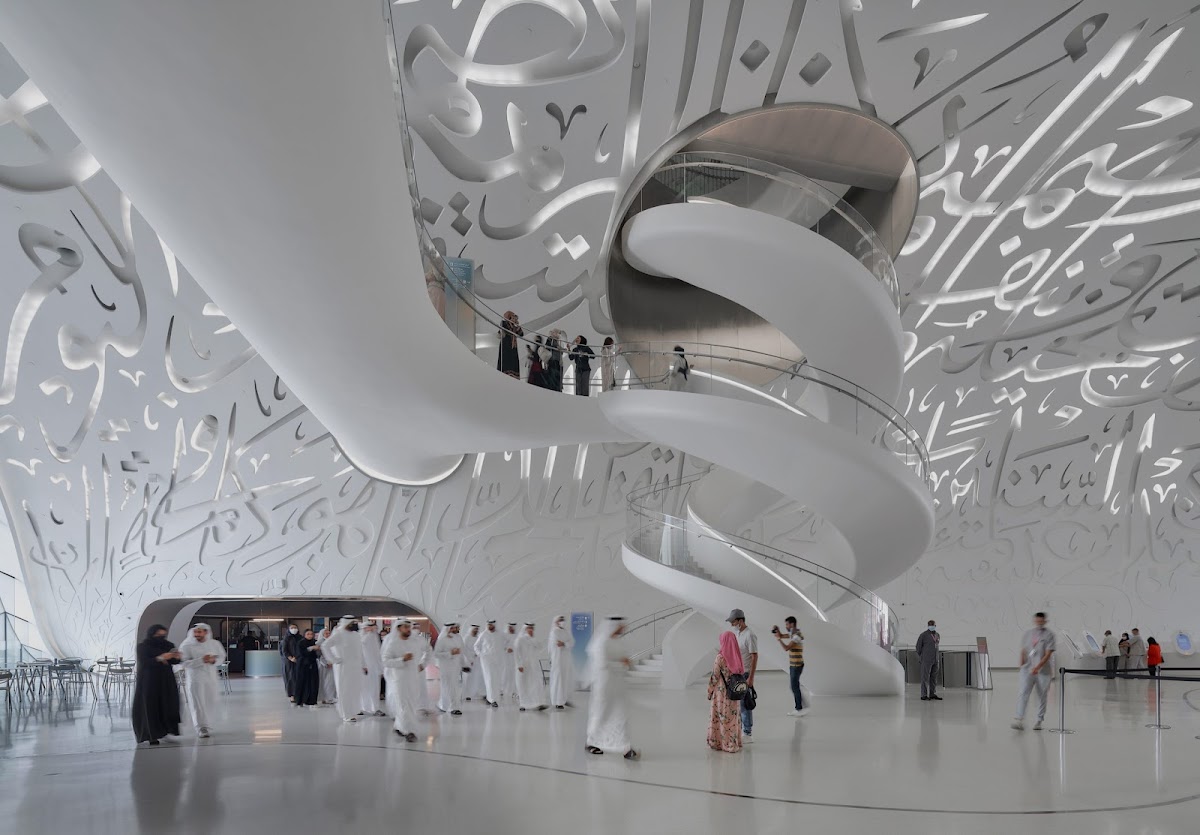
Adorning the facade are intricate Arabic calligraphy quotes from His Highness Sheikh Mohammed bin Rashid Al Maktoum. Phrases such as "The future belongs to those who can imagine it, design it, and execute it. It is not something you await, but rather create" are etched onto the building, transforming it into a living statement of intent. These inscriptions, combined with the building's unique form, challenge visitors to ponder their role in shaping the future.
Immersive Interiors: A Journey Through Future Worlds
Inside, the museum maintains the exterior's organic flow, with seamless curves, high ceilings, and sophisticated lighting creating an immersive environment. Visitors are immediately transported into a futuristic realm, akin to boarding a spacecraft destined for tomorrow. The museum's design ensures a fluid progression through its themed exhibitions.
Key exhibition spaces include 'OSS Hope,' which offers an immersive journey to a space station in 2071, exploring solutions to future energy and resource challenges. 'The Heal Institute' presents a vision of Earth's future ecosystems, featuring a digital rainforest and a 'Library of Life' dedicated to preserving biodiversity. 'Al Waha' (The Oasis) provides a serene space for wellbeing and meditation, prompting reflection on human balance in a technology-driven future. Each zone is designed to inspire imagination and critical thinking about humanity's path forward.
Visitor Information and Recommendations
For a successful visit to the Museum of the Future, consider the following details:
- Operating Hours: The museum operates daily from 10:00 AM to 7:30 PM, with the last entry at 6:30 PM. It is advisable to check the official website for any changes, especially during holidays.
- Admission Fees: Adult tickets are 149 AED, children (3-12 years) are 95 AED. Children under 3 and people of determination (disabled) are admitted free.
- Location: Sheikh Zayed Rd, Trade Centre, Dubai.
- Transportation: The most convenient access is via the Emirates Towers Metro Station (Red Line), which connects directly to the museum via a pedestrian bridge. Taxis, Uber, and Careem services are also readily available. On-site underground parking is provided for those driving.
- Reservations: Due to high popularity, advance online booking is essential. Same-day ticket purchases, especially during weekends, holidays, or peak seasons, are often difficult or impossible.
- Recommended Visit: A visit typically takes 3-4 hours. The cooler winter months (November to March) are ideal for exploring Dubai. A suggested itinerary includes the Museum of the Future, followed by the Dubai Frame, Old Dubai (Deira), and finally, the Dubai Mall.
Visitor Info
| Estimated Visit | 3~4hr |
| Translating | Translating |
| Translating | Translating |
| Recommended Route | Translating |