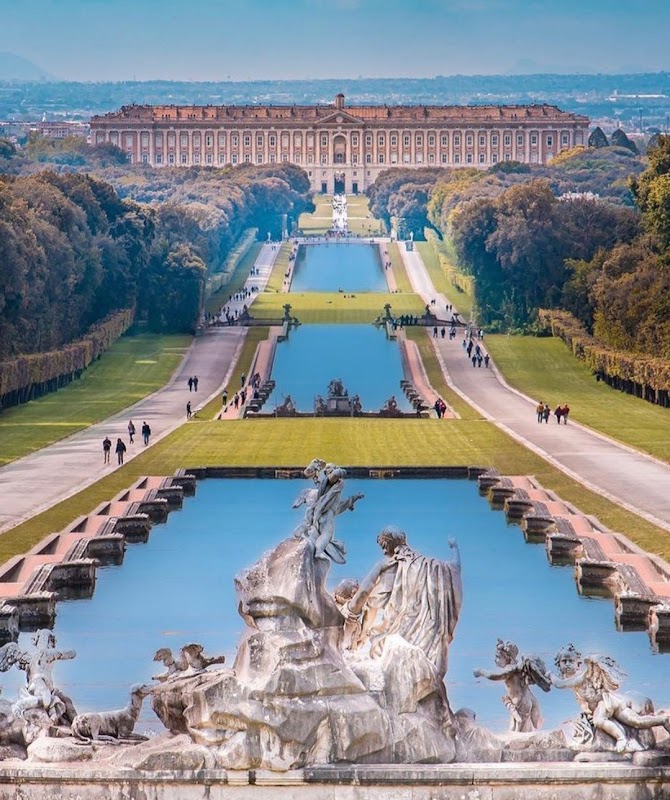
Royal Palace of Caserta: The Last and Greatest of Italian Baroque
Royal Palace of Caserta: The Last and Greatest of Italian Baroque
From June 16 to 20, 2026, an expedition was conducted to Caserta, Italy, a city located approximately 40 km northeast of Naples in the Campania region. This city is home to the magnificent Royal Palace of Caserta, a UNESCO World Heritage site, along with the Museo 'Michelangelo' and the Planetario di Caserta, offering a diverse cultural experience.
The Royal Palace of Caserta: A Monument of Bourbon Grandeur
The Royal Palace of Caserta, situated at Sottovia Carlo Vanvitelli, 1908, is a monumental structure commissioned by King Charles III of Naples in the 18th century. Designed to rival the Palace of Versailles and El Escorial, it measures 250 meters wide and 190 meters deep, featuring over 1,200 rooms, 34 grand staircases, and 1,700 windows. Its construction began in 1752 and spanned nearly a century, embodying the Bourbon monarchy's ambition and the pinnacle of Italian Baroque architecture.
Inside, visitors encounter the majestic Grand Staircase adorned with frescoes, leading to the Royal Apartments. These lavish rooms showcase extensive collections of paintings, sculptures, and furniture, reflecting the opulent lifestyle of the royal family. Key spaces include the gilded Throne Room, the Royal Chapel, and a vast library. Beyond the palace, a sprawling 120-hectare garden extends, featuring long canals, numerous fountains like the Fontana di Diana e Atteone, and the impressive Grand Cascade at its far end.
Museo 'Michelangelo': Exploring Renaissance Art
The Museo 'Michelangelo', located at Viale Michelangelo Buonarroti, 5 in downtown Caserta, offers a focused exploration of Renaissance artistic principles. While it does not house original masterpieces by Michelangelo, it presents sculptures, drawings, and works by artists influenced by him. The museum emphasizes anatomical drawings, showcasing the Renaissance pursuit of ideal human form, and features sculptures that embody Michelangelo's "terribilità" style, characterized by intense emotional depth and perfect proportions. Architectural sketches also highlight his versatile genius.
Planetario di Caserta: A Journey into the Cosmos
The Planetario di Caserta, found at Via delle Querce, 15, is a science museum dedicated to astronomy and space exploration. It provides educational programs and exhibitions aimed at enhancing public understanding of the universe. The planetarium offers immersive shows on its dome-shaped screen, recreating the night sky with stars, galaxies, and planets. Visitors can also observe celestial bodies through large telescopes, experiencing the vastness and mystery of space firsthand. Exhibitions trace the history of astronomy, celebrating the contributions of figures like Galileo and Copernicus.
Visitor Information for Caserta's Cultural Sites
The Royal Palace of Caserta is open Wednesday to Monday from 8:30 AM to 7:30 PM, closed on Tuesdays. Admission for the palace and garden is 16 euros for adults. The Museo 'Michelangelo' operates Monday to Friday from 8:30 AM to 6:30 PM, closed on weekends, with an adult admission of 5-8 euros. The Planetario di Caserta is open Tuesday to Sunday from 10:00 AM to 6:00 PM, closed on Mondays, with admission ranging from 5-8 euros, and 10-15 euros for planetarium shows and telescope viewing. It is recommended to check official websites for the most current information and to make advance reservations, especially for the palace and planetarium shows.
Visitor Info
| Admission | Translating |
| Hours | Wed-Mon 08:30-19:30 (Tue closed) |
| Location | Viale Douhet, 2/a, 81100 Caserta CE, Italy |
| Getting There | Translating |
| Estimated Visit | Translating |