Houston, Renzo Piano's First Museum
Houston, Renzo Piano's First Museum
The Menil Collection — Houston's Serene Art Campus
The Menil Collection, located at 1516 Branard St, Houston, TX 77006, USA, is a private art museum that opened in 1987. Situated in the quiet Montrose residential neighborhood, it forms a unique park-like campus known as the 'Menil District.' This tranquil setting, just a 10-minute walk from the MetroRail Museum District station, offers a peaceful escape from the city's bustle, blending art with nature.
The Menil District encompasses the main building, the Rothko Chapel, the Cy Twombly Gallery, and the recently opened Menil Drawing Institute. These structures are designed to harmonize with the surrounding 1930s homes, creating a cohesive and accessible art environment. Visitors can explore the various buildings and enjoy the Menil Park lawns, a popular spot for local picnics.
A Legacy of Collecting — John and Dominique de Menil
The Menil Collection reflects the lifelong passion of its founders, John and Dominique de Menil, a French oil magnate couple. Their vision extended beyond mere acquisition; they sought to explore human spirit and culture through art. The de Menils amassed an eclectic collection of approximately 17,000 objects, spanning ancient to contemporary art, with notable strengths in early medieval, Byzantine, and tribal art, as well as significant holdings of Surrealism and modern American and European masters.
Their collecting philosophy emphasized fostering dialogue between diverse artistic traditions, rather than adhering to specific periods or regions. This deeply personal and eclectically curated collection, donated to the public, became the foundation for the museum's establishment in 1987, distinguishing the Menil Collection as a unique cultural institution.
Renzo Piano's First Museum — The 1987 Main Building
The Menil Collection's main building, opened in 1987, marks a pivotal point in the career of Italian architect Renzo Piano. Although already renowned for the Centre Pompidou in Paris, this project was his first museum design and profoundly influenced his subsequent work. Piano often credits the Menil project with 'changing his architectural career,' highlighting its significance as a prototype for his future museum designs.
The Menil Collection showcases Piano's early mastery of light, space, and the relationship between architecture and art. It stands as an original example of his sensitive and human-centered approach to design, where the building itself serves as a subtle backdrop, enhancing the viewing experience rather than dominating it.
Architecture of Light — Dominique's Vision, Piano's Solution
Dominique de Menil presented Renzo Piano with a crucial condition for the museum's design: to illuminate the artworks solely with natural light. This challenge, set against Houston's intense sunlight, required an innovative solution to protect the art while revealing its true colors and textures without artificial illumination. Piano dedicated years to experimenting with ceiling structures to meet this demand.
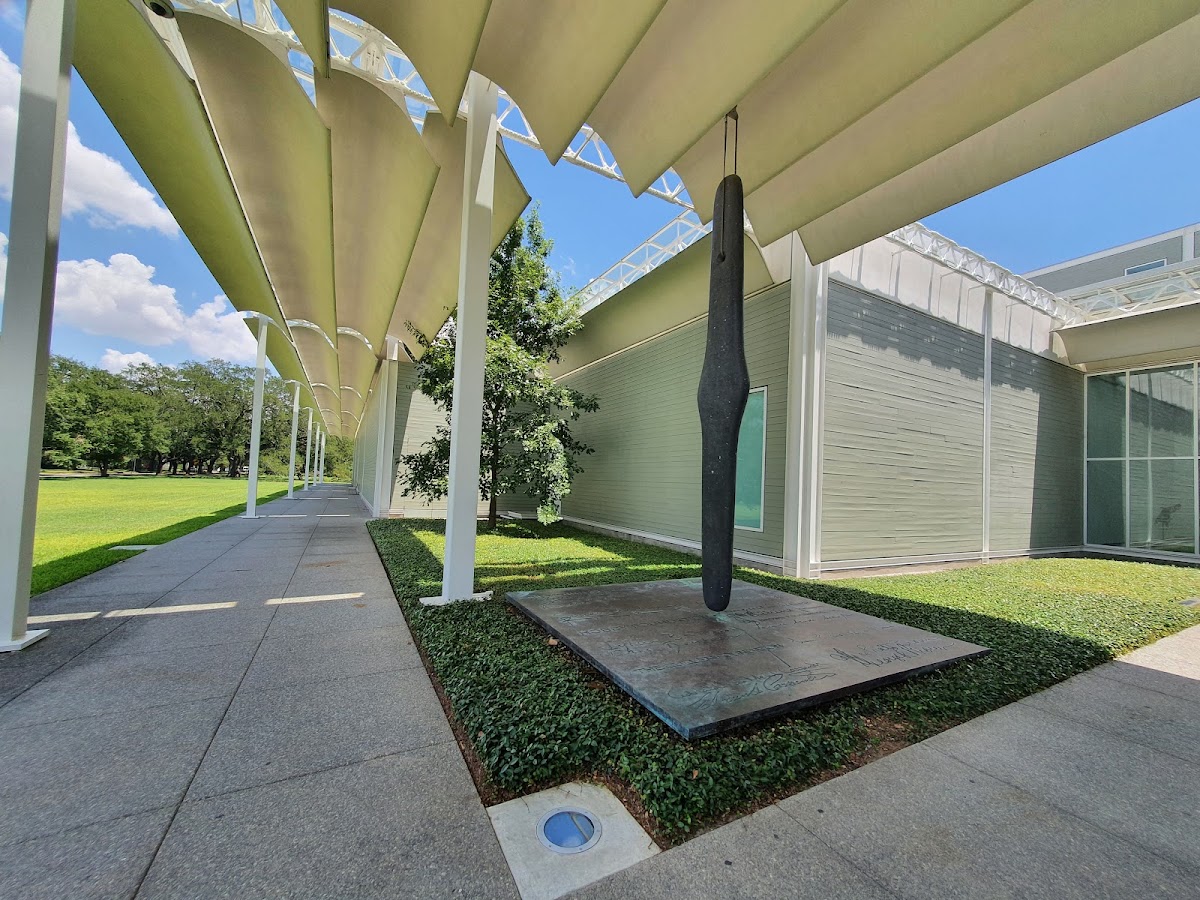
His solution was the ingenious 'leaves' ceiling, a sophisticated system designed to filter and diffuse the strong Texan sun. This design successfully brings soft, stable natural light into the galleries, maximizing both art preservation and the viewing experience. It remains one of the most distinctive and celebrated features of the Menil Collection's architecture.
The 'Leaves' Ceiling and Material Harmony
The 'leaves' ceiling, composed of over 300 thin, curved ferrocement panels, overlaps like foliage to gently disperse direct sunlight, regulating the amount of light entering the interior. This ensures that artworks are presented with consistent, rich colors throughout the day, despite the changing natural light. The subtle shifts in illumination also deepen the visitor's engagement with the art and the passage of time.
The main building's exterior features white wooden siding and gray brick flooring, chosen to blend seamlessly with the modest, orderly character of the surrounding 1930s residential neighborhood. Its single-story design emphasizes continuity with the outdoor environment, allowing the museum to integrate naturally into the landscape. Piano's design prioritizes the art, making the building a vessel for light and a backdrop for the collection.
Beyond the Main Building — The Menil District Campus
The Menil Collection extends beyond its main building to form the 'Menil District,' a unique art campus where art and nature converge. This park-like environment offers visitors a diverse range of artistic experiences. In addition to the main building, the district includes the Rothko Chapel, dedicated to Mark Rothko's works, the Cy Twombly Gallery, and the recently inaugurated Menil Drawing Institute.
Each building within the district possesses distinct architectural features that harmonize with its surroundings, specializing in specific artists or genres. The Menil District is more than a collection of museums; it is a spatial embodiment of the de Menils' art philosophy. Visitors can wander through the expansive campus, exploring different artistic encounters and finding moments of contemplation amidst Houston's natural setting.
Surrealism at its Core — The de Menils' Passion
Surrealism was a central passion for the de Menils, and the Menil Collection boasts one of the most concentrated Surrealist displays in the United States. It features over 20 key works by René Magritte, alongside significant pieces by Max Ernst, Alberto Giacometti, Man Ray, and Yves Tanguy. These works are densely arranged within a single gallery, offering an immersive exploration of the movement.
The collection illuminates various facets of the Surrealist movement, showcasing artists' attempts to delve into dreams, the subconscious, and worlds beyond reality. The de Menils were drawn to the revolutionary and spiritual depth of Surrealist art, seeking to understand the complex aspects of human existence through these works. Visitors can directly engage with the unique imagination and philosophical inquiries of Surrealism here.
Byzantine, Medieval, and Tribal Art — A Dialogue of Cultures
The Menil Collection also holds a distinguished position for its Byzantine and Medieval collection, famously including frescoes repatriated to Cyprus through the de Menils' efforts. Icons and sacred objects from the 12th to 15th centuries are displayed in a quiet, reverent atmosphere, conveying the deep spirituality and historical value of religious art.
Furthermore, the collection of African, Pacific, and Native American art reflects Dominique de Menil's unique philosophy. Challenging the Western-centric concept of 'primitive art,' she insisted on displaying these works with equal prominence to Western art. This approach acknowledges the universal value and beauty of artistic expressions from diverse cultures, fostering a dialogue between different traditions.
Rothko Chapel — A Space for Meditation and Silence
The Rothko Chapel, opened in 1971, is a unique space dedicated to the works of Mark Rothko. Located approximately a 5-minute walk north of the Menil's main building, it houses 14 of Rothko's monumental black canvases. These works transcend mere painting, offering visitors a profound experience of meditation and introspection. The chapel's interior is designed for quiet contemplation, with the canvases' hues and depths subtly shifting with changes in light.
The Rothko Chapel operates as a non-denominational sanctuary for worship, meditation, and lectures, embodying the de Menils' philosophy of spiritual experience through art. Admission is free, allowing visitors to find inner peace amidst Rothko's profound color field abstractions.
Cy Twombly Gallery — Works Selected by the Artist
The Cy Twombly Gallery, another pavilion within the Menil District designed by Renzo Piano in 1995, is a rare space dedicated to the artist Cy Twombly. It features a selection of his major works personally chosen by Twombly himself, displayed across nine rooms. This allows for an in-depth exploration of the artist's unique world in a dedicated solo exhibition setting.
Twombly's art blurs the lines between painting and drawing, creating a distinctive visual language through scribbles, script, and symbolic forms. Renzo Piano designed the gallery to complement Twombly's free-spirited energy, providing an open yet restrained space with abundant natural light that encourages focus on the artworks. Visitors can follow Twombly's artistic journey through his large-scale series here.
Menil Drawing Institute and Surroundings — Completing the Art District
The Menil Drawing Institute, a recent addition to the Menil District, specializes in the study and exhibition of drawing art. Its inclusion completes the Menil District as a comprehensive cultural complex, encompassing a wide range of artistic fields from painting and sculpture to ancient artifacts, religious art, and drawing. Each building, while independent, is organically connected within the overall context of the district.
The Menil District is situated in Montrose, one of Houston's most pedestrian-friendly neighborhoods. The Menil Park lawns surrounding the museum offer a pleasant spot for visitors to relax or picnic. Additionally, the Contemporary Arts Museum Houston (CAMH) and the Museum of Fine Arts, Houston are located approximately a 10-minute drive away, allowing for a full day of museum visits.
Visitor Information — Free Admission and Area Connections
Admission to the Menil Collection, including both permanent and special exhibitions, is completely free. All facilities within the Menil District, including the Rothko Chapel, also offer free entry. The museum operates from Wednesday to Sunday, 11:00 AM to 7:00 PM, and is closed on Mondays and Tuesdays. Visitors are encouraged to check the official website for the latest information.
A visit to the main Menil Collection building typically takes about 2 hours. Exploring the entire Menil District, including the Rothko Chapel, Cy Twombly Gallery, and Menil Drawing Institute, requires approximately half a day. The museum is conveniently located a 10-minute walk from the Houston MetroRail Museum District station, at 1516 Branard St, Houston, TX 77006, USA. Free parking is also available for those traveling by car.
Visitor Info
| Translating | Translating |
| Area | Translating |
| Admission | Translating |
| Hours | Wed-Sun 11:00-19:00. Closed Mon-Tue |
| Getting There | Translating |
| Address | 1516 Branard St, Houston, TX 77006, USA |
| Official Site | https://www.menil.org |