Staatsgalerie Stuttgart — James Stirling's Postmodern Turning Point
Staatsgalerie Stuttgart — James Stirling's Postmodern Turning Point
Staatsgalerie Stuttgart — A Postmodern Landmark
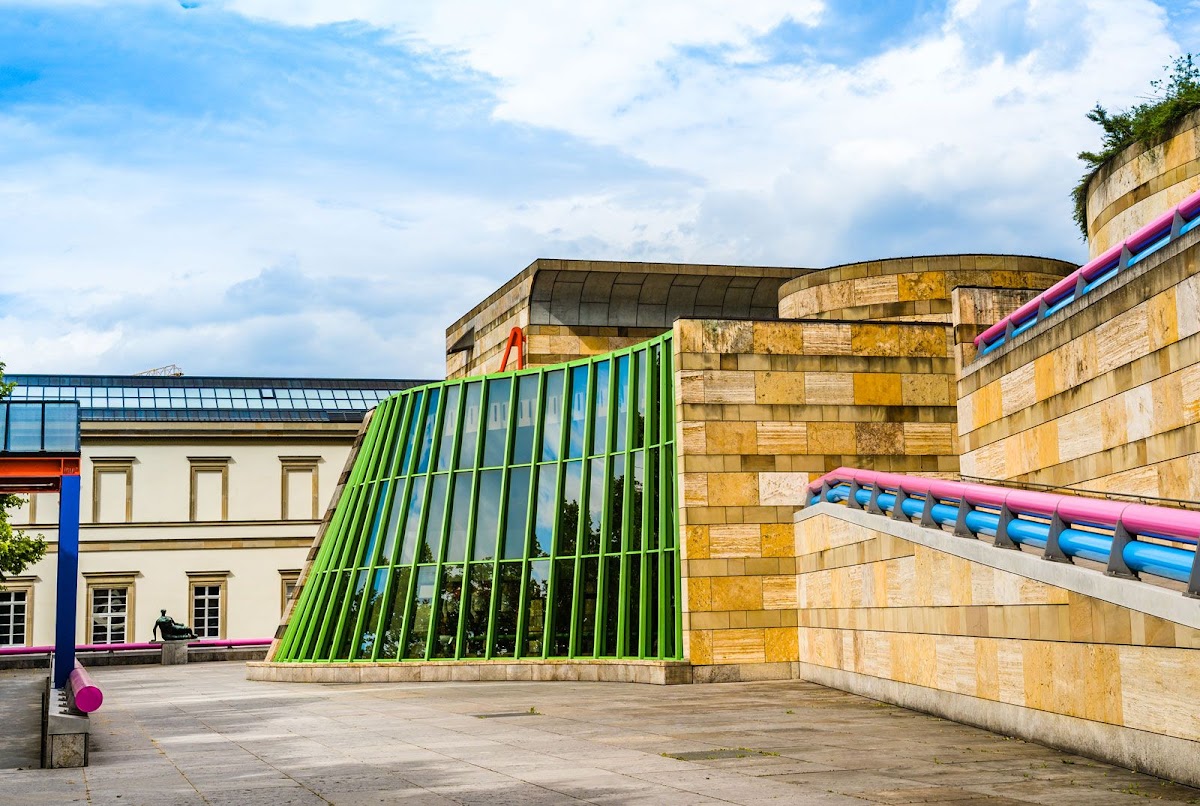
The Neue Staatsgalerie in Stuttgart, Germany, is a prominent art gallery located at Konrad-Adenauer-Straße 30-32. Opened in 1984, it stands as a significant extension to the older Staatsgalerie, which dates back to 1843. Designed by British architect James Stirling, this building is celebrated as a seminal work of Postmodern architecture, known for its vibrant colors, contrasting materials, and innovative spatial organization.
Stirling's Architectural Vision
Stirling & Wilford's design for the Neue Staatsgalerie challenged the rigid principles of Modernism. The building features a distinctive circular open-air sculpture rotunda at its heart, allowing public pathways to cut through the museum site, connecting urban pedestrian routes. Its exterior is characterized by alternating stripes of travertine and sandstone, oversized green steel window frames, and brightly colored handrails in pink, blue, and sky blue. This 'collage of citations' references historical architectural elements, including Le Corbusier's promenade architecturale, Schinkel's Altes Museum, and Louis Kahn's use of red sandstone, reinterpreting them within a contemporary context.
A Rich and Diverse Collection
The museum houses an extensive collection spanning from the 14th century to contemporary works. Its holdings include a significant collection of Pablo Picasso's Cubist drawings and prints, considered one of the largest in Germany. Visitors can also explore masterpieces by Bauhaus and Neue Sachlichkeit artists, such as Oskar Schlemmer's iconic Bauhaustreppe (1932) and works by Max Beckmann. The Surrealism room features large installations and objects by Joan Miró, Marcel Duchamp, and Salvador Dalí, while the American Abstract Expressionism collection showcases major works by Jackson Pollock, Barnett Newman, and Franz Kline.
Otto Dix's The War
A notable highlight is Otto Dix's monumental triptych, Der Krieg (The War), which depicts the horrors of World War I. Rediscovered in 1992 and subsequently added to the permanent collection, this powerful work serves as a crucial artistic document of German modern history and a profound commentary on the human cost of conflict.
Visiting Information
The Neue Staatsgalerie is easily accessible, located just a 1-minute walk from the U-Bahn Staatsgalerie station (U5/U6/U7 lines) and about a 15-minute walk from Stuttgart Central Station. Admission to the permanent collection is free, while special exhibitions cost 8€ for adults. The museum is closed on Mondays, operating from 10:00 AM to 5:00 PM Tuesday through Sunday, with extended hours until 8:00 PM on Thursdays. A visit of 2 to 2.5 hours is recommended.
Stuttgart is also renowned for its architectural tours. The museum can be combined with visits to the Kunstmuseum Stuttgart (a glass cube building from 2005) and the Weissenhof Estate (a 1927 modernist housing complex featuring works by Le Corbusier, Mies van der Rohe, and Gropius), both within easy reach. The city also offers the Mercedes-Benz Museum and Porsche Museum for those interested in its industrial heritage.
Visitor Info
| Translating | Translating |
| Area | Translating |
| Admission | Translating |
| Hours | Translating |
| Getting There | Translating |
| Address | Konrad-Adenauer-Straße 30-32, 70173 Stuttgart, Germany |
| Official Site | https://www.staatsgalerie.de/en/ |