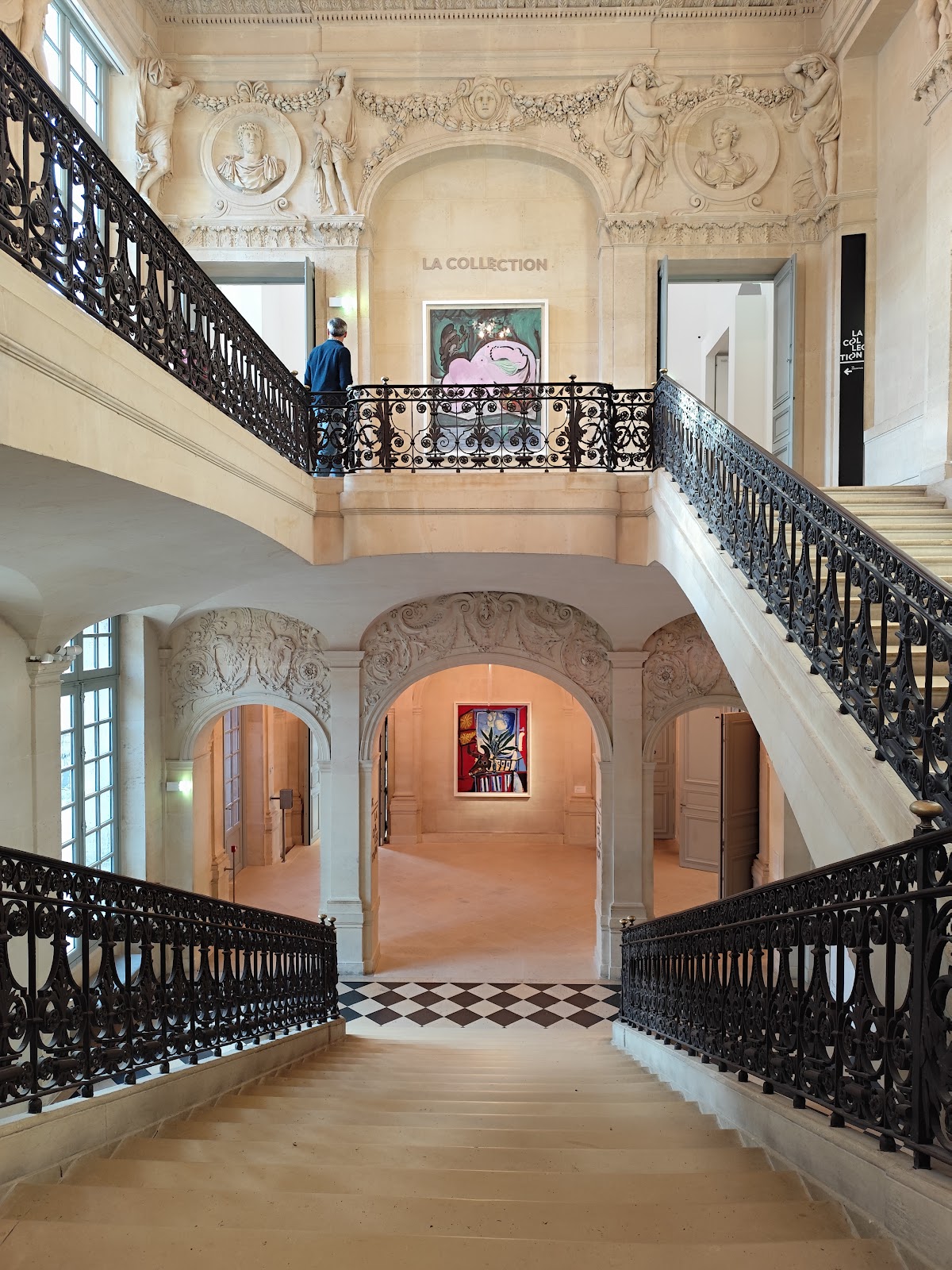
The Artist's Life in a 17th-Century Parisian Mansion
The Artist's Life in a 17th-Century Parisian Mansion
Musée Picasso Paris — A 17th-Century Mansion Housing a Modern Master
The Musée Picasso Paris is located in the historic Hôtel Salé in the Marais district of Paris, France. This 17th-century Baroque mansion, originally built in 1659 for salt tax collector Pierre Aubert de Fontenay, was transformed into a museum in 1985. Following a five-year renovation led by architects Jean-François Bodin and Stéphane Thouin, it reopened in 2014, enhancing its facilities and exhibition spaces.
Picasso's Legacy and the "Dation en Paiement"
Pablo Picasso's death in 1973 left behind an immense body of work. To settle inheritance taxes, his heirs utilized France's unique "dation en paiement" system, introduced in 1968, which allows for tax payment in cultural assets. This led to a landmark agreement in 1979, where approximately 1,500 of Picasso's personal works and about 100 works from his private collection (including Cézanne, Renoir, Matisse, and Rousseau) were transferred to the French state. This collection forms the core of the museum, making it the world's largest dedicated Picasso collection, spanning his entire artistic evolution.
A Comprehensive Collection of 5,000 Works
The museum houses around 5,000 works by Pablo Picasso, encompassing paintings, sculptures, drawings, prints, and ceramics. This extensive collection offers a complete overview of his stylistic shifts, from his Blue and Rose Periods to Cubism, Neoclassicism, Surrealism, and his late expressive works. Key masterpieces include "La Vie" (1903), a poignant Blue Period work, and "Portrait of Olga in an Armchair" (1917), marking his Neoclassical phase.
The collection also features numerous preparatory drawings and prints for "Les Demoiselles d'Avignon," providing insight into the birth of Cubism. Late works like "Le Baiser" (1969) showcase his powerful, expressive brushwork. Unique to the museum are his object sculptures, such as "Tête de taureau" (Bull's Head, 1942), crafted from bicycle parts, and "La Chèvre" (The Goat, 1950), demonstrating his innovative use of everyday materials.
Visiting the Museum
The museum's layout follows a chronological path, guiding visitors through Picasso's 90-year artistic journey from the first floor to the second, with prints displayed in the basement. A visit typically takes about two hours. Visitors can also enjoy views of the Marais rooftops from the second-floor windows. The museum is closed on Mondays. It operates from 10:30 AM to 6:00 PM on Tuesdays to Fridays, and from 9:30 AM to 6:00 PM on Saturdays and Sundays. It is conveniently located near the Saint-Paul metro station and within walking distance of the Musée Carnavalet and Centre Pompidou, making it an ideal stop for a cultural day in Paris.
The museum's bookstore offers reproductions of Picasso's signed and produced print editions, often at more accessible prices than elsewhere, making them popular souvenirs for art enthusiasts.
Visitor Info
| Translating | Translating |
| Area | Translating |
| Admission | 14€ |
| Hours | 10:30-18:00 (Mon closed) |
| Getting There | Translating |
| Address | 9 Rue des Coutures Saint-Gervais, 75003 Paris, France |
| Official Site | https://www.museepicassoparis.fr |