Where Diego Rivera's Murals Saved a City
Where Diego Rivera's Murals Saved a City
Detroit Institute of Arts — A Cultural Hub in Midtown
The Detroit Institute of Arts (DIA), located at 5200 Woodward Ave, Detroit, MI 48202, stands as a prominent cultural institution in the city's Midtown district. Accessible via the QLine tram (DIA station), the museum is surrounded by other significant cultural venues, including MOCAD, the Motown Museum, and the Charles H. Wright Museum of African American History, forming a vibrant cultural corridor.
The main building, completed in 1927, is a grand Beaux-Arts structure designed by Paul Philippe Cret. Its marble facade and classical proportions reflect the museum's historical significance as one of the oldest and largest art institutions in the United States.
A Legacy Since 1885 — Sixth Oldest in the U.S.
Established in 1885, the DIA holds the distinction of being the sixth oldest art museum in the United States. Its founding marked a crucial step in Detroit's cultural development, driven by local artists and philanthropists. Over the decades, the museum has expanded its collections and influence, becoming a cornerstone of the city's cultural identity.
The institution has consistently aimed to enrich the community by providing access to diverse artistic expressions and fostering a deeper understanding of global cultures. This long-standing commitment underscores its role in shaping Detroit's cultural landscape.
Paul Philippe Cret's Beaux-Arts Masterpiece
The DIA's main building, a testament to Beaux-Arts architecture, was designed by the French-American architect Paul Philippe Cret. Completed in 1927, the structure features a magnificent marble exterior and classical elements that convey a sense of grandeur and permanence. Cret's design established a distinguished home for the museum's growing collection.
Subsequent expansions in the 1970s and 2007 carefully integrated with Cret's original vision, ensuring the architectural integrity of the complex while accommodating modern exhibition needs. The building itself is a significant piece of art and history.
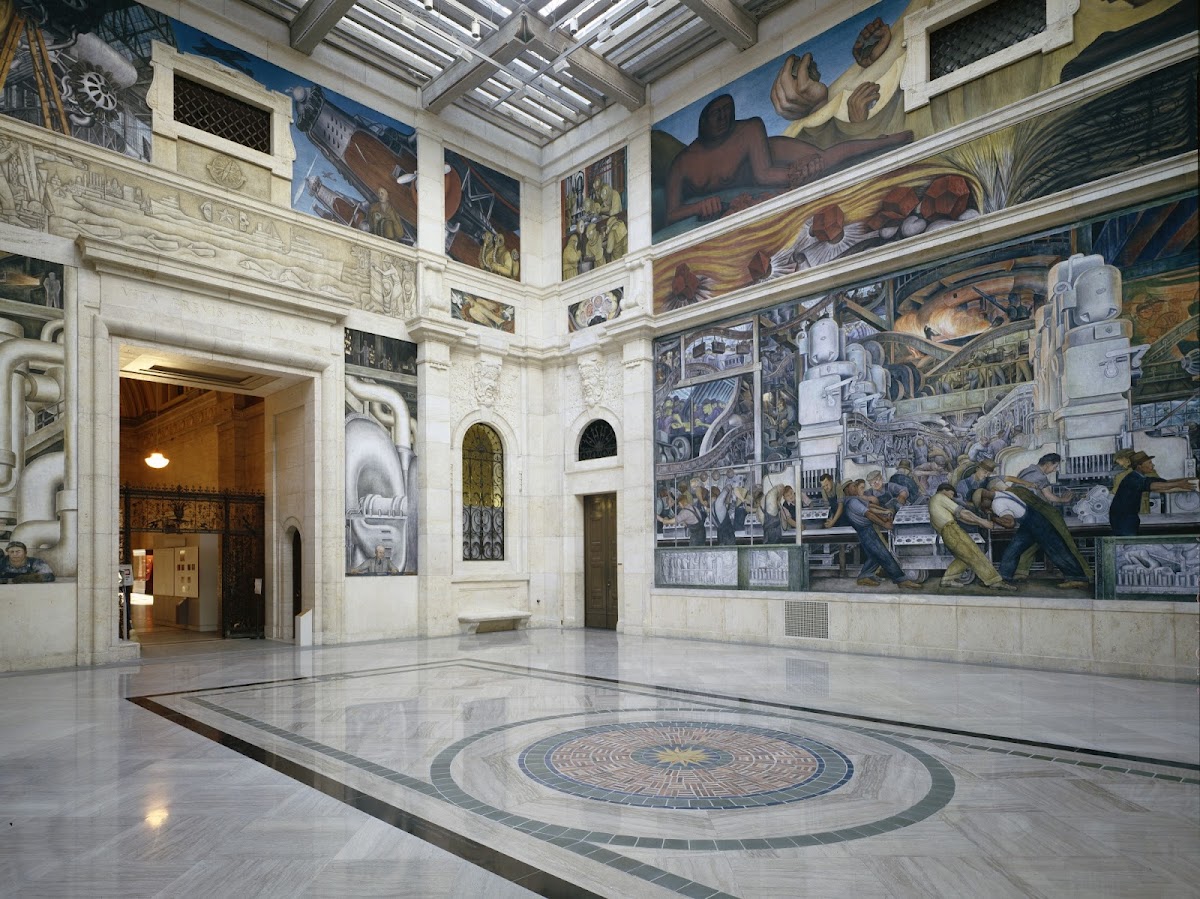
Diego Rivera's Detroit Industry Murals — A Monument to Labor
The most celebrated work within the DIA's collection is Diego Rivera's monumental "Detroit Industry Murals," created between 1932 and 1933. Commissioned by Edsel Ford, son of Henry Ford, these frescoes vividly depict the industrial might and labor force of Detroit during the Great Depression era.
Rivera immersed himself in the Ford factories, meticulously sketching the assembly lines, machinery, and workers. This direct engagement with the industrial environment allowed him to capture the raw energy and human element of Detroit's manufacturing heartland, resulting in a deeply authentic portrayal.
The 27 Fresco Panels — Rivera's "Finest Work"
Completed in March 1933, the "Detroit Industry Murals" comprise 27 fresco panels that envelop the four walls of the museum's central Rivera Court. These murals are a powerful narrative of American industrial labor, racial diversity, and the intricate relationship between nature and technology.
Rivera himself considered this work his "finest." The murals showcase everything from the dynamic automobile production lines to the complexities of pharmaceutical, chemical, and genetic industries, juxtaposing humanity's technological prowess with the elemental forces of nature. Recognized as a National Historic Landmark, they remain a pinnacle of 20th-century public art in North America.
Detroit's 2013 Bankruptcy Crisis — A Threat to Art
In 2013, when the city of Detroit declared bankruptcy, the DIA's extensive art collection faced a severe threat. As city assets, the artworks were considered for liquidation to help settle Detroit's substantial debts. This prospect ignited a national debate about the public ownership of art and the role of cultural institutions in times of economic crisis.
The potential sale of masterpieces, including Rivera's murals, drew widespread condemnation and highlighted the precarious position of public art collections when tied to municipal finances. The crisis brought into sharp focus the intrinsic value of art beyond monetary terms.
The "Grand Bargain" — Saving the Collection
To prevent the sale of the DIA's collection, a remarkable coalition of national foundations, private donors, and the state of Michigan came together to form the "Grand Bargain." This unprecedented effort raised over $800 million, which was used to help the city's creditors while simultaneously securing the museum's collection from being sold.
The "Grand Bargain" stands as a testament to collective action in preserving cultural heritage and became a symbol of Detroit's resilience and recovery. This initiative ensured that the DIA's vast holdings remained intact and accessible to the public, solidifying its role as a cultural anchor.
DIA's Rebirth — An Independent Nonprofit
Following the "Grand Bargain," the Detroit Institute of Arts transitioned from a city department to an independent nonprofit organization. This strategic move granted the museum greater autonomy and financial stability, insulating it from future municipal fiscal crises. The DIA emerged as a powerful symbol of Detroit's revitalization and a model for public museum governance.
The museum's recovery and transformation are frequently cited as a best practice in public art institution management. The narrative of a community uniting to save its cultural treasures adds a profound layer of meaning for visitors, reflecting a collective commitment to preserving artistic and historical value even in the face of adversity.
Key Collections — European Masters to American Moderns
The DIA boasts an encyclopedic collection of approximately 65,000 works, spanning diverse global cultures and historical periods, with particular strengths in American, European, and African art. Notable European holdings include Peter Paul Rubens's "The Meeting of David and Abigail" (1625–1628), considered one of the finest large-scale Baroque paintings by Rubens in the U.S.
The museum also houses an 1887 self-portrait by Vincent van Gogh, one of the earliest Van Gogh self-portraits in an American collection. Its American painting galleries feature iconic works by John Singer Sargent, Mary Cassatt, Georgia O'Keeffe, and Edward Hopper, including Hopper's renowned "Tompkins Square."
Global Art — African, Islamic, and Asian Galleries
Beyond its Western art strengths, the DIA is committed to showcasing a broad spectrum of global artistic achievements. Its African art galleries display masks and sculptures from West and Central Africa, offering insights into diverse cultural traditions and spiritual beliefs. The Islamic art collection features exquisite ceramics and metalwork, reflecting the rich artistic heritage of the Islamic world.
The Asian art galleries present a range of Buddhist sculptures, paintings, and ceramics, illustrating the artistic traditions of various Asian cultures. These continent-specific galleries underscore the museum's dedication to fostering cultural understanding and contributing to a global dialogue on art history and appreciation.
Visiting Information — Hours and Admission
The Detroit Institute of Arts operates from Tuesday to Sunday. It is closed on Mondays. From Tuesday to Thursday, hours are 9:00 AM to 4:00 PM. On Fridays, the museum extends its hours to 9:00 AM to 9:00 PM. Weekend hours (Saturday and Sunday) are 10:00 AM to 5:00 PM. Visitors are encouraged to check the official website for the most current information.
General admission is $14 for adults, $9 for seniors, and $8 for youth aged 6-17. Residents of Detroit, Warren, and Oakland counties enjoy free admission. The museum is located at 5200 Woodward Ave, Detroit, MI 48202, and is easily accessible via the QLine tram (DIA station). A visit typically requires 2 to 3 hours to fully explore the collections.
Visitor Info
| Translating | Translating |
| Area | Translating |
| Admission | Translating |
| Hours | Translating |
| Getting There | Translating |
| Address | 5200 Woodward Ave, Detroit, MI 48202, USA |
| Official Site | https://www.dia.org |