How a Port City Uses Its Museum
How a Port City Uses Its Museum
Yokohama Museum of Art in Minato Mirai
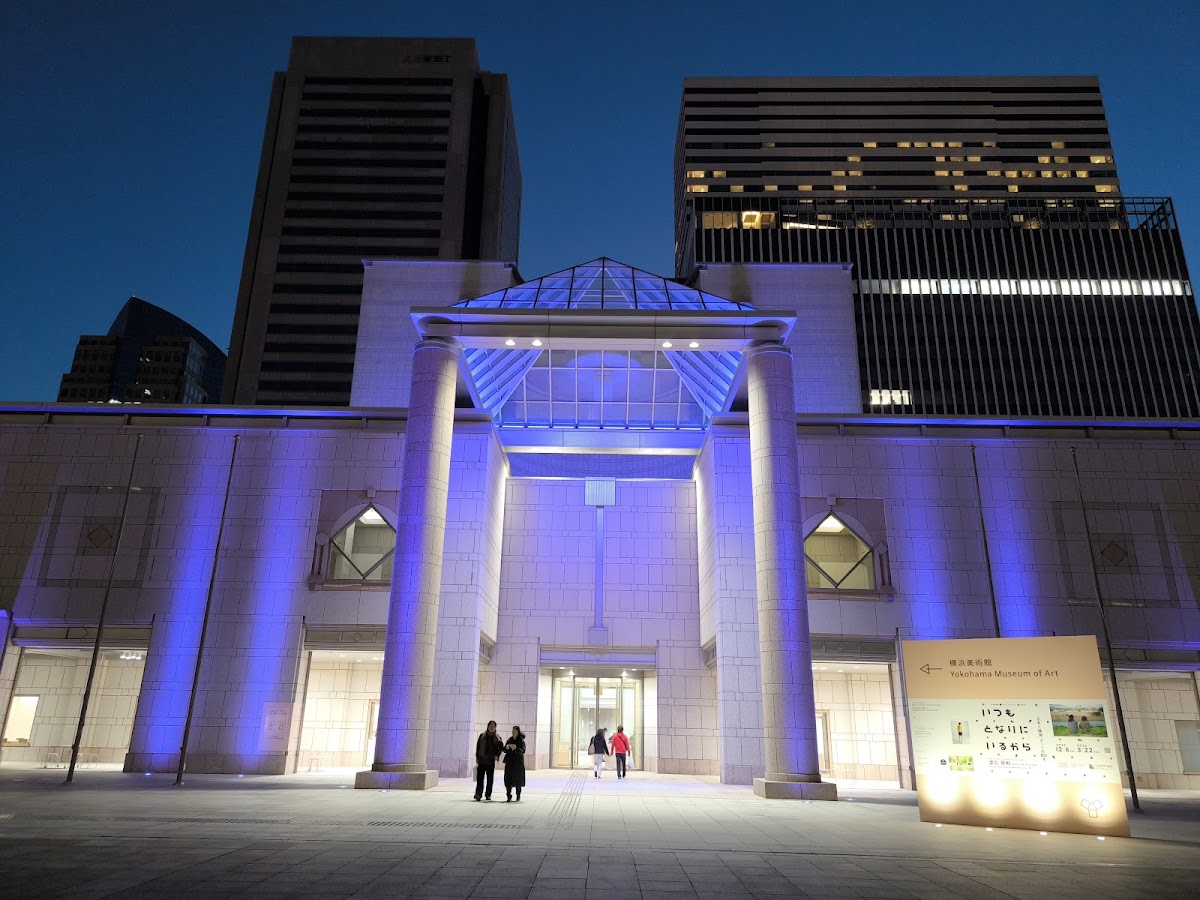
Yokohama Museum of Art stands at the center of Minato Mirai 21, the waterfront district developed on former shipyard land. Its long stone facade, central semi-cylindrical tower, and symmetrical wings make it a civic landmark rather than a discreet gallery. The museum officially opened to the public in November 1989, when the new district was still taking shape.
Architect Kenzo Tange designed the building as a comprehensive art center. Across a facade about 180 metres long, galleries occupy the middle while workshop studios and the Art Library anchor opposite ends. The arrangement gives equal architectural weight to seeing, making, and learning about art.
Kenzo Tange's Grand Gallery
Inside, the Grand Gallery rises to about sixteen metres. Granite surfaces and stepped spaces extend roughly sixty-three metres to either side, creating an indoor plaza where visitors can sit, meet, watch people, and encounter art. The hall feels less like a conventional lobby than a room shared by the museum and the city.
After the museum's renovation, the Grand Gallery became the center of the free Jiyu Area. Visitors can enter this defining space without first committing to a ticketed exhibition. Galleries 8 and 9, including a glass-walled display visible from the Art Plaza, further soften the boundary between paid galleries and everyday public use.
A Collection Shaped by Yokohama Port
The Yokohama Museum of Art collection contains more than 15,000 works as of 2025. It focuses on modern and contemporary art from the late nineteenth century, the period when the opening of Yokohama Port transformed the city's relationship with the wider world. Works associated with Yokohama sit beside Japanese and international modern art.
The collection includes artists such as Cezanne, Picasso, Dali, and Magritte, but its value is not simply a list of familiar names. The museum uses the history of a port city to examine how images and ideas travelled, how Japanese artists responded to imported forms, and how local art entered international conversations.
Why Photography Matters in Yokohama
Photography has a particularly important place in the collection. Yokohama was among the first Japanese port cities to develop commercial photography studios in the late Edo period. Early photographs recorded people and landscapes for audiences both inside and outside Japan, making the medium part of the city's history of exchange.
The museum follows photography from these early practices into the medium's central role in twentieth-century art. Viewing photographs beside painting and contemporary work reveals different ways of constructing a city's image. A camera records reality, but framing, circulation, and audience determine what kind of Yokohama the image presents.
Nine Galleries, an Art Library, and Workshops
The museum has nine gallery spaces that can be configured for special exhibitions and collection displays. Beyond them, the Art Library holds more than 240,000 exhibition catalogues, specialist books, periodicals, and audiovisual materials. It is open free of charge, allowing a question raised in the galleries to continue at a reading desk.
Children's and citizens' workshops occupy dedicated painting, sculpture, printmaking, craft, and audiovisual rooms. Their presence is central to the institution's identity. Art is not presented only as something completed and placed on a wall; visitors can also learn how materials behave and how creative decisions are made.
The 2025 Reopening
The museum closed in March 2021 for its first major renovation. Nearly 14,000 artworks and approximately 230,000 library volumes had to be moved to external storage. It reopened in stages: the 2024 Yokohama Triennale brought visitors back to the building, parts of the free area returned later that year, and the full reopening followed in February 2025.
This phased return shows why a museum is more than renovated rooms. Collections, books, workshops, staff, and public routines all had to come home. The renewed building now makes its civic purpose especially visible in the free hall, library, studios, and plaza as well as in the ticketed exhibitions.
Planning a Yokohama Art Visit
The museum is a short walk from Minatomirai Station and can also be reached on foot from Sakuragicho Station. Approaching across the Art Plaza gives the clearest view of Tange's symmetry and the central tower. Inside, begin in the Grand Gallery, check which galleries are open, and leave time for the Art Library or free Jiyu Area.
A visit pairs naturally with a walk toward Yokohama's waterfront. The route connects the museum's themes of port history, photography, international exchange, and urban planning to the city outside. Two to three hours is comfortable for the museum itself; adding Minato Mirai and the harbour turns it into a half-day art itinerary.
Visit Info
- Address: 3-4-1 Minatomirai, Nishi-ku, Yokohama, Kanagawa 220-0012, Japan
- Hours: 10:00-18:00, 입장 마감 17:30. 목요일·연말연시 휴관, 전시별 일정은 공식 안내 확인
- Fee: 전시별 상이. 무료로 이용할 수 있는 지유 에어리어·미술정보센터 구역은 공식 안내 확인
- Transport: 미나토미라이선 미나토미라이역 3번 출구에서 도보 약 3-5분, JR 사쿠라기초역에서 도보 약 10분
- Time needed: 약 2-3시간, 미나토미라이 산책과 함께 보면 반나절
- Website: https://yokohama.art.museum/eng/
Visitor Info
| Address | 3-4-1 Minatomirai, Nishi-ku, Yokohama, Kanagawa 220-0012, Japan |
| Hours | Translating |
| Admission | Translating |
| Getting There | Translating |
| Duration | Translating |
| Translating | https://yokohama.art.museum/eng/ |