Ceramics Hidden Beneath a Seaside Park
Ceramics Hidden Beneath a Seaside Park
CLAY Museum of Ceramic Art Denmark in Middelfart
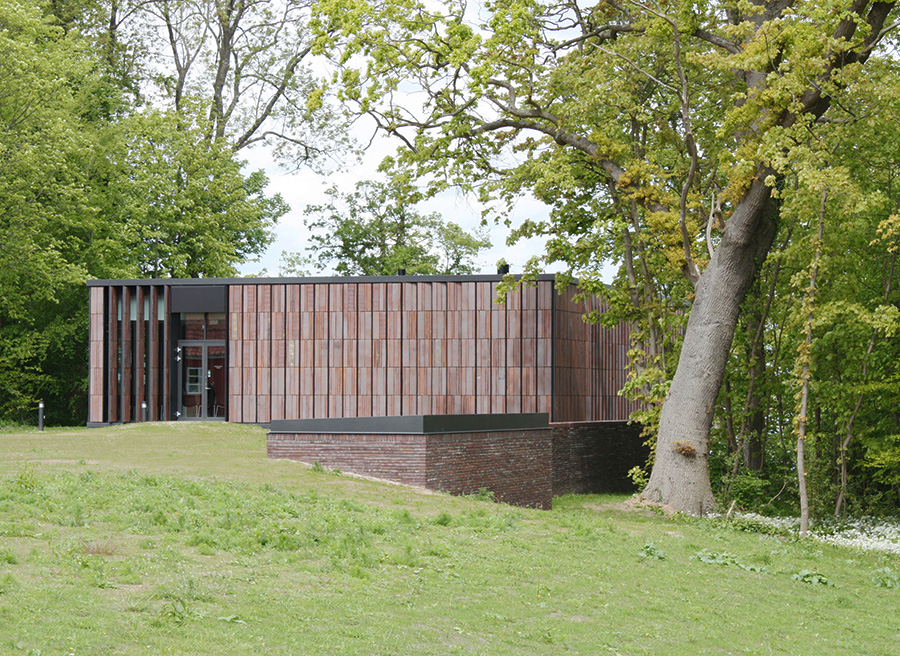
CLAY Museum of Ceramic Art Denmark sits in a seaside park in Middelfart, on the island of Funen. At first the museum appears to be a historic red-brick villa surrounded by lawns and mature trees. Much of the institution is hidden below the sloping ground, where modern galleries connect to the old house.
This relationship between earth and architecture suits a museum devoted to clay. The extension keeps the historic park visible while creating enough space for Danish industrial ceramics, international studio pottery, and contemporary experiments. Moving underground becomes part of the story of a material taken from the ground and transformed by fire.
Grimmerhus, the 1857 Villa
The original villa is known as Grimmerhus. Architect Johan Daniel Herholdt designed it in 1857 for Niels Basse Fønss and his wife Louise, who were connected with nearby Hindsgavl Castle. Its Renaissance-inspired exterior and Gothic Revival interior reflect the eclectic architectural taste of the nineteenth century.
The building later served several purposes. Middelfart municipality acquired it in 1919, and from 1925 it operated as a summer guesthouse. Grimmerhus was listed in 1993 and restored, allowing a group of active ceramic artists to turn the former residence into a museum.
A Ceramics Museum Founded by Artists
CLAY began with an idea rather than an inherited collection. Artists and ceramicists in the group Clay Today wanted a permanent institution for modern ceramic art. The Museum of Ceramic Art Grimmerhus opened in October 1994, and its own collection grew through donations from private collectors, foundations, and supporters from 1998 onward.
That beginning still shapes the museum. CLAY preserves Danish ceramic heritage, but it also follows living artists who test the limits of clay. Studio vessels, sculptural ceramics, pottery, design objects, and works that resist any practical use can be considered in the same institution.
The Underground Extension
From 2012 to 2015, the museum underwent a major expansion and renovation by Kjaer & Richter. The project added about 1,500 square metres of new construction and refurbished or converted roughly 1,000 square metres of the listed buildings. CLAY reopened under its present name in May 2015.
The winning design placed the main extension beneath the terrain south of the villa. Stairs and an elevator connect it to an existing side wing, while the ground's natural slope toward the sea allows parts of the new building to emerge into the park. Old brick, new concrete, landscape, and exhibition space remain distinct without becoming disconnected.
The Royal Copenhagen Collection
The underground Treasury presents more than 235 years of Danish ceramic production. It brings together selected works by Royal Copenhagen, Bing & Grondahl, and Aluminia in porcelain, stoneware, and faience. Comparing related plates, vessels, and decorative objects reveals changes in painting, glaze, form, technology, and popular taste.
The complete Royal Copenhagen Collection contains around 55,000 objects and was donated to the museum in 2010. Its scale transformed CLAY into an essential place for studying Danish ceramic industry and design. The displays also make visible the many painters, modellers, kiln specialists, and designers behind objects often known only by a factory mark.
From Studio Pottery to Asger Jorn
CLAY's own collection includes Danish and international studio ceramics, artist ceramics, pottery, and ceramic design. Here irregular edges, flowing glaze, exposed clay, and traces of firing can be deliberate choices rather than flaws. These works show how contemporary artists move between vessel, sculpture, painting, and installation.
A ceramic relief by Danish artist Asger Jorn broadens the story further. The energy associated with his paintings becomes physical in raised clay and glossy glaze. Placed within a museum that also holds factory archives and domestic tableware, such a work challenges any simple division between fine art, craft, and industrial design.
Planning a Ceramics Visit in Middelfart
CLAY can be reached on foot from Middelfart Station in about fifteen minutes. Allow around two hours for the historic villa, underground galleries, Treasury, and contemporary exhibitions. The museum shop and cafe can be entered without an exhibition ticket, making the park part of local daily life as well as a destination for ceramic specialists.
If time allows, continue along the ceramics trail through the museum park and Middelfart. Outdoor works meet rain, moss, trees, and sea air very differently from objects protected in a display case. The route completes CLAY's central idea: ceramics belong not only to museum history, but also to architecture, public space, industry, and everyday use.
Visit Info
- Address: Kongebrovej 42, DK-5500 Middelfart, Denmark
- Hours: 화-일 10:00-17:00, 월요일 휴관. 연말 및 공휴일 특별 운영은 공식 안내 확인
- Fee: 성인 DKK 140, 학생 DKK 70, 18세 미만 무료. 카페와 숍은 무료 입장
- Transport: 미델파르트역에서 도보 약 15분, 코네브로 숲과 해협 방향
- Time needed: 약 2시간, 공원과 세라믹 루트 산책을 더하면 반나절
- Website: https://claymuseum.dk/en/
Visitor Info
| Address | Kongebrovej 42, DK-5500 Middelfart, Denmark |
| Hours | Translating |
| Admission | Translating |
| Getting There | Translating |
| Duration | Translating |
| Translating | https://claymuseum.dk/en/ |