Glass Flowers Beneath Jeju Stone Walls
Glass Flowers Beneath Jeju Stone Walls
Yumin Art Museum in Seopjikoji, Jeju
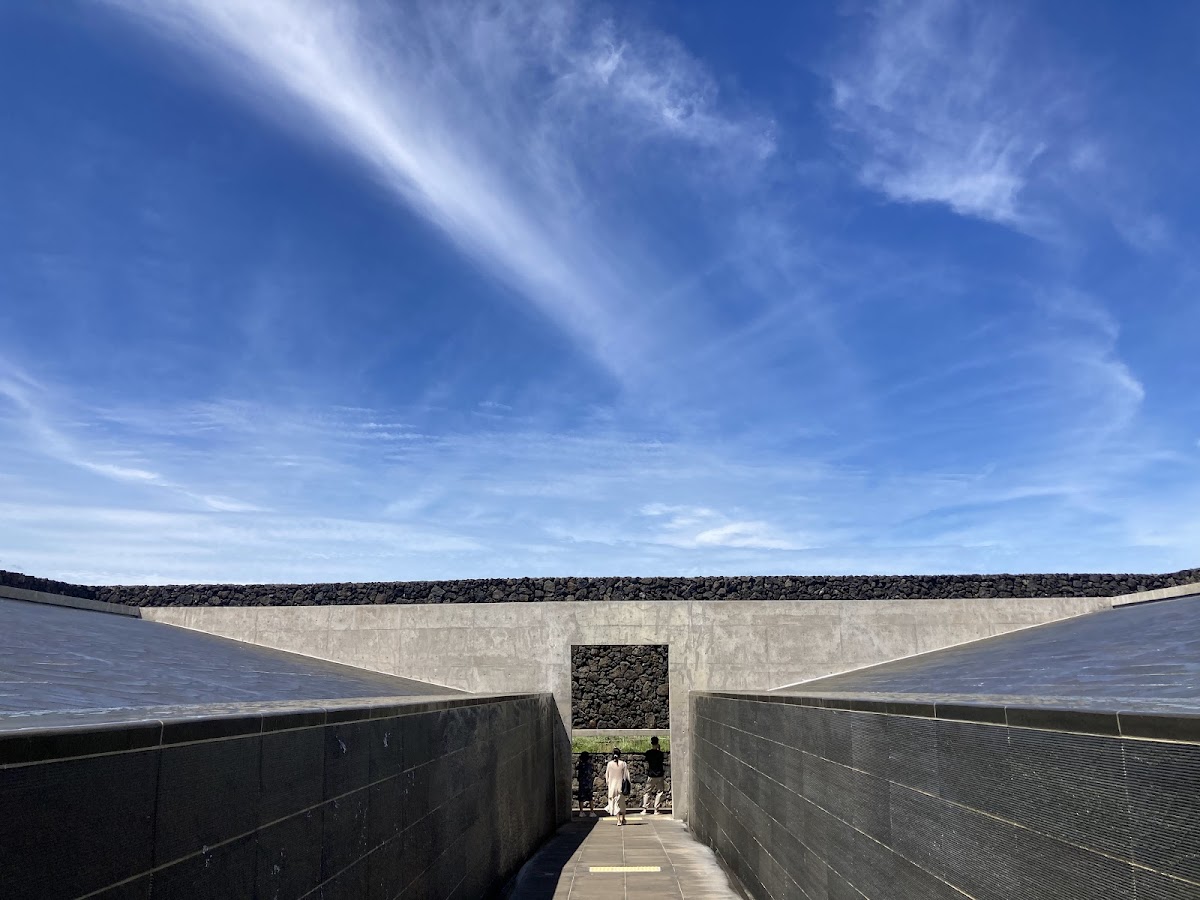
Yumin Art Museum, also known as the Yumin Art Nouveau Collection, is set within Seopjikoji on the eastern coast of Jeju Island. Rather than presenting a large facade, the museum begins with black volcanic-stone walls, low grass, water, and a path that descends into the ground. The sea and sky appear, disappear, and return as visitors move toward the galleries.
This approach makes the landscape the first part of the exhibition. The museum is not simply a container for decorative glass. Jeju wind, reflected water, dark basalt, and pale concrete prepare the eye for a collection filled with flowers, insects, leaves, and changing colour.
Tadao Ando's Architecture of Water and Wind
Japanese architect Tadao Ando designed much of the building below ground so that it would not dominate the Seopjikoji horizon. Smooth exposed concrete stands beside rough volcanic stone, while narrow passages and turns slow the route. Water reflects the sky and temporarily softens the weight of the walls.
Ando's architecture is experienced through movement. A wall closes the view, a stair lowers the body, and a new opening frames sky or vegetation. The sequence allows visitors to feel Jeju's light, wind, water, and sound before entering the controlled atmosphere of the galleries.
French Art Nouveau and the Ecole de Nancy
The collection focuses on French Art Nouveau glass from the late nineteenth and early twentieth centuries, especially artists associated with the Ecole de Nancy. Art Nouveau sought to bring art into daily life through furniture, jewellery, posters, lighting, and glass. Curving lines and forms drawn from plants were not added decoration; they shaped the object itself.
Nancy had both advanced glass industries and a community of artists, designers, and craftspeople willing to experiment. They layered coloured glass, carved through surfaces, used acid etching, and accepted variations created by heat. A vase could be produced in a workshop and still retain the differences of a handmade object.
Emile Galle, Daum, and Rene Lalique
Emile Galle treated glass as a surface for botany, poetry, and symbolism. Flowers and trees grow around the body of a vase, while layers of colour create depth that changes with the viewing angle. His works reward close looking because an apparently painted image may actually have been revealed by cutting away an outer layer of glass.
The Daum workshop developed another rich language of colour, landscape, and collaborative production. Rene Lalique expanded Art Nouveau across jewellery, perfume bottles, and decorative glass, combining translucent material with metal and sculptural form. The museum also introduces other makers, allowing one natural motif to be compared across different techniques and sensibilities.
The Collection of Hong Jin-ki
The museum grew from the collection assembled by Hong Jin-ki, whose pen name was Yumin. He studied the historical, technical, and aesthetic relationships among the works rather than collecting isolated luxury objects. His particular interest in Nancy glass gave the museum a coherent story of artists, workshops, materials, and techniques.
In 2017, marking the centenary of Hong's birth, forty-seven significant works from the collection were presented to the public. A private act of collecting became a rare place in Korea where French Art Nouveau glass can be studied as a connected movement rather than as a group of decorative highlights.
How to Look at Art Nouveau Glass
Glass changes according to light and position. Front lighting reveals carved surfaces, while transmitted light makes inner colour layers visible. Small bubbles, uneven thickness, and tool marks scatter light in ways that perfectly uniform industrial glass does not. Walking a step to the side can make one flower disappear and another layer emerge.
It helps to imagine the heat behind each quiet object. Molten glass had to be shaped quickly, cooled carefully, layered, carved, and sometimes etched with acid. The final vase contains a designer's drawing, a craftsperson's timing, and the unpredictable behaviour of a kiln.
Planning a Jeju Art and Architecture Visit
Allow at least an hour for the museum and more time if architecture is a main interest. Follow the entrance route slowly, compare concrete with basalt, and look back at the water after seeing the glass. The same natural forms move between landscape, architecture, and collection.
A visit pairs naturally with a walk around Seopjikoji. Outside, waves, grasses, flowers, and volcanic stone return in living form. The experience explains why this is best classified as an art destination: Tadao Ando's building and the Yumin Art Nouveau Collection work together as one carefully paced encounter.
Visit Info
- Address: 제주특별자치도 서귀포시 성산읍 섭지코지로 107
- Hours: 매일 09:00-18:00. 계절·시설 운영에 따른 변동은 공식 안내 확인
- Fee: 전시·시설 패키지별 상이, 공식 예매 안내 확인
- Transport: 섭지코지 주차 후 휘닉스 아일랜드 셔틀 또는 도보 이동, 현장 동선 확인
- Time needed: 약 1-1시간 30분, 섭지코지 산책과 함께 보면 반나절
- Website: https://phoenixhnr.co.kr/static/jeju/architecture/yuminart
Visitor Info
| Address | Translating |
| Hours | Translating |
| Admission | Translating |
| Getting There | Translating |
| Duration | Translating |
| Translating | https://phoenixhnr.co.kr/static/jeju/architecture/yuminart |