A Round Gallery Looking Toward Peace
A Round Gallery Looking Toward Peace
Hiroshima Museum of Art in the City Centre
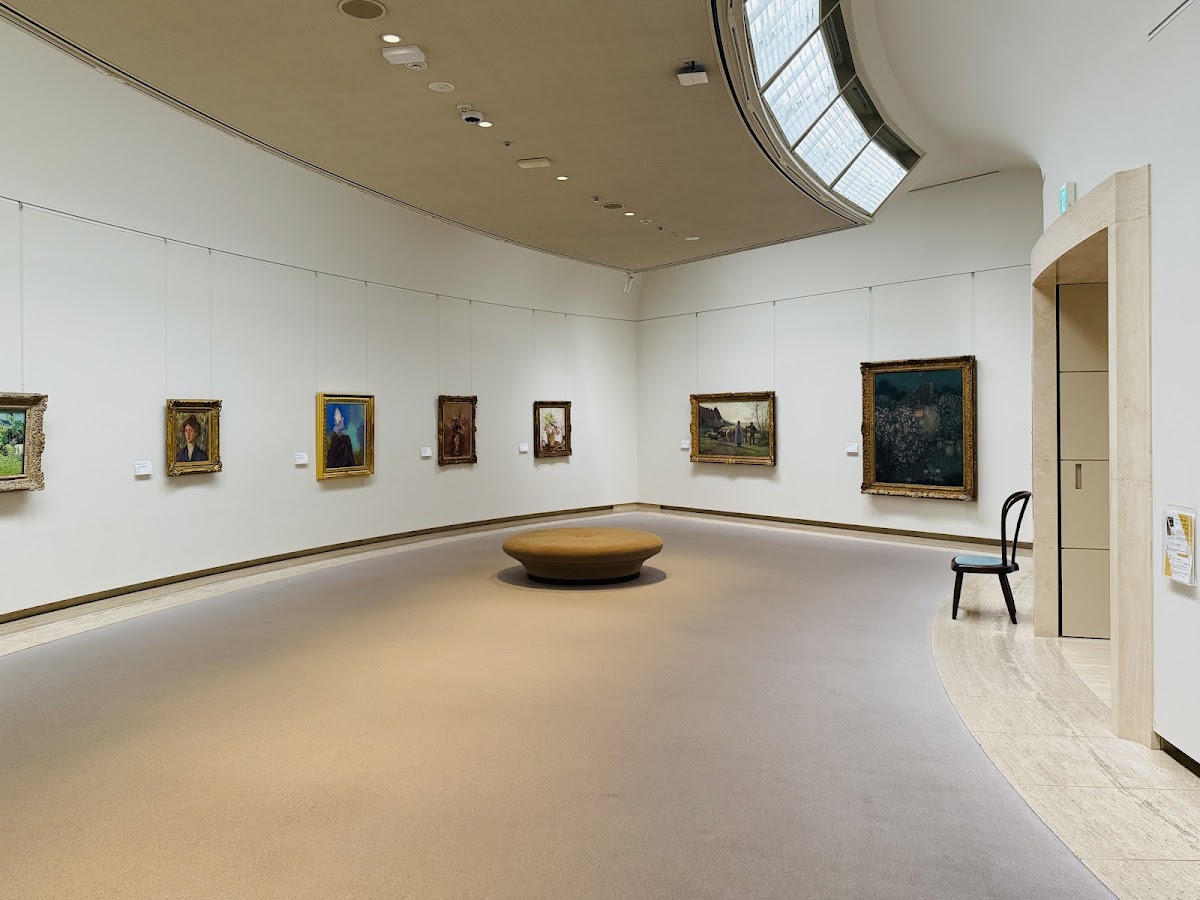
Hiroshima Museum of Art stands among trees near Hiroshima Castle, within walking distance of the Peace Memorial Park and central Kamiyacho. The low circular building feels quieter than the busy streets around it. Opened on 3 November 1978, the museum was founded around the theme of love and peace.
That idea does not turn the collection into a single historical lesson. Instead, paintings of gardens, rivers, people, families, and city life create a place where ordinary human experience can be protected and reconsidered. In Hiroshima, the decision to preserve beauty and everyday life carries particular weight.
A Circular Building Shaped by Hiroshima
The round domed main gallery was designed in reference to the Atomic Bomb Dome, while the surrounding corridors recall those of Itsukushima Shrine on Miyajima. Two of Hiroshima's best-known World Heritage sites, one associated with destruction and the other with long cultural continuity, quietly shape the museum's plan.
Visitors repeatedly move around the centre and into adjacent galleries. The circular route creates a calm rhythm: one room disappears gradually before the next opens. Architecture carries memory without reproducing either monument literally.
From Romanticism to Impressionism
The Western modern art collection moves from Delacroix, Courbet, Millet, and Corot toward Manet, Monet, Renoir, Sisley, Degas, and Pissarro. It allows visitors to follow how nineteenth-century painters shifted from academic subjects toward contemporary life, rural labour, changing weather, and the immediate experience of light.
Claude Monet's Morning on the Seine from 1897 is a key work. River, trees, and sky dissolve into mist and reflected colour. Up close, separate brushstrokes remain visible; from a distance, the landscape forms. The painting turns patient observation of one place into the subject itself.
Van Gogh's Daubigny's Garden
Vincent van Gogh's Daubigny's Garden is one of the museum's best-known paintings. Created at Auvers-sur-Oise near the end of his life, it fills a wide canvas with grass, buildings, sky, and strongly directed colour. Knowledge of the artist's final months can suggest sadness, yet the garden itself remains vigorous and alive.
When the museum marked its fortieth anniversary in 2018, it adopted green as its institutional colour. Green represents peace and also connects to the rich garden tones of this painting. One work therefore links the collection, the museum's public identity, and its founding theme.
Cezanne, Picasso, and the School of Paris
Post-Impressionism and Neo-Impressionism are represented by artists including Signac, Seurat, Cezanne, Gauguin, Toulouse-Lautrec, Redon, and Bonnard. Later rooms move toward Matisse, Braque, Leger, and Picasso, showing how colour and form became independent languages rather than tools for copying visible reality.
The School of Paris adds Modigliani, Chagall, Foujita, and other artists who travelled to the French capital from different countries. Their work makes modern art a history of movement and translation. Seen in an international city of peace, these crossings between cultures become especially resonant.
Japanese Western-Style Painting and Nihonga
Hiroshima Museum of Art does not stop with French modernism. Its Japanese Western-style painting collection includes artists such as Asai Chu, Kuroda Seiki, Fujishima Takeji, and Kishida Ryusei. Their works show how oil painting was learned, adapted, and used to depict Japanese bodies, interiors, and landscapes.
Nihonga by Takeuchi Seiho, Yokoyama Taikan, Uemura Shoen, and others follows a different material path through mineral pigments, paper or silk, line, and open space. Seeing both traditions prevents Japanese modernity from looking like a simple replacement of old art by Western art. Different media answered the same changing era.
A Living Collection
Major works are not always on the wall. Paintings travel to other exhibitions or rest for conservation, and the museum publishes a current list of works on view. A visit should therefore be approached as an encounter with a changing collection rather than a guaranteed checklist of famous names.
The circular corridors, garden, and cafe provide useful pauses between concentrated galleries. Looking away from paintings and returning later often preserves more than trying to complete every room without a break.
Planning a Hiroshima Art Visit
The museum is about five minutes on foot from Hiroshima Bus Center or the Kamiyacho-higashi streetcar stop. One and a half to two hours is comfortable for the collection and a temporary exhibition. Check the museum calendar because Monday closures have exceptions during holidays and special exhibitions.
Combining the museum with Peace Memorial Park creates a meaningful half-day route. The park faces historical loss directly; the museum protects the visual record of landscapes, people, and ordinary life. Together they offer different but connected ways of thinking about what peace is meant to preserve.
Visit Info
- Address: 3-2 Motomachi, Naka-ku, Hiroshima 730-0011, Japan
- Hours: 09:00-17:00, 입장 마감 16:30. 월요일·연말연시 휴관, 공휴일·특별전 기간 예외 확인
- Fee: 소장품전·특별전별 상이, 공식 티켓 안내 확인
- Transport: 히로시마 버스센터 또는 노면전차 가미야초히가시 정류장에서 도보 약 5분
- Time needed: 약 1시간 30분-2시간, 평화기념공원과 함께 보면 반나절
- Website: https://www.hiroshima-museum.jp/en/
Visitor Info
| Address | 3-2 Motomachi, Naka-ku, Hiroshima 730-0011, Japan |
| Hours | Translating |
| Admission | Translating |
| Getting There | Translating |
| Duration | Translating |
| Translating | https://www.hiroshima-museum.jp/en/ |