Under a White Roof in Daejeon, Letters Become a Crowd
Under a White Roof in Daejeon, Letters Become a Crowd
Lee Ungno Museum in Daejeon
Lee Ungno Museum stands low in Daejeon's cultural district, between Hanbat Arboretum and the city's major arts venues. It opened in May 2007 to present the life and work of Lee Ungno, an artist who moved from traditional ink painting to collage, Letter Abstracts, prison drawings, and the People series. The museum works best as a record of change rather than a monument to one fixed style.
Daejeon and Lee's wife, artist Park In-kyung, signed the first donation agreement in 2004. The city received an initial group of 106 works in 2005, including Letter Abstracts and People paintings, followed by 101 works that included drawings made during Lee's imprisonment. Those gifts established the foundation for the opening collection and preserved chapters that could otherwise have remained dispersed.
Laurent Beaudouin Turns a Letter into Architecture
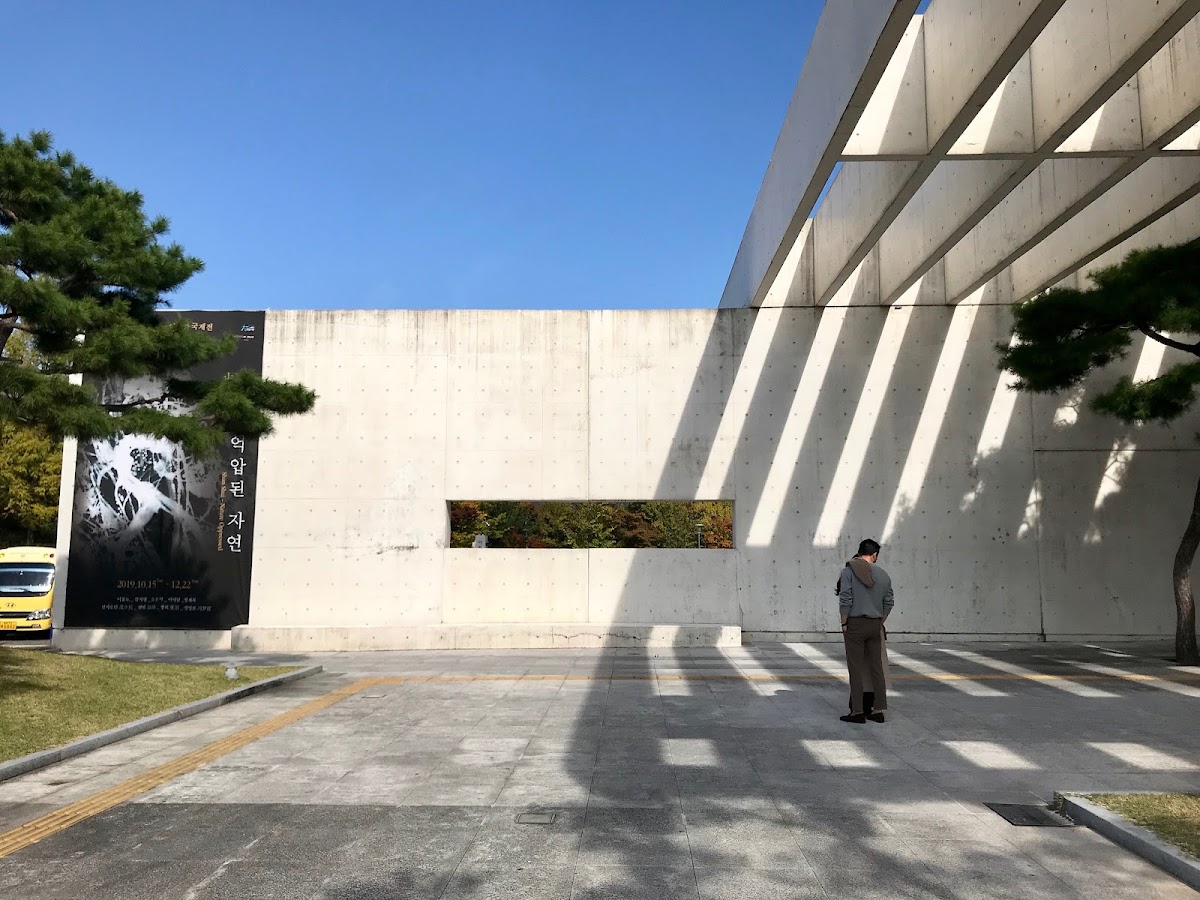
French architect Laurent Beaudouin based the museum on Lee's 1972 work Su, a Letter Abstract formed by breaking apart and recombining the Chinese character for longevity. Repeated roof beams, walls, and changing axes translate the drawn strokes into structure. The building does not imitate a painting; it asks visitors to move through the same ideas of division, rhythm, and recombination.
Beaudouin also reinterpreted walls and courtyards from Korean architecture. Interior and exterior spaces remain connected, and the route alternates between rooms, shaded passages, framed views, and open courts. The museum describes this sequence as a walk. White concrete, dark shadows, and trees make the relationship between ink and empty paper visible at the scale of a building.
From Calligraphy and Landscape to Paris Collage
Born in Hongseong in 1904, Lee studied literati painting and the Four Gentlemen under calligrapher Kim Gyujin. His control of brush pressure, ink density, and open space remained important even after his images became abstract. Study in Japan during the late 1930s and early 1940s introduced new approaches to landscape and observation, helping him bring contemporary life into an inherited ink tradition.
Lee moved to France in 1958. In Paris he encountered postwar abstraction but responded through paper, ink, cloth, wood, and calligraphic memory. Torn and layered paper became rough walls, unreadable signs, or shifting maps. His 1962 exhibition Lee Ungno: Collages at Galerie Facchetti announced that transformation without reducing his work to a simple blend of East and West.
Letter Abstracts Between Meaning and Form
In the Letter Abstracts, shapes resembling Chinese characters, Hangul, or Roman letters are cut, rotated, repeated, and stacked. They resist ordinary reading while retaining the memory of language. A viewer moves between trying to decipher a sign and noticing weight, spacing, colour, and rhythm. That hesitation is central to the work.
The series also varies more than its name suggests. Some paintings build dense walls of dark marks; others scatter coloured strokes like moving bodies. Lee treated writing as both a cultural system and a field of forms. Su, the work behind the museum's architecture, makes this connection especially clear.
Prison Works Made from Limited Materials
Lee was imprisoned in South Korea in 1967 after being implicated in the East Berlin Affair. With conventional art supplies restricted, he used rice paste, food containers, fans, paper, soy sauce, and whatever materials were available. The museum's official chronology records roughly three hundred prison works. Their importance lies not only in perseverance but in how confinement changed scale, surface, and visual language.
After his release in March 1969, Lee returned to France. The later donation of prison works to Daejeon brought this difficult history into the same collection as his international exhibitions and abstract paintings. Visitors can see material experiment and political history without turning either into a footnote.
Teaching in Paris and Painting a Crowd
In 1964 Lee helped establish the Academie de Peinture Orientale de Paris at the Cernuschi Museum. Teaching calligraphy and ink painting to students from another cultural background sharpened his interest in how a stroke can carry tradition yet remain open to reinvention. Education, collaboration, and conversation were active parts of his practice.
During the 1980s, small human figures gathered across his People paintings. From a distance they form a wave; up close each body bends, raises an arm, or leans toward another. The works evoke South Korea's democratic movements and the trauma of Gwangju while remaining broader images of solidarity, resistance, and communal life. Letters begin to resemble bodies, and bodies become signs.
How to Visit Lee Ungno Museum
Allow time to compare works from different periods instead of looking only for a single masterpiece. Notice what remains consistent as materials change: the pressure of a line, the use of empty space, and the rhythm created by repetition. Displays rotate, so the value of each visit lies in the relationships assembled on that day.
After the galleries, walk around the courtyards and beneath the white roof. Beaudouin's beams bring the strokes of Su back into view, and the route continues naturally into Hanbat Arboretum. Lee Ungno Museum reveals an artist who did not choose between tradition and modernity; he repeatedly rebuilt the terms of that choice.
Visit Info
- Address: 대전광역시 서구 둔산대로 157
- Hours: 3월-10월 10:00-19:00, 11월-2월 10:00-18:00. 입장 마감은 종료 30분 전, 월요일·1월 1일·설날·추석 휴관
- Fee: 기획·특별전 성인 1,000원, 청소년·어린이 600원. 상설·소장품전 및 감면 대상은 공식 안내 확인
- Transport: 대전예술의전당·한밭수목원 인근. 정부청사역에서 버스 또는 도보 이동 후 미술관 표지 확인
- Time needed: 약 1시간 30분-2시간, 한밭수목원과 함께 보면 반나절
- Website: https://www.leeungnomuseum.or.kr/
Visitor Info
| Address | Translating |
| Hours | Translating |
| Admission | Translating |
| Getting There | Translating |
| Duration | Translating |
| Translating | https://www.leeungnomuseum.or.kr/ |