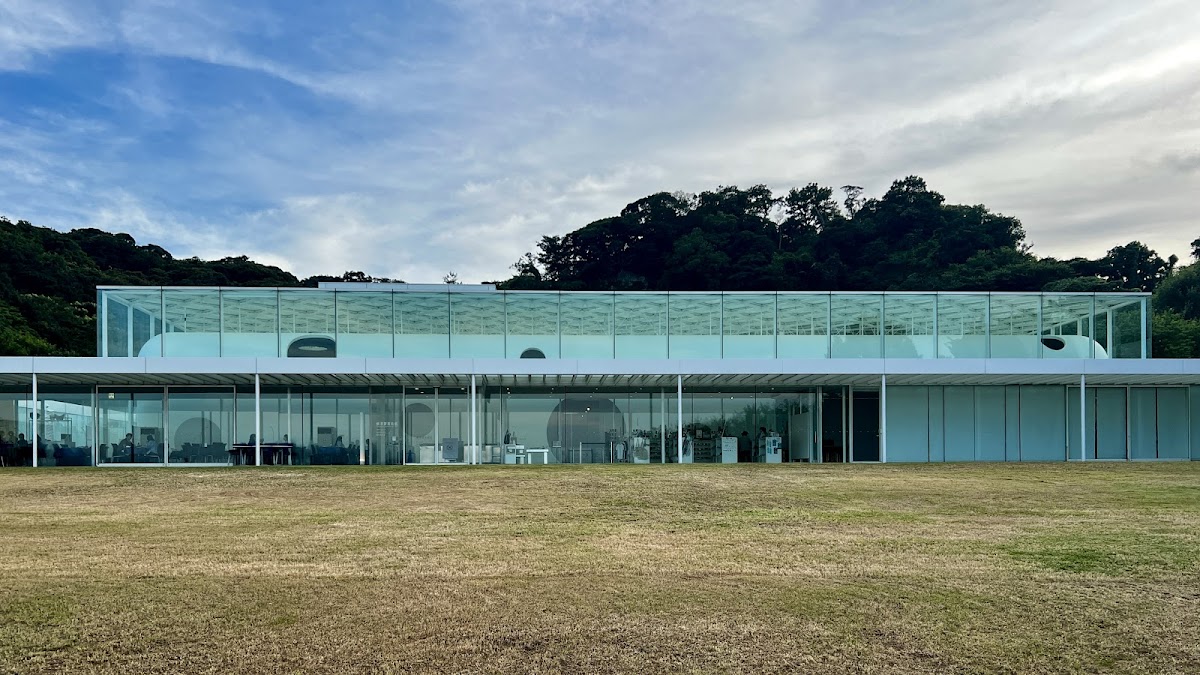
A White Museum Holding the Blue Horizon of Tokyo Bay
A White Museum Holding the Blue Horizon of Tokyo Bay
Yokosuka Museum of Art Between Tokyo Bay and Kannonzaki
Yokosuka Museum of Art occupies a narrow meeting point between Tokyo Bay and the wooded slopes of Kannonzaki Park. Opened on 28 April 2007 for the centenary of Yokosuka's municipalization, it offers the port city a cultural horizon beyond its familiar naval and industrial history. The sea becomes landscape, collection theme, public lawn, and a constant presence inside the building.
The museum is surrounded by nature on three sides and faces the water to the north. Visitors can move from the seaside lawn through the galleries, onto the roof, and toward paths leading to the lighthouse and former battery sites. Art, local history, and a coastal walk are treated as parts of one visit.
Riken Yamamoto and the Double-Skin Museum
Riken Yamamoto & Field Shop developed the design after a 2002 qualifications-based selection. To preserve the valley and bay landscape, much of the building was placed below ground. Its roof becomes an accessible viewing surface, while the long glass volume remains low against the horizon.
The exhibition and storage rooms sit inside a protected central box. A glass outer skin and an iron inner skin control the demanding light and climate of the seaside site. Circular openings of different sizes puncture the inner walls and ceilings, framing sky, trees, water, corridors, and other visitors without exposing sensitive art directly to the exterior.
A Collection Shaped by Yokosuka and the Sea
The city began collecting before the museum opened, and the holdings now include about five thousand works, mainly Japanese modern and contemporary painting and sculpture. Official acquisition priorities include artists connected to Yokosuka and the Miura Peninsula, works depicting the region, art concerned with the sea, and representative developments in Japanese modern and contemporary art.
These criteria allow a local collection to open outward. The same sea can appear as labour, military geography, leisure, memory, or abstract colour. Quarterly collection displays in the underground galleries and the Asai Kanemon Hall create changing routes through these subjects rather than fixing one permanent sequence.
Asai Kanemon and Rokuro Taniuchi
A major donation of works by painter Asai Kanemon in 1996 helped define the future museum. Presenting a body of work across time gives the city more than a list of notable names; it creates a sustained record of how an artist observed place, people, and a changing visual culture.
The separate Rokuro Taniuchi Pavilion holds more than 1,300 original covers made for the weekly magazine Shukan Shincho. Taniuchi produced the covers from 1956 until his death in 1981 and had a studio in Kamoi, Yokosuka. Streets, schools, snow, coastlines, and children's play turn ordinary memory into compact, dreamlike scenes.
The Lawn, Library, Roof, and Coastal Route
The seaside lawn, Umi no Hiroba, includes Isamu Wakabayashi's VALLEYS and supports events with the workshop room. The art library is free to enter without an exhibition ticket, while the restaurant and rooftop extend the stay toward the changing view of Tokyo Bay. These public facilities occupy the open edge of Yamamoto's nested plan.
A longer route can continue through Kannonzaki Park to the lighthouse and former coastal batteries. The transparent museum and the brick military remains present two very different responses to the same strategic landscape. Walking between them makes Yokosuka's natural beauty and historical weight visible together.
Temporary Closure Through 4 September 2026
The main building and the Rokuro Taniuchi Pavilion are currently closed for renovation through 4 September 2026, with reopening scheduled for 5 September. This temporary closure is more important than the standard weekly hours for anyone planning a current visit. Check the official calendar before travelling.
After reopening, ordinary hours are 10:00 to 18:00, with closure on the first Monday of each month and from 29 December to 3 January; additional exhibition-change closures may occur. Public transport usually involves a bus toward Kannonzaki from Maborikaigan or Yokosuka Station. Allow at least half a day for the museum and park.
A Museum That Keeps the Horizon in View
When the doors reopen, look beyond the building as an isolated architectural object. Notice how a painting, a circular opening, the moving sea, a reader in the library, and a small magazine cover remain visible within one broad field of experience. That relationship is the lasting achievement of Yokosuka Museum of Art.
Yamamoto's architecture protects the collection without cutting it off from daily life. The museum does not simply offer a beautiful view after the exhibition. Tokyo Bay, Kannonzaki, Japanese modern art, and the memories held in Taniuchi's covers continually reshape how each other is seen.
Visit Info
- Address: 4-1 Kamoi, Yokosuka, Kanagawa 239-0813, Japan
- Hours: 2026년 9월 4일까지 개보수로 장기 휴관, 9월 5일 재개관 예정. 평상시 10:00-18:00, 매월 첫 월요일·12월 29일-1월 3일 휴관
- Fee: 2026년 4월 이후 소장품전·다니우치 로쿠로관 일반 450엔, 고교·대학생 및 65세 이상 350엔. 기획전은 별도
- Transport: 게이큐 마보리카이간역 또는 JR 요코스카역에서 간논자키행 버스, 미술관 앞 정류장에서 도보 약 2분
- Time needed: 재개관 후 약 1시간 30분-2시간, 간논자키 공원과 등대까지 함께 보면 반나절
- Website: https://www.yokosuka-moa.jp/en/
Visitor Info
| Address | 4-1 Kamoi, Yokosuka, Kanagawa 239-0813, Japan |
| Hours | Translating |
| Admission | Translating |
| Getting There | Translating |
| Duration | Translating |
| Translating | https://www.yokosuka-moa.jp/en/ |