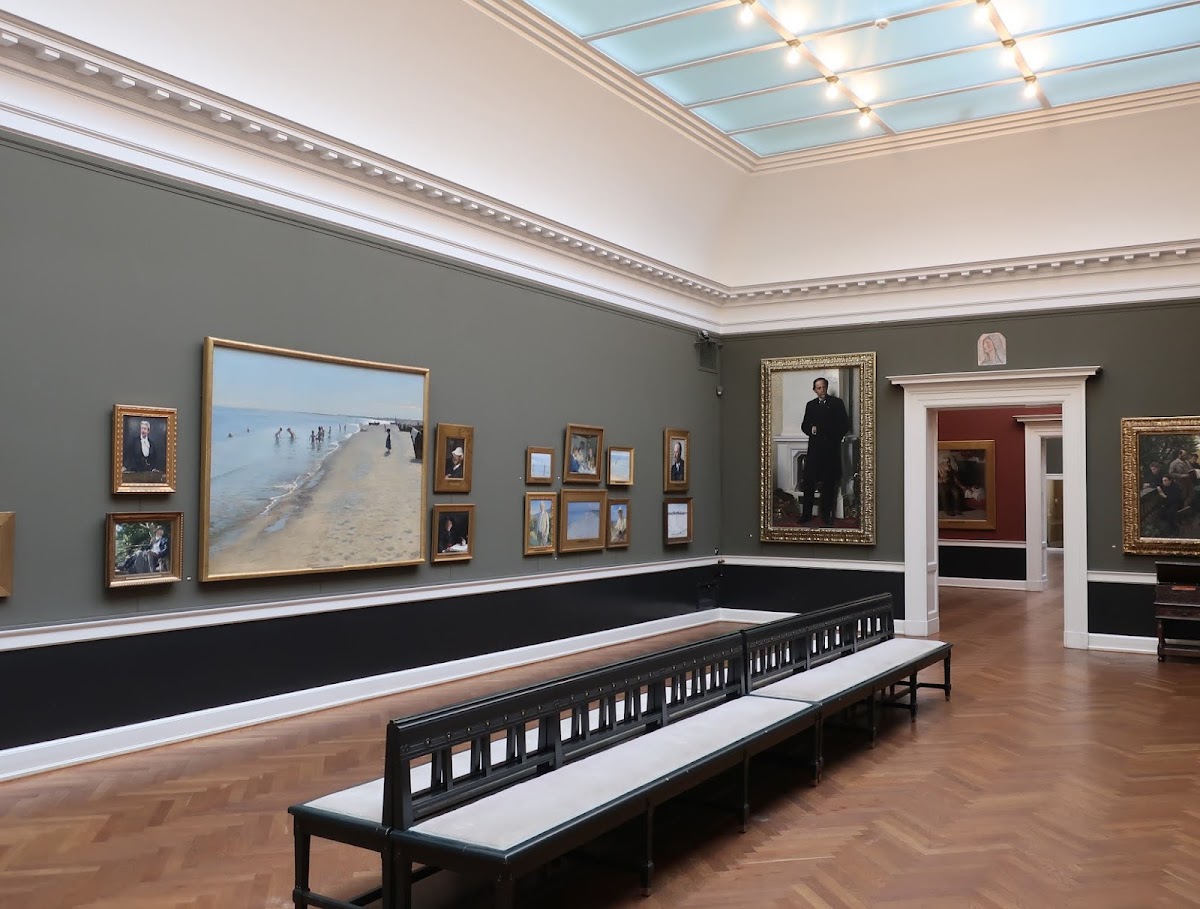
The Quiet Copenhagen House That Collected Denmark's Faces
The Quiet Copenhagen House That Collected Denmark's Faces
The Hirschsprung Collection in Copenhagen
The Hirschsprung Collection sits in Østre Anlæg, a park formed from Copenhagen's former fortifications. Unlike a monumental national museum, it opens into small rooms where paintings, drawings, furniture, and personal objects remain close to the viewer. The collection follows Danish art from the Golden Age through the Skagen Painters and into early modernism.
Its name comes from tobacco manufacturer Heinrich Hirschsprung and his wife Pauline. Their museum feels domestic because intimacy was a deliberate condition of the gift. Heinrich believed that small studies and delicate sketches needed their own house rather than absorption into a larger national collection.
Art, Tobacco, and a Public Gift
The family business grew from a tobacco shop opened in Copenhagen in 1826 into a modern cigar factory under Heinrich and his brother Bernhard. Industrial wealth enabled collecting, but relationships with artists shaped its character. P.S. Kroyer's 1881 portrait of the Hirschsprung family records friendship as well as patronage.
Heinrich publicly exhibited the collection at Charlottenborg in 1888. The catalogue contained 313 objects, including about 150 paintings and work by roughly sixty Danish artists. In 1902 Heinrich and Pauline announced the donation of their entire collection to the nation, asking for a separate building and independent management.
H.B. Storck's Small Temple to Art
Architect Hermann Baagoe Storck developed a clear plan around four large top-lit galleries surrounded by smaller side-lit rooms. The marble-clad exterior uses pediments and Doric-inspired pilasters, giving the building the appearance of a restrained classical temple. Construction began in 1908, the year Heinrich died, and the museum opened on 8 July 1911.
Joakim Skovgaard designed lobby decorations including a floor mosaic centred on a tobacco plant. The motif connects the family business to the institution without turning the museum into a corporate monument. The building was listed in 1995 for its architectural and cultural significance.
Emil Hannover's 1911 Chronological Hang
Art historian Emil Hannover, the first director, arranged the interiors and broke with a traditional salon hang organized by subject. He placed works chronologically so visitors could move from teacher to student and follow artistic change room by room. Furniture from artists' homes reinforced the scale and atmosphere of the collection.
That principle remains recognizable today. The museum is not frozen, but many relationships between works still follow the logic established in 1911. A historic display method becomes an active guide rather than background decoration.
The Danish Golden Age
C.W. Eckersberg and his pupils form the foundation of the Golden Age galleries. Christen Kobke and J.Th. Lundbye brought precise observation to Copenhagen streets, nearby landscapes, family, and ordinary life. Their often modest subjects show how national culture could be built from close attention rather than grand historical spectacle.
Small rooms suit these paintings. Viewers can approach the drawn structure, clear daylight, and careful surfaces without losing the relationship among teachers, colleagues, and younger artists. The collection makes a familiar art-historical label feel like a network of people.
Skagen Painters and Early Modernism
P.S. Kroyer, Anna Ancher, and Michael Ancher carried Danish art toward the northern fishing community of Skagen. Beach gatherings, fishermen, domestic labour, and summer evening light reveal different responses to one place. Anna Ancher's interiors turn sunlight and familiar rooms into bold arrangements of colour.
Later galleries include Theodor Philipsen, L.A. Ring, and Vilhelm Hammershoi. Impressionist colour, social reality, and silent grey interiors push the clear observation of the Golden Age toward modern uncertainty. In Hammershoi's work, a closed door or a figure seen from behind can hold attention through almost no visible event.
Planning a Quiet Copenhagen Visit
The museum is open Tuesday through Sunday from 10:00 to 17:00 and remains open until 20:00 on the last Thursday of each month. It is closed on Mondays. Østerport and Nørreport stations are both within walking distance, and the National Gallery of Denmark is nearby for a useful comparison in scale and collection.
Allow ninety minutes or more, especially for drawings and small studies. Then step back into Østre Anlæg. The transition from a 1911 collector's house to the contemporary park clarifies the museum's lasting strength: it lets a century of Danish art speak through faces, rooms, friendship, and changing light.
Visit Info
- Address: Stockholmsgade 20, 2100 København Ø, Denmark
- Hours: 화요일-일요일 10:00-17:00, 월요일 휴관. 매월 마지막 목요일 Hirschsprung LATE는 20:00까지
- Fee: 성인 110 덴마크크로네, 29세 미만과 동반 친구 1인 각 75크로네, 18세 미만 무료
- Transport: 외스테르포트역 또는 뇌레포트역에서 도보 약 10분, 외스트레 아늘레그 공원 안쪽
- Time needed: 약 1시간 30분-2시간, 덴마크 국립미술관과 함께 보면 반나절 이상
- Website: https://hirschsprung.dk/en/
Visitor Info
| Address | Stockholmsgade 20, 2100 København Ø, Denmark |
| Hours | Translating |
| Admission | Translating |
| Getting There | Translating |
| Duration | Translating |
| Translating | https://hirschsprung.dk/en/ |