When Art Entered the Old Swimming Pool of Roubaix
When Art Entered the Old Swimming Pool of Roubaix
La Piscine in Roubaix
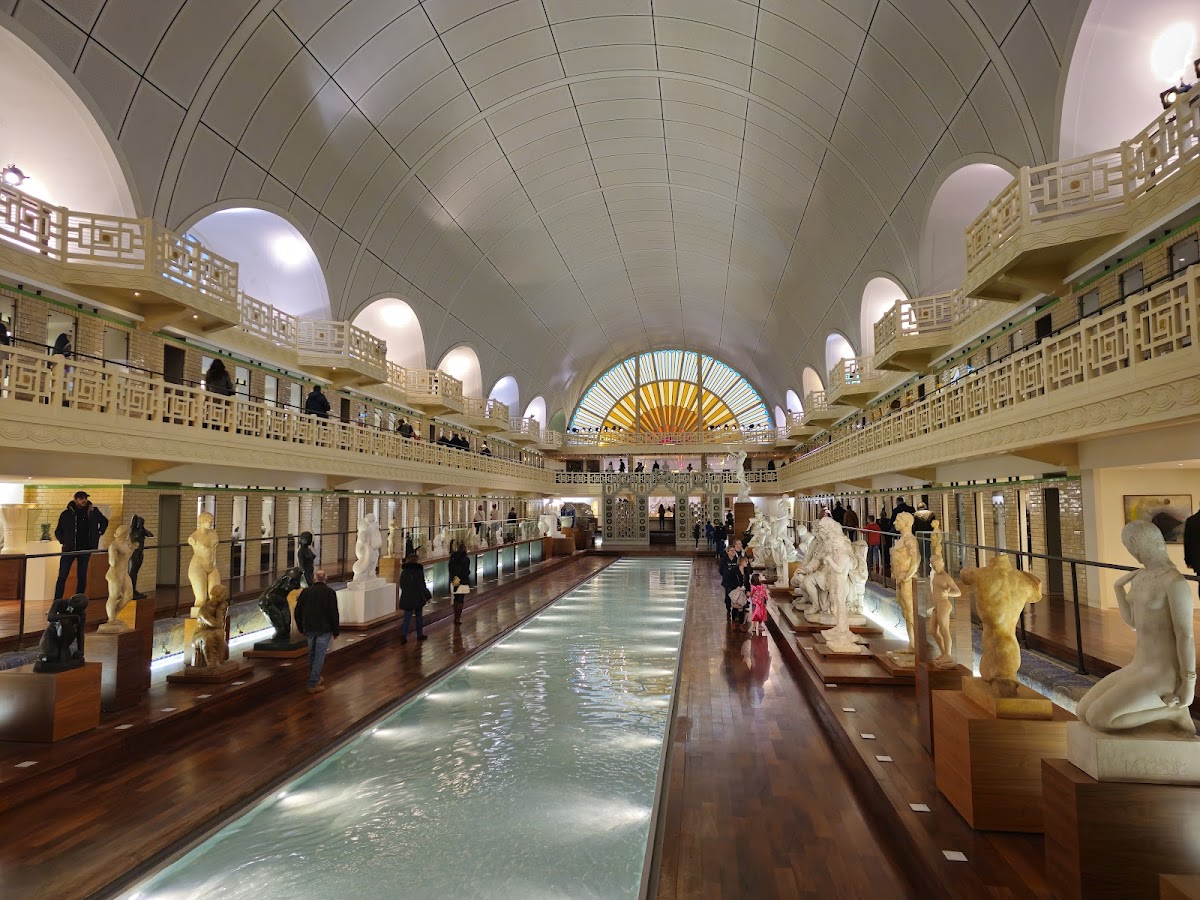
La Piscine, formally the Andre Diligent Museum of Art and Industry, opens with a long strip of water beneath an arched roof. Sculpture lines the former pool, changing cabins repeat along two levels, and sunburst stained-glass windows spread coloured light across the hall. The swimming stopped, but water, tile, sound, and civic memory remain active parts of the museum.
The combined name of art and industry matters in Roubaix. This was a major textile city, and the collection connects painting and sculpture with fabric, fashion, ceramics, glass, furniture, design, and manufacturing knowledge. The building is not a spectacular shell placed around unrelated objects; its history helps explain why these objects belong together.
From Industrial Museum to Civic Swimming Pool
Local manufacturers founded an industrial museum in 1835, opening it to the public in 1865. Samples and technical knowledge supported education in a city built on textile production. Design, chemistry, skilled labour, machinery, and market taste were already inseparable from what the museum preserved.
Roubaix began planning an ambitious public pool in 1922. Albert Baert's design was accepted in 1924, construction ran from 1927 to 1932, and the building opened on 2 October 1932. Its monastic plan placed the pool like a cloister court, while Art Deco rails, tiles, and stained glass turned hygiene, sport, and social life into a civic celebration.
Closure in 1985 and a New Museum Plan
The pool closed in 1985 because the vaulted roof faced a risk of collapse. In 1990 the city approved conversion into a museum. The challenge was not simply to preserve an attractive ruin. Art required stable galleries and conservation standards, while local memory depended on the open hall, pool, cabins, and familiar light.
A complete white-box insertion would have erased the place; untouched nostalgia would have prevented serious museum use. The eventual project separated and reconnected those demands, allowing historical architecture and contemporary exhibition functions to remain legible at the same time.
Jean-Paul Philippon Keeps the Water
Architect Jean-Paul Philippon began the main transformation in 1998, and La Piscine opened as a museum in 2001. He retained a shallow central basin and made it a sculpture garden. Reflections animate stone and bronze, while the sound of water softens the vast hall. Former changing cabins became intimate displays for decorative arts.
Philippon later designed the 2016-2018 expansion. New areas increased exhibition capacity without replacing the historic pool as the social centre of the museum. Visitors repeatedly return to the basin between more concentrated galleries, much as swimmers once gathered around it.
Camille Claudel and Sculpture by the Pool
Nineteenth- and twentieth-century sculptures stand along the water, gaining a second, unstable image in reflection. One of the museum's signature works is Camille Claudel's La Petite Chatelaine, acquired in 1996. The young subject's carefully modelled hair, tilted head, and alert expression hold their own even within the dramatic architecture.
Seeing Claudel only through her relationship with Auguste Rodin reduces the work. In front of the sculpture, asymmetry, surface, material, and psychological tension become primary. La Piscine gives a small bust enough proximity to challenge the scale of the hall around it.
Textiles, Fashion, and the Henri Bouchard Studio
Textile samples, clothing, ceramics, glass, and furniture record how Roubaix produced surfaces as well as goods. A finished dress contains decisions about fibre, weave, dye, pattern, machinery, and labour. The collection places artist, designer, factory, and worker inside one material history.
The expansion includes a reconstruction of sculptor Henri Bouchard's studio, crowded with plaster models, tools, studies, and works at different stages. It reveals sculpture as repeated physical labour. A gallery for the postwar Groupe de Roubaix extends the institution beyond the industrial nineteenth century and Art Deco pool into regional modern art.
Planning a Visit to La Piscine
Begin with the full pool hall, then make a slower circuit through sculpture, painting, decorative arts, textiles, and the studio. Return to the water at the end; the second view usually reveals objects missed in the first architectural impression. Two hours is a minimum, and a major temporary exhibition can easily extend the visit to half a day.
La Piscine opens Tuesday to Thursday from 11:00 to 18:00, Friday to 20:00, and weekends from 13:00 to 18:00. It is closed on Mondays and specified public holidays. The building proves that art did not merely replace an emptied pool. Water, public memory, industry, craft, and new exhibitions continue to reflect one another in the same civic room.
Visit Info
- Address: 23 Rue de l'Espérance, 59100 Roubaix, France
- Hours: 화요일-목요일 11:00-18:00, 금요일 11:00-20:00, 토요일·일요일 13:00-18:00. 월요일 및 지정 공휴일 휴관
- Fee: 기획전 기간 일반 11유로·할인 9유로, 기획전 외 일반 9유로·할인 7유로. 무료·통합권 조건은 공식 안내 확인
- Transport: 릴 플랑드르역에서 메트로 2호선 Gare Jean-Lebas역 하차 후 도보, 루베역에서도 도보 이동 가능
- Time needed: 약 2-3시간, 특별전과 섬유·조각 전시를 모두 보면 반나절
- Website: https://www.roubaix-lapiscine.com/
Visitor Info
| Address | 23 Rue de l'Espérance, 59100 Roubaix, France |
| Hours | Translating |
| Admission | Translating |
| Getting There | Translating |
| Duration | Translating |
| Translating | https://www.roubaix-lapiscine.com/ |