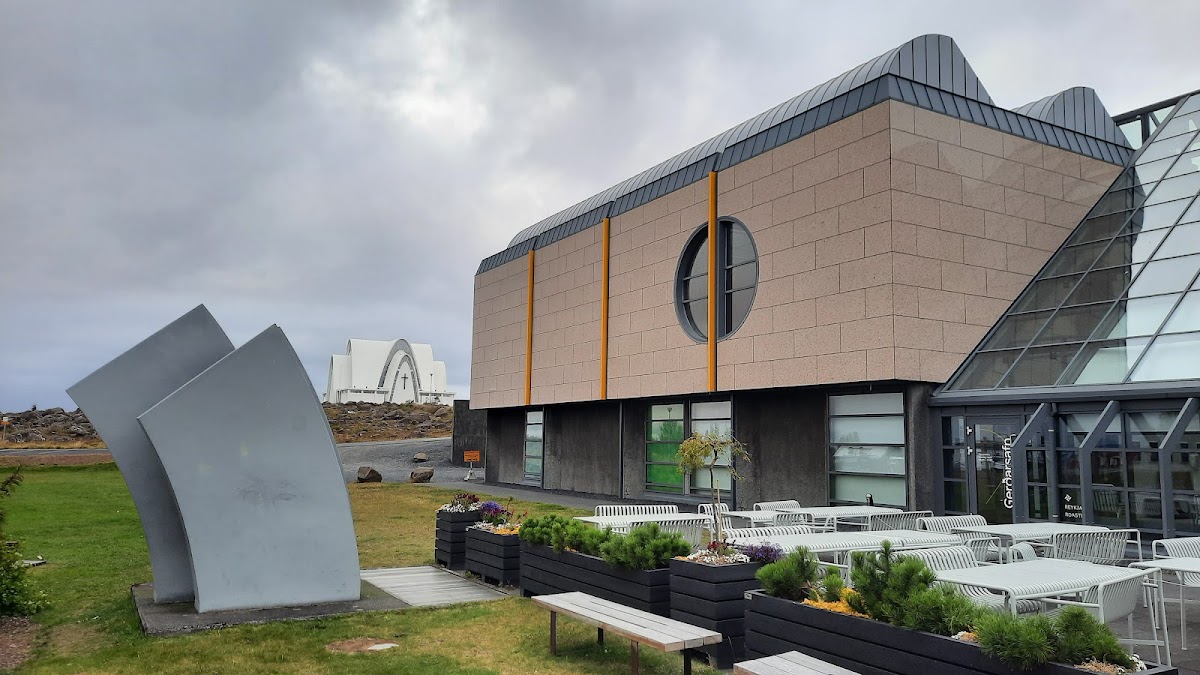
A White Museum in Kópavogur for Gerður's Iron and Glass
A White Museum in Kópavogur for Gerður's Iron and Glass
A Museum Named for an Icelandic Sculptor
Gerðarsafn Kópavogur Art Museum stands in the Hamraborg cultural district near Kópavogur's library, concert hall, and church. Its pale exterior, circular windows, and metal roof introduce the geometric relationships found throughout the work of Gerður Helgadóttir.
Opened in 1994, it is described as the only Icelandic museum built in honour of a female artist. The institution preserves Gerður's legacy while operating as a progressive museum of modern and contemporary Icelandic and international art.
A Gift of About 1,400 Works
Gerður died in 1975 at the age of forty-seven. In 1977 her relatives gave the town of Kópavogur about 1,400 works from her estate. The gift carried a condition: the town should construct a museum bearing her name, preserve the work, and make it available to the public.
Seventeen years passed between donation and opening. That time turned a family estate into a public responsibility supported by galleries, storage, research, and education. More than 1,400 works now allow viewers to follow sketches, models, material tests, and completed sculpture rather than a few isolated masterpieces.
From Florence to a Working Life in Paris
Born in 1928, Gerður studied at Iceland's School of Arts and Crafts and travelled to Florence in 1949, the first Icelandic artist to study there. She soon moved to Paris, where she lived and worked for most of her career. Classical sculptural training and postwar abstraction entered her practice through this movement.
Working as a young foreign woman in sculpture demanded space, materials, money, and professional persistence. Gerður nevertheless established an active career, and French critics considered her among the notable sculptors working in Paris. Her art cannot be reduced to either Icelandic identity or Parisian modernism; it developed through their contact with Italy, church commissions, and later travel to Egypt.
Geometric Iron and Lines in Space
During the 1950s Gerður became a pioneer of three-dimensional abstract art in Iceland through geometric iron sculpture. Plates, rods, circles, and straight lines organise both material and empty space. Light passes through openings, and the surrounding wall or landscape becomes active within the work.
She then made sculpture from extremely fine iron wire. Overlapping lines grow dark from one viewpoint and almost disappear from another, while shadows produce a second drawing on the wall. These works do not simply move a drawing off paper. They require the viewer's body and position to complete their changing structure.
Welded Bronze and the Impact of Egypt
A shift to welding bronze transformed Gerður's forms. Controlled geometry gave way to irregular, organic surfaces that can suggest bone, plant growth, or an unknown body. The accident of molten metal remained visible, yet her sustained concern with space and structure continued beneath the rougher skin.
After travelling to Egypt in 1966, references to ancient Egyptian art appeared in her work. Upright figures, simplified signs, and weathered surfaces brought a sense of long historical time into postwar sculpture. Parisian experiment and the memory of ancient objects met without becoming direct copies.
Stained Glass, Mosaic, and Public Space
Gerður considered herself primarily a sculptor, but she was also an important stained-glass artist. After encountering window art in Italy, she learned glass cutting at the Barillet workshop in Paris in 1955. Coloured panes and lead lines extended her research into architecture, where daylight continually rearranges the work.
Her windows can be found in Icelandic and German churches, including Skálholt Cathedral and Kópavogur Church. She also produced mosaics, notably the large 1973 work on Reykjavík's former Customs House. Glass and mosaic moved her art beyond the gallery into worship, streets, buildings, and changing weather.
From Memorial Museum to Contemporary Programme
Gerðarsafn presents Gerður's collection alongside temporary exhibitions by Icelandic and international contemporary artists. It also holds substantial collections by Barbara Árnason, Magnús Á. Árnason, Valgerður Briem, and others. A museum founded around one artist has become a place where generations and media can be placed in conversation.
The institution's origin continues to matter. Honouring a woman artist is not treated as a completed historical gesture but as a question for current programming, collecting, and visibility. Memorial and contemporary museum support one another when the inherited collection remains open to new interpretations.
How to Look at Gerður's Iron and Glass
Do not search for one correct front to the sculpture. Walk slowly around wire works, observe welding marks on bronze, and notice how stained glass responds to the day's weather. In rooms with circular windows, include architecture, your own shadow, and the city beyond in the view.
Continue outside to the sculpture park and, if time allows, walk to Kópavogur Church to see how stained glass behaves within worship and architecture. Gerður's legacy is strongest when objects, light, space, and the town are experienced together.
Visit Info
- Address: Hamraborg 4, 200 Kópavogur, Iceland
- Hours: 매일 12:00-18:00. 공휴일과 전시 교체 일정은 공식 사이트 확인
- Fee: 성인 1,200 ISK, 학생·고령자 600 ISK, 18세 미만 무료. 기타 무료 대상과 변동 사항은 공식 안내 확인
- Transport: 레이캬비크 도심에서 스트라이토 버스로 하므라보르그 정류장 하차, 코파보귀르 교회와 도서관 인근
- Time needed: 약 1시간 30분-2시간, 코파보귀르 문화지구와 교회까지 함께 보면 2-3시간
- Website: https://gerdarsafn.kopavogur.is/en/
Visitor Info
| Address | Hamraborg 4, 200 Kópavogur, Iceland |
| Hours | Translating |
| Admission | Translating |
| Getting There | Translating |
| Duration | Translating |
| Translating | https://gerdarsafn.kopavogur.is/en/ |