By the River Nissan, Halland Collects a Region's Ways of Seeing
By the River Nissan, Halland Collects a Region's Ways of Seeing
A Museum Between the River Nissan and Norre Katts Park
Hallands Konstmuseum stands beside the River Nissan in central Halmstad, where a brick museum meets a park and riverside path. The building was completed in September 1933 with funding from a national lottery. Its lit windows still make the museum feel like part of an everyday route through the city.
After institutional and administrative changes, responsibilities were divided around 2010 and 2011 between the art museum in Halmstad and Halland's cultural history museum in Varberg. A major renovation and extension completed in 2019 gave the art collection new galleries, public spaces, and conservation facilities.
A Collection with Roots in 1865
The collection began with the Halland Antiquarian Society, founded in 1865. Its materials passed in 1887 to the new Halland Museum Society, which gradually added documents, books, and art to objects of regional cultural history. This origin explains the museum's continuing breadth.
Painting and sculpture sit beside photography, craft, architecture, archives, and older historical material. Definitions of what deserves museum care have expanded over time. Institutional history is therefore not one opening date but a series of transfers through which responsibility for regional memory was maintained.
Nearly 5,000 Entries and a Broad Idea of Halland
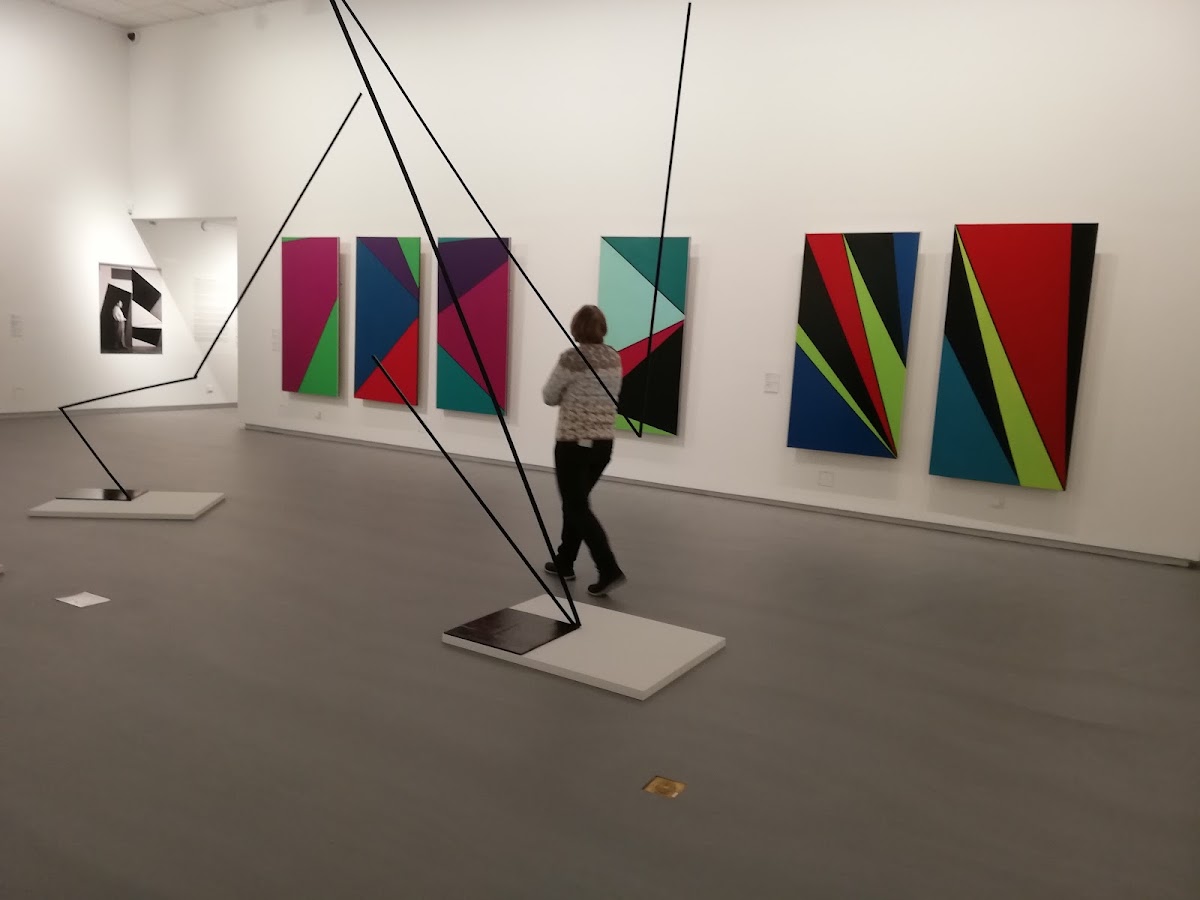
The art collection contains nearly 5,000 registered entries, some representing multiple works. It includes the Halmstad Group, Thea Ekström, Olle Bærtling, Lotta Antonsson, Nina Bondeson, Tarik Kiswanson, and artists connected to the Varberg School and the Hanhals and Söndrum colonies.
Regional art does not mean one local style. Surrealism, geometric abstraction, socially engaged graphic art, experimental photography, textile practice, and contemporary installation all appear. Halland is defined through movement and working relationships as much as birthplace or subject matter.
The Halmstad Group and West-Coast Surrealism
The Halmstad Group was formed in 1929 by six painters: Erik Olson, Axel Olson, Esaias Thorén, Waldemar Lorentzon, Stellan Mörner, and Sven Jonson. They became central to Swedish Surrealism, connecting new European art with the light, coast, architecture, and personal memories of Halland.
Their paintings combine shorelines, long shadows, mechanical forms, classical fragments, and dreamlike figures. Viewed together, shared motifs reveal individual differences. One artist turns the coast into hard geometry while another creates psychological unease. A regional group becomes visible as a relationship rather than a uniform style.
Torsten Billman and the Value of Process
Torsten Billman is represented by finished works, numerous sketchbooks, illustrations, and his personal library. His graphic art gives weight to sailors, labour, and people at society's margins through concentrated black lines and open white areas.
Sketchbooks and books reveal how observed faces, reading, politics, and publishing entered completed images. The museum also collects illustration, architectural drawing, and garden design, fields once treated as secondary to fine art. Process and working context are preserved alongside final objects.
Lennart Olson and Abstract Photography
Photographer Lennart Olson encountered abstract art in 1950s Paris and developed a distinctive abstract approach to bridges, cables, shadows, and engineered structures. In 1958 he co-founded the Tio fotografer agency with nine other Swedish photographers.
The museum's extensive Olson holdings include negatives, prints, mounted photographs, films, documents, and his library. They support research into shooting, selection, and printing rather than reducing the artist to a few famous images. Glass-plate negatives by Severin Nilson and contemporary work by Gerry Johansson and Lotta Antonsson widen the collection's account of photography.
Painted Hangings, Weaving, and Experimental Knitting
Craft holdings include one of Sweden's largest collections of southern Swedish painted wall hangings, as well as weaving, embroidery, folk costume, Märta Måås-Fjetterström, Sylvia Stave, and Britt-Marie Christoffersson's experimental knitting samples.
Domestic textiles carried warmth, decoration, stories, and highly developed material knowledge, yet were often undervalued because of genre and gender. Collecting unfinished samples as well as completed objects recognises experimentation itself. The approach echoes the preservation of an artist's sketchbook.
The 2019 Building and a Collection Still Growing
When the renewed museum opened in 2019, commissioned artistic interventions entered corridors, stairs, and shared spaces as well as galleries. The old brick building and new elements remain visibly distinct, much like historical collections and contemporary acquisition within one institution.
Svea Larson's bequest provides roughly two million Swedish kronor annually for acquiring Halland-based art and craft. A private estate became a continuing public structure rather than a single gift. New work can enter the collection each year, keeping the region's art history open to living artists and changing media.
How to Visit Hallands Konstmuseum
Choose three different media in the collection display, perhaps a Halmstad Group painting, an Olson photograph, and a textile. Comparing line, repetition, place, and material across them is more revealing than searching for one regional identity. Much of the collection remains in storage, with selections also available through Digitalt Museum.
After the galleries, use the restaurant's panoramic windows or walk through Norre Katts Park along the River Nissan. Hallands Konstmuseum does not offer one definitive image of Halland. It gathers the many ways painters, photographers, craftspeople, and architects have learned to see the region.
Visit Info
- Address: Tollsgatan 2, 302 32 Halmstad, Sweden
- Hours: 화요일·목요일-일요일 11:00-17:00, 수요일 11:00-20:00, 월요일 휴관. 일부 공휴일 휴관
- Fee: 성인 95 SEK, 학생·연금 수급자 70 SEK, 20세 미만 무료. 주말 일반 해설은 통상 입장료 포함
- Transport: 할름스타드 중앙역에서 도보 약 15-20분. 노레 포르트 정류장에서 공원을 지나 약 400m, 카스타녜알렌 정류장에서 약 300m
- Time needed: 약 1시간 30분-2시간, 닛산강과 노레 카츠 공원 산책을 포함하면 2-3시간
- Website: https://hallandskonstmuseum.se/en/
Visitor Info
| Address | Tollsgatan 2, 302 32 Halmstad, Sweden |
| Hours | Translating |
| Admission | Translating |
| Getting There | Translating |
| Duration | Translating |
| Translating | https://hallandskonstmuseum.se/en/ |