Three Rooms in Nagi Where Art and Architecture Share a Body
Three Rooms in Nagi Where Art and Architecture Share a Body
Red Volumes, a Cylinder, and a Mountain
Nagi MOCA appears as a group of sharply distinct forms in rural Okayama: a red volume, a horizontal cylinder, low dark walls, concrete, water, and Mount Nagi beyond. The museum was not designed as neutral rooms into which art would later be placed. Its three permanent works determined the architecture, and the architecture in turn makes those works possible.
The rooms are called Sun, Moon, and Earth. They were developed for Shusaku Arakawa and Madeline Gins, Kazuo Okazaki, and Aiko Miyawaki. Each is inseparable from its light, orientation, floor, wall, and view. Before entering, note the distances between the structures and the mountain behind them; the exhibition has already begun outside.
Building the Work in 1994
Designed by Arata Isozaki, the museum opened on 25 April 1994. The artists were asked to conceive large works that conventional galleries could not hold, and each space was developed through dialogue between artist and architect. Isozaki compared the artwork to a sacred image and architecture to its shelter, though the completed building makes the two impossible to separate.
This reversed a familiar museum sequence. Instead of completing flexible galleries and then scheduling exhibitions, Nagi created spaces that could exist nowhere else. A small municipality entered an international discussion on contemporary art not by copying a metropolitan museum, but by treating its own mountain, sky, and orientation as irreplaceable materials.
Sun and the Architectural Body
The Sun room contains Arakawa and Gins’s Ubiquitous Site / Nagi’s Ryoanji / Architectural Body. Inside the red cylindrical volume, maze patterns on floor and ceiling appear reversed. A thick black cylinder leans through the centre while both horizontal surfaces rise and tilt, disturbing the stable relationship between feet, eyes, and gravity.
Elements referring to the rock garden at Ryoanji are repeated above and below. The visitor cannot remain a detached observer; every step requires bodily correction. Colour and geometry are striking in photographs, but balance is the real medium. Moving slowly reveals how a body continually constructs its own sense of space rather than simply receiving architecture.
Moon as Shelter and Pause
Kazuo Okazaki’s HISASHI — A Supplement occupies the long half-cylindrical Moon room. Hisashi means an eave, a modest structure under which people and other living beings can pause out of rain or strong sun. After the instability of Sun, this room makes hesitation, protection, absence, and rest part of looking.
Okazaki explored how an object is completed by what seems to be missing around it. Here, gaps, wall, light, memory, and the visitor’s presence supplement the objects. The flat outer wall points towards the position of the mid-autumn moon at about ten at night. Even during a daytime visit, that orientation connects the enclosed room to celestial time.
Earth and a Moment of Movement
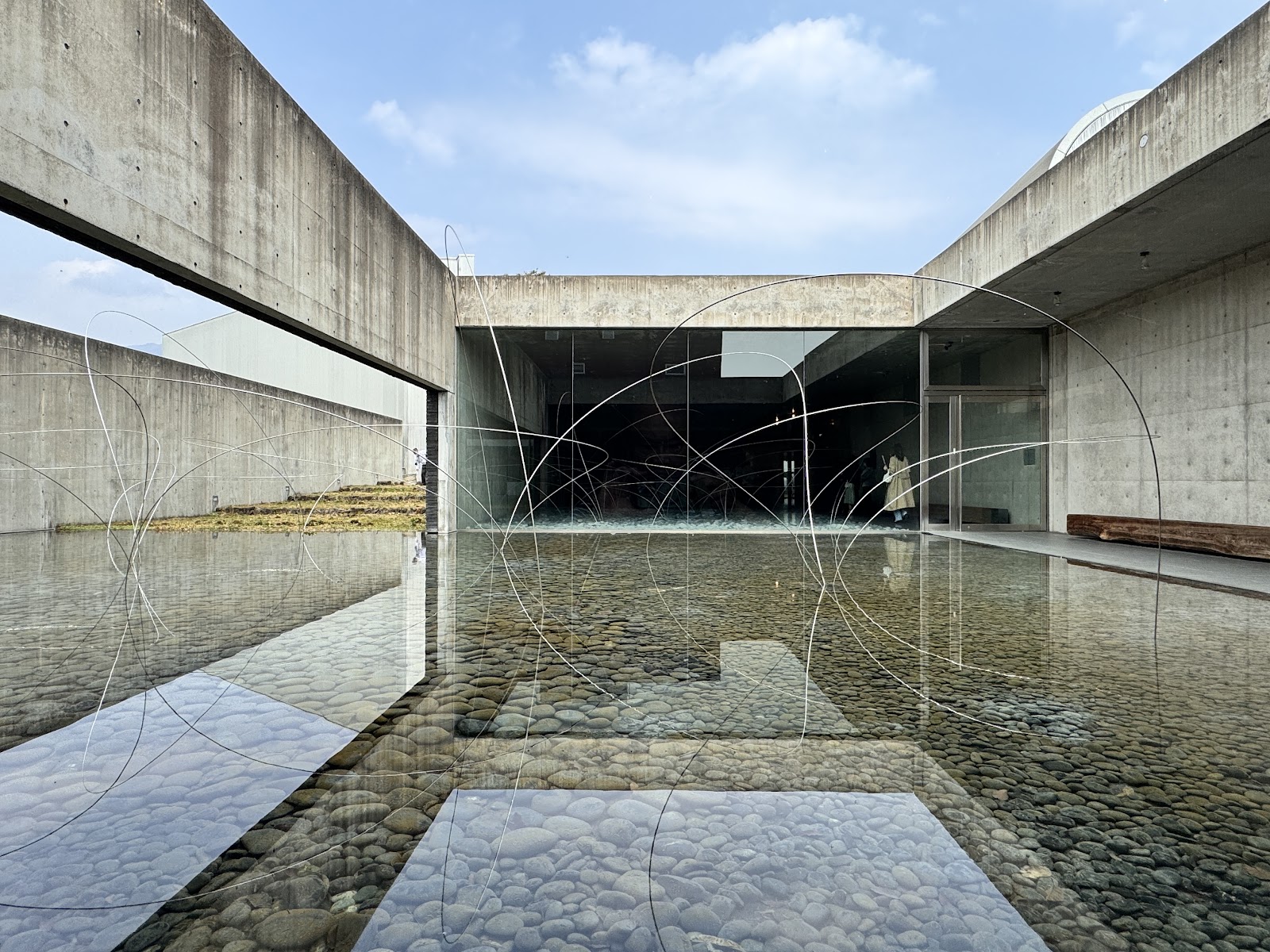
Aiko Miyawaki’s Utsurohi — A Moment of Movement extends across shallow water in the Earth room. Fine metal lines arc through the air, with small elements suspended like points in a drawing. Reflections double and break the lines, while wind, clouds, and changing light alter their density. Solid sculpture behaves like a temporary trace.
The principal axis of Earth points directly to the summit of Mount Nagi. From the café, Earth, Moon, Sun, and the mountain can be seen together, a composition Isozaki related to folding screens of sun, moon, mountain, and water. The landscape is not scenery placed behind art; it is the coordinate that holds the three rooms together.
Three Site-Specific Axes
Sun follows the north–south axis, Moon addresses a particular lunar direction, and Earth reaches towards the mountain. The rooms do not line up as a conventional enfilade. Each receives a different coordinate from the sky and land, turning the complex into an instrument for observing place.
Site-specific therefore means more than being too large to move. Relocation would change the mountain axis, lunar orientation, reflections, and seasonal light that activate the work. The location is a working material, while architecture keeps that relationship legible over time. A second visit in another season can produce a substantially different reading.
A Museum Beside a Library
Nagi MOCA shares its entrance complex with the town library, galleries, and a café. Residents borrowing books and travellers arriving for contemporary art cross the same threshold. The southern gallery presents changing exhibitions, including artists from the region, while the three permanent rooms retain their long duration.
The café is more than an amenity. Its window gathers the water, three structures, and Mount Nagi into one view, allowing the visitor to reassemble spaces experienced separately. The relationship between a globally ambitious art project and an everyday civic facility is central to the museum’s public character.
Allow Time for the Body
To experience the museum is not simply to pass through spectacular interiors. Sun asks for balance, Moon for pause, and Earth for waiting. Enter each room before reading every explanation, then notice pressure underfoot, changes in vision, discomfort, silence, and the movement of air. Those observations give the artists’ concepts physical meaning.
Current notices indicate renovation work planned around autumn 2026, with details to be announced. Opening days, transport, and temporary closures should be checked shortly before travel. Buses from the Tsuyama area can involve long waits, so leave room for the library, café, and landscape. At Nagi, slow arrival is not separate from the art: it prepares the body to become part of the museum’s map.
Visit Info
- Address: 441 Toyosawa, Nagi, Katsuta District, Okayama 708-1323, Japan
- Hours: 9:30-17:00, 입장 마감 16:30. 월요일(공휴일이면 개관), 공휴일 다음 날 휴관. 2026년 가을 개보수 예정이므로 공식 공지 확인
- Fee: 일반·대학생 상설전 700엔. 기획전만 관람할 때와 무료 대상은 전시별 공식 안내 확인
- Transport: JR 쓰야마역에서 나기 버스센터 방면 버스 이용 후 나기 테라스 정류장 일대 하차, 노선과 환승 시간은 출발 전 확인. 자동차로 주고쿠자동차도 쓰야마IC에서 약 20분
- Time needed: 약 1시간 30분-2시간, 도서관과 카페·주변 산책을 더하면 2시간 30분
- Website: https://www.town.nagi.okayama.jp/moca/
Visitor Info
| Address | 441 Toyosawa, Nagi, Katsuta District, Okayama 708-1323, Japan |
| Hours | Translating |
| Admission | Translating |
| Getting There | Translating |
| Duration | Translating |
| Translating | https://www.town.nagi.okayama.jp/moca/ |