Red Brick in Daehakro, Where Korean Contemporary Art Meets the Public
Red Brick in Daehakro, Where Korean Contemporary Art Meets the Public
A Museum Opening onto Marronnier Park
ARKO Art Center sits low among trees, theatres, streets, and gathering places in Daehakro. Its red-brick walls, steps, passages, and changing levels do not isolate art from the neighbourhood. People waiting for a performance, crossing the park, or meeting friends share the same forecourt as exhibition visitors.
The institution’s history records how Korean contemporary art acquired exhibition space and how a public venue expanded from lending rooms to curating, research, archives, and exchange. Before entering, walk around the exterior. ARKO Arts Theater, the park, and surrounding alleys show that the museum’s public role begins with its urban position.
Misulhoegwan Begins in 1974
The institution opened in 1974 as Misulhoegwan in the former Deoksu Hospital building in Gwanhun-dong. Korea then had far fewer museums and commercial galleries, and artists and art organisations urgently needed places to show work. Providing shared exhibition rooms was therefore not a minor preliminary function; it was essential cultural infrastructure.
A work cannot enter public memory if there is nowhere to encounter it. Rental-based programming gave different groups and generations a visible schedule, while raising questions that remain current: who receives space, how public support differs from the commercial market, and what obligations follow when an institution distributes a scarce resource.
Kim Swoo-geun’s Building in 1979
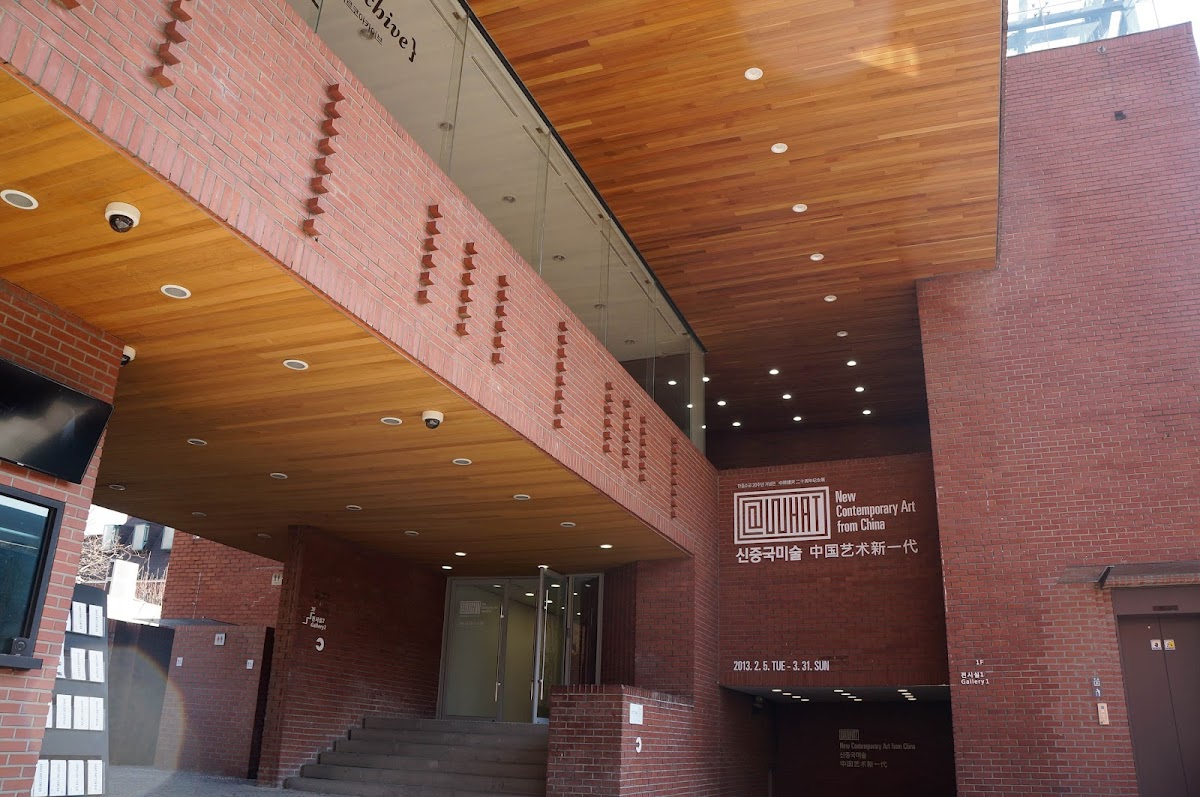
Misulhoegwan moved to its present building in May 1979. Marronnier Park occupies the former site of Seoul National University, and the arrival of an art centre and theatre helped turn the area into a cultural district. Architect Kim Swoo-geun designed both neighbouring red-brick buildings, which became defining landmarks of Daehakro.
The museum is composed through smaller masses, recesses, stairs, and passages rather than one monumental front. Repeated brick brings the scale down to the pedestrian, while shadow changes across deep surfaces through the day. Moving around corners and between low and high spaces reveals more than a single façade photograph can show.
From Venue to Curatorial Institution
As public and private museums and commercial galleries increased from the late 1980s, the institution reduced rentals and developed more of its own exhibitions. It became Marronnier Art Center in 2002 and adopted the name ARKO Art Center in 2005, after the Korea Culture and Arts Foundation became Arts Council Korea.
The change expanded responsibility from allocating walls to researching themes, commissioning artists, interpreting work, and preserving what remained after an exhibition. Curating is not merely gathering prominent names. It decides which questions deserve public attention and how uncertain, emerging practices can be placed in a context without prematurely fixing their meaning.
Research, Inclusion, and Sharing
Since 2021 ARKO has articulated usefulness, inclusivity, collaboration, and sharing as key strategies. The museum presents itself as a platform where research, production, exhibitions, and exchange circulate. Socially engaged exhibitions, public programmes, archives, and support for creative research are meant to reinforce one another rather than remain isolated outputs.
Usefulness does not require art to provide immediate solutions. Making an unnamed experience visible or allowing several positions to confront one issue can be a public use. Inclusion asks who has repeatedly been absent, while collaboration acknowledges that artists, curators, researchers, educators, and audiences hold different forms of knowledge.
Archives After the Walls Come Down
When an exhibition closes, walls are removed, works leave, and lighting disappears. Publications, installation photographs, artist files, and the ARKO archive allow those temporary arrangements to become research material. The records show not only what was displayed but also how Korean contemporary art was described, translated, supported, and debated.
An archive can reveal repeated invitations and significant absences, shifts in terminology, and the influence of public funding on production. Looking at an earlier exhibition before a visit also changes the building: the same rooms can be imagined as sites for painting, installation, moving image, performance, lectures, and disagreement across decades.
A Link to Insa Art Space
ARKO also operates Insa Art Space, which opened in 2000 as an alternative public institution supporting emerging artists and curators. Research, criticism, portfolios, and early experiments are as important there as finished exhibitions. Together, the two venues show why different stages of practice require different kinds of time and support.
Arts Council Korea took on operation of the Korean Pavilion at the Venice Biennale in 2024, connecting local research and international exchange within a wider structure. This does not make every Daehakro exhibition a rehearsal for an overseas stage. It underscores the need for long-term movement of knowledge and people between local practices and international conversations.
Half a Century of Making Room
Current admission is free, allowing visitors to return between appointments or take a chance on an unfamiliar subject. Inside, look at a work closely, step back to understand the curatorial arrangement, and finally carry its questions into the park. Those three distances connect material, exhibition, and city.
From providing scarce rooms in 1974 to supporting research and archives today, ARKO Art Center has repeatedly changed how it makes room for art. The brick building endures, but publicness is never completed by architecture alone. It must be renewed through access, interpretation, institutional responsibility, and the everyday sharing of a forecourt with the people of Seoul.
Visit Info
- Address: 서울특별시 종로구 동숭길 3 아르코미술관
- Hours: 화-일요일 11:00-19:00, 입장 마감 18:30. 수요일 11:00-21:00, 입장 마감 20:30. 월요일과 지정 휴관일은 공식 공지 확인
- Fee: 무료
- Transport: 서울 지하철 4호선 혜화역 2번 출구에서 마로니에공원 방향 도보 약 3분
- Time needed: 약 1시간-1시간 30분, 아르코예술극장과 대학로 건축 산책을 더하면 2시간 30분
- Website: https://www.arko.or.kr/artcenter/
Visitor Info
| Address | Translating |
| Hours | Translating |
| Admission | Free |
| Getting There | Translating |
| Duration | Translating |
| Translating | https://www.arko.or.kr/artcenter/ |