Lund’s Museum of Sketches Collects the Hesitation Before Completion
Lund’s Museum of Sketches Collects the Hesitation Before Completion
Before the Finished Work
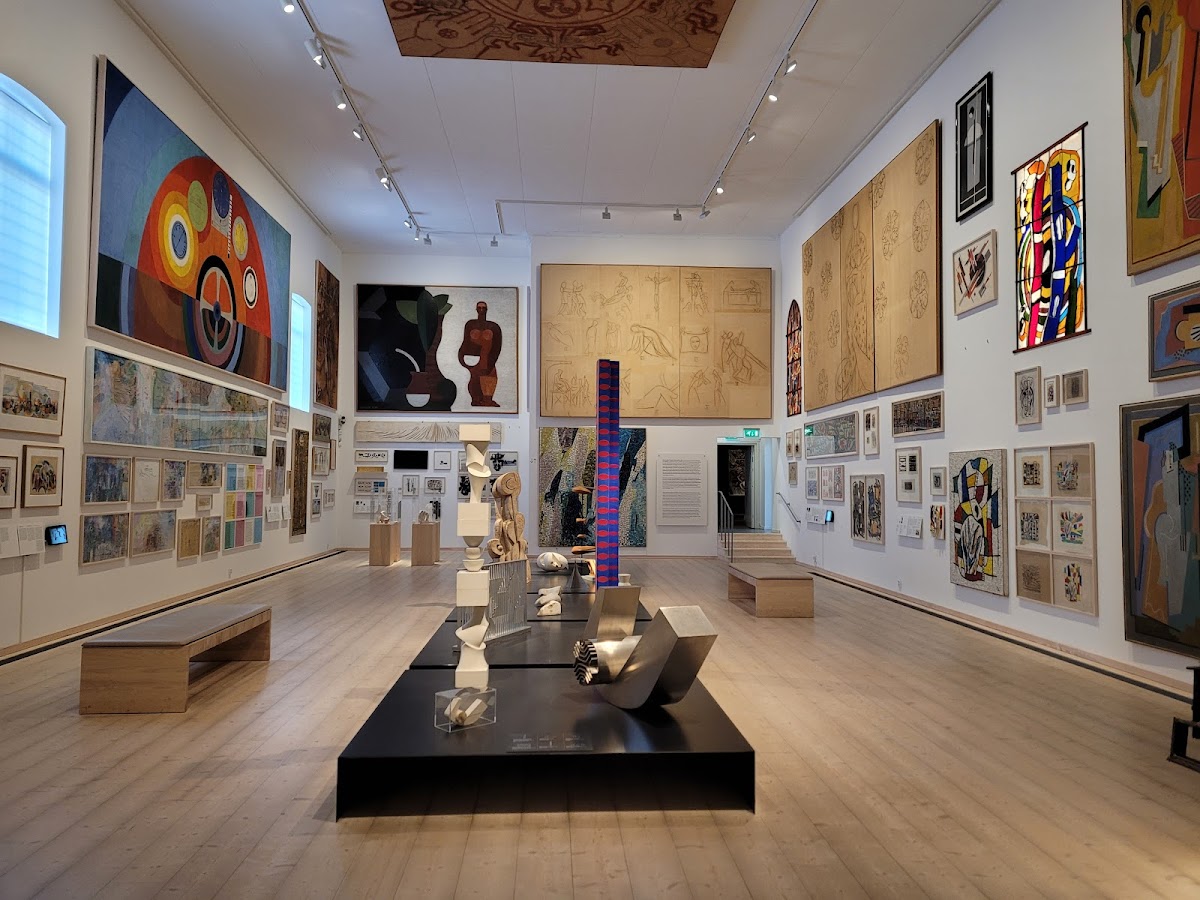
Walls at Skissernas Museum are dense with pencil lines, colour studies, photographs, letters, models, large paintings, and plaster forms. The display resembles a working studio more than a sequence of isolated masterpieces. Its subject is not only what an artist completed, but the decisions, reversals, and discarded possibilities that came first.
The full name is Skissernas Museum — Museum of Artistic Process and Public Art. A sketch here can be a quick drawing, a copper-wire model only centimetres high, a five-metre plaster sculpture, a mural study, or documentation of architecture and site. Different degrees of completion are treated as evidence rather than ranked by polish.
Ragnar Josephson’s Archive
Ragnar Josephson founded the collection in 1934 while professor of art history at Lund University. He wanted to study what he called the birth of a work of art: how a first idea changes through drawings and models, and what an artist accepts or abandons before arriving at a final form.
Public art was especially useful because work for stations, schools, civic buildings, and squares often requires many studies and negotiations. The first materials included postcards and photographs gathered through student surveys of decorative art. Josephson’s Archive of Decorative Art gave preliminary work, then considered of little value, a new purpose in research and teaching.
Nineteen Sketches Become Thirty Thousand
Prince Eugen, himself an artist, made the first donation to the Swedish collection: nineteen sketches. His support encouraged other artists to donate or sell studies at modest prices. From that small beginning, the collection has grown to around 30,000 works by Swedish and international artists from the early twentieth century to today.
Acquisition is only the beginning. The museum must establish provenance, connect a sketch to its commission and finished site, conserve many fragile materials, and make the records searchable. A single drawing gains meaning when it can be read beside project descriptions, correspondence, photographs, and the later work in public space.
Opening to the Public in 1941
As the archive outgrew the art history department, Lund University provided parts of a former women teachers’ college. The collection opened to the public in 1941 and became Arkivmuseet, the Archive Museum. Material formerly handled in drawers could now be compared across large walls by students and citizens alike.
Visible revisions challenge the myth of effortless genius. Erased lines and rejected models do not weaken the finished work; they reveal the quality of judgement required to make it. The institution became Konstmuseet in 1984, Skissernas Museum in 1991, and added its present subtitle in 2013, clarifying a focus that remains unusual internationally.
Reading a Public Artwork Backwards
The collection ranges from scribbled paper and tiny wire constructions to monumental plaster works and occasionally completed pieces. Displays include projects by artists such as Henry Moore and Christo and Jeanne-Claude alongside Swedish and international figures. Search for several stages of one project rather than collecting famous names.
Public commissions absorb constraints beyond the studio. Materials may change with budgets, height with safety rules, and location after architectural revisions or public debate. A change can compromise an idea or solve it more precisely. By preserving alternatives, the museum lets viewers reconstruct those negotiations without pretending the path was straight.
Six Eras of Architecture
The museum joins buildings from six periods: an 1882 gymnasium, a 1921 college building by Carl Andrén, barracks connected by Hans Westman in 1949, and his high Swedish Gallery of 1959 with its viewing bridge. In 1988 Karl Koistinen and Göran Hellborg collaborated with artist Sivert Lindblom on galleries, a library, studio, and expressive façade.
Johan Celsing’s 2001–05 renovation added storage, workshops, and a temporary gallery while joining older parts. Elding Oscarson completed the latest entrance, shop, restaurant, and covered Birgit Rausing Hall in 2016. Its weathering-steel exterior refers to nearby brick without imitating it and received the Kasper Salin Prize in 2017.
A Building That Shows Its Revisions
Moving through changes in ceiling, concrete, plaster, window, and circulation is like reading an architectural sketchbook at full scale. No single expansion erases every earlier solution. That accumulated structure suits a museum which refuses to regard preliminary stages as inferior versions of a final answer.
The crowded hanging of the Swedish and International Galleries also continues Josephson’s early installation and the productive disorder of an artist’s studio. At first the density can overwhelm. Use the viewing bridge, shift between close detail and the whole wall, and trace recurring problems across artists rather than trying to inspect every object equally.
Preserving Hesitation
The museum also holds extensive correspondence and an image and clipping archive of about 150,000 items on public art from the 1930s onwards. A major collection move limits physical research access and loans from late 2025 through 2027, although the museum remains open and much digitised material can be explored online.
After a visit, public sculpture elsewhere in the city no longer appears to have arrived fully formed. One can ask what was requested, resisted, revised, or lost. Skissernas Museum preserves hesitation as professional knowledge. A strong work is not one that never wavered, but one that found its form through sustained testing.
Visit Info
- Address: Finngatan 2, 223 62 Lund, Sweden
- Hours: 화-수·금 11:00-17:00, 목요일은 계절별 17:00 또는 19:00까지, 토-일 12:00-17:00, 월요일 휴관. 공휴일·여름 운영은 공식 안내 확인
- Fee: 성인 100 SEK, 연금 수급자 75 SEK, 학생·25세 미만 무료. 목요일 무료 시간은 계절별 공식 안내 확인
- Transport: 룬드 중앙역에서 도보 약 10-15분. 1번 버스 비스콥스후세트 또는 쇨베가탄 정류장 이용 가능
- Time needed: 약 2시간-2시간 30분, 건축과 조각공원·기획전을 자세히 보면 3시간
- Website: https://skissernasmuseum.se/en/
Visitor Info
| Address | Finngatan 2, 223 62 Lund, Sweden |
| Hours | Translating |
| Admission | Translating |
| Getting There | Translating |
| Duration | Translating |
| Translating | https://skissernasmuseum.se/en/ |