A Stone-Tower Studio in Espoo Where Gallen-Kallela Painted Myth
A Stone-Tower Studio in Espoo Where Gallen-Kallela Painted Myth
A White Tower West of Helsinki
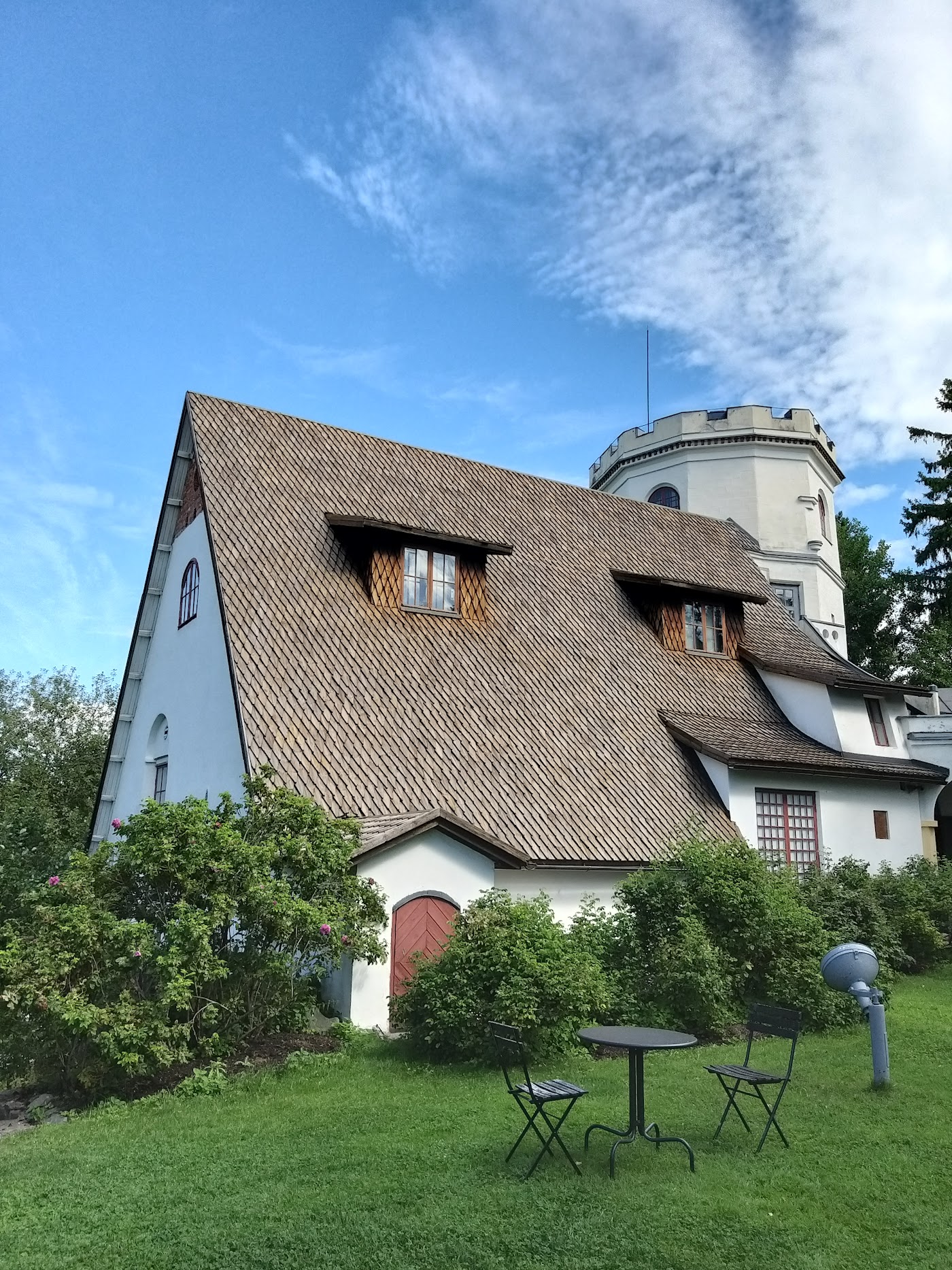
Near Laajalahti Bay in Espoo, steep roofs and a white tower appear among trees. Tarvaspää, home of the Gallen-Kallela Museum, was built as an artist’s studio before it became an exhibition building. Its asymmetry, changing windows, stairs, and tower combine the atmosphere of a small castle with the practical needs of work.
Akseli Gallen-Kallela is widely known for images drawn from the Finnish national epic, the Kalevala. The museum broadens that identity through architecture, paintings, graphic art, furniture, textiles, stained glass, family possessions, photographs, archives, and books. It presents the environment in which an artist worked rather than reducing a life to several famous canvases.
Imagining a Studio in 1907
In 1907 the Gallen-Kallela family moved to the old main building of Alberga Manor, owned by the family of Akseli’s wife Mary. Around this time he began sketching a future workspace at Tarvaspää, developing an early idea called the house of wind with architect Eliel Saarinen.
The project responded to a practice that crossed large painting, printmaking, furniture, textiles, and glass. It required high light, broad walls, storage, places for study, and a relationship between work and family life. Tarvaspää was a retreat in nature, but it remained close to Helsinki and connected to professional networks across Europe.
Building After the African Journey
After the family’s 1909–10 stay in what is now Kenya, design and construction began in 1911 on the Linudd peninsula. The nearby Villa Linudd was adapted for year-round family use during the work. The studio-castle was completed in 1913 and originally dedicated primarily to work, with objects brought from Africa displayed on the tower’s second floor.
Those ethnographic and natural-history collections also belong to the history of European colonial looking. They should prompt questions about makers, acquisition, classification, and the movement of objects, not function only as evidence of an adventurous artist. A museum dedicated to one person can preserve admiration while exposing the power structures of his period.
An Artist Designs His Architecture
The high studio is the core and the room that has most clearly retained its original function. Large windows serve work, broad walls accommodate canvases, and the tower, stairs, and lower rooms separate making, storage, display, and view. Castle-like form and practical organisation are tightly related.
Because Gallen-Kallela worked across art and design, doors, railings, furniture, and window proportions do not feel like neutral background. Tarvaspää is recognised as an important early twentieth-century Finnish studio building. The nationally significant protected environment preserves that unity, though the historic structure means that only part of the museum is fully accessible.
Kalevala as a Process
Works such as his Kalevala scenes became powerful images during debates over Finnish language, culture, and political identity. Strong contour, flattened colour, and dramatic bodies gave epic stories memorable visual form. Yet a national image is never inevitable: the artist chose episodes, gestures, clothing, landscape, and the relation between oral tradition and modern Finland.
The collection allows those choices to be studied across media. It includes about 115 oil paintings, more than 550 drawings and sketches, and a near-complete body of graphic work, as well as posters, reliefs, sculpture, furniture, textiles, and stained glass. A celebrated painter becomes visible as a maker who repeatedly learned and tested techniques.
Family Life, Photographs, and Books
The cultural-history collection contains tools, utensils, clothing, toys, textiles, and furniture used by the family. These objects show how work overlapped with meals, childcare, guests, travel, and household labour. Tarvaspää was not an isolated monument to one male genius; Mary, the children, relatives, assistants, and visitors all formed its daily world.
Gallen-Kallela took many photographs, leaving family scenes, acquaintances, homes, and journeys through Europe, Africa, and America. The home library of Akseli and Mary contains about 3,500 volumes spanning periodicals, art, science, literature, travel, and exhibition catalogues. Reading and photography reveal intellectual and visual sources beyond the painted surface.
From Private Studio to Museum
The museum opened in 1961 and is operated by the Akseli Gallen-Kallela Museum Foundation. Changing exhibitions examine Gallen-Kallela, his contemporaries, family, travels, and art while also including contemporary practice. The house is therefore not frozen at one historic moment; new research can revise familiar national narratives.
Villa Linudd, the mid-nineteenth-century building where the family stayed, now houses a café. Walking between the studio, villa, garden, and shore restores relationships that a gallery room alone cannot show. The museum’s collections include not only works and archives but the buildings and landscape of Tarvaspää.
Seasonal Light and a Human Scale
Long summer light, autumn colour, winter snow, and the bay change the studio throughout the year. Opening hours also vary by season and during exhibition installation, so the official calendar should be checked for the exact date. The walk from public transport and limited access in parts of the historic structure are worth planning in advance.
Tarvaspää does not diminish Gallen-Kallela’s stature by making his life concrete. It shows an artist who painted epic myth, designed furniture, photographed family, collected abroad, read widely, and managed the costs of a building. The museum’s greatest object is the whole place in which imagination, labour, ambition, and ordinary life acquired a shared form.
Visit Info
- Address: Gallen-Kallelan tie 27, 02600 Espoo, Finland
- Hours: 계절별 변동. 2026년 여름 11:00-18:00, 수요일 20:00까지. 가을 이후 화-금 11:00-16:00, 토-일 11:00-17:00 중심이며 전시 교체 휴관이 있어 공식 안내 확인
- Fee: 성인 14유로, 연금 수급자 9유로, 학생·실업자 7유로, 18세 미만 무료. 뮤지엄카드 사용 가능
- Transport: 헬싱키 중심부에서 트램·버스로 Munkkiniemi 일대 이동 후 도보로 접근하거나, 레파바라 방면 버스 202 이용 뒤 Tarvaspääntie 정류장에서 약 1.5km 도보. 최신 경로 확인
- Time needed: 약 1시간 30분-2시간, 정원과 빌라 카페·해안 산책을 더하면 2시간 30분-3시간
- Website: https://gallen-kallela.fi/en/
Visitor Info
| Address | Gallen-Kallelan tie 27, 02600 Espoo, Finland |
| Hours | Translating |
| Admission | Translating |
| Getting There | Translating |
| Duration | Translating |
| Translating | https://gallen-kallela.fi/en/ |