Richmond's Museum for Every Day of the Year, Beyond the Faberge Eggs
Richmond's Museum for Every Day of the Year, Beyond the Faberge Eggs
A Museum That Opens onto Arthur Ashe Boulevard
The Virginia Museum of Fine Arts occupies a long, layered campus on Arthur Ashe Boulevard in Richmond. A brick building, later wings, a glass atrium, and a sculpture garden reveal themselves gradually. It does not read as a single finished monument. The campus records how a public institution has repeatedly made room for a growing collection and audience.
Known as VMFA, the institution is both a state agency and a privately endowed educational organization. That unusual arrangement supports a museum whose permanent collection is free and whose doors open every day of the year. Residents can treat it as a place for a short evening visit, while travelers can build a full day around the galleries and garden.
The Faberge eggs are a famous reason to come, but they are not a sufficient map. American, African, South Asian, European, ancient, photographic, and contemporary collections extend far beyond that celebrated room. The more revealing question is how so many distinct gifts and collecting histories became public property in Richmond.
John Barton Payne and Fifty-One Paintings for Virginia
The museum begins with John Barton Payne, a lawyer and public servant who gave fifty-one paintings to the Commonwealth of Virginia in 1919. He later offered a $100,000 matching gift toward a museum building. Public funding and private support answered the proposal, creating the practical foundation for VMFA.
When the museum opened in 1936, it became a landmark among American state-supported art museums. Opening a publicly funded museum while the effects of the Great Depression remained visible carried a clear idea: art should serve as an educational resource for people across the state, not remain the privilege of collectors or a few large cities.
Payne's original group is modest beside a collection that now approaches 50,000 works. Its importance lies in changing the direction of ownership. Private pictures became common assets, the state accepted responsibility for a building, and later donors helped expand its contents. Free admission makes more sense when understood as part of that founding exchange.
Taking a State Museum beyond Richmond
A building in Richmond could not by itself reach every Virginian. Distances between coastal, mountain, rural, and urban communities remained substantial. Loans, traveling exhibitions, lectures, and educational partnerships therefore became central to the museum's work. VMFA's Statewide Partnerships continue that public mission.
The Artmobile made the idea literal in 1953. A vehicle fitted as an exhibition space traveled to schools and communities with actual works of art. The early program continued until 1994, moving in the opposite direction from the conventional museum invitation: instead of asking every visitor to travel to the gallery, the gallery traveled by road.
Digital access and contemporary partnerships address the same question in new forms. Who can reach Richmond, and what should a state museum do for those who cannot? Inside the building, free admission lowers one barrier. Beyond it, statewide education gives the word Virginia in the museum's name an active meaning.
From the 1936 Brick Building to Rick Mather + SMBW
The architecture preserves the chronology of growth. The original 1936 building was followed by major additions, including a 1970 wing. In 2010 the James W. and Frances G. McGlothlin Wing, designed by Rick Mather + SMBW, opened with new galleries and a light-filled atrium connecting different generations of the campus.
Daylight acts as orientation rather than spectacle. Garden views and broad stairs give visitors a stable point to return to after moving through older wings. As museums become larger, the ability to recover one's position matters as much as the facade. The atrium makes that navigation part of the architectural experience.
VMFA is expanding again. McGlothlin Wing II, designed by SmithGroup, is scheduled to open in 2028 with additional galleries, education, and event spaces. The museum remains open during construction, although selected galleries and objects may close or move. A visit now encounters an institution actively rearranging itself rather than a final, permanent plan.
A First Route through Nearly 50,000 Works
The collection spans more than 6,000 years and nearly 50,000 objects. Ancient Egyptian, Greek, and Roman art joins African, East Asian, South Asian, European, American, decorative, photographic, and modern and contemporary holdings. The list sounds encyclopedic, but trying to complete every department in one visit turns difference into fatigue.
A better first route combines a collection central to VMFA's history, such as Faberge or British art, with one less familiar area. Looking carefully at the materials and gestures of South Asian sculpture before entering American painting avoids forcing every culture onto a single timeline. Labels can establish use, place, and context before visual comparison begins.
Free admission removes the need to extract maximum value from one exhausting circuit. Choose one work in each room, read its title and material, and let some galleries wait. Visitors staying in Richmond can divide the museum between a daytime visit and the late opening from Wednesday through Friday.
Lillian Thomas Pratt and the Faberge Collection
Lillian Thomas Pratt assembled her Russian decorative arts collection between 1933 and 1946. In 1947 she bequeathed more than 400 objects to VMFA, including roughly 170 works made by the Faberge workshops. The group is recognized as the largest public collection of Faberge outside Russia.
The imperial Easter eggs command attention through gold, enamel, gemstones, mechanisms, and tightly controlled scale. Yet leaving after the eggs misses the broader achievement. Cases, frames, boxes, jewelry, and personal accessories show Faberge as a workshop that designed an elite material world, not a maker repeating one successful souvenir form.
Technical brilliance is only one layer of the display. These objects belonged to the wealth, hierarchy, diplomacy, and gift culture of imperial Russia, then dispersed after revolution. Pratt gathered them again in the United States. Their presence in a free public museum in Richmond is the latest stage in a history of changing owners and meanings.
From Paul Mellon's Sporting Pictures to South Asia
Paul Mellon and his family gave or supported more than 1,800 works at VMFA. Mellon's enthusiasm for British sporting art created one of the museum's most distinctive strengths. Paintings by George Stubbs and others turn horses, racing, hunting, and country life into a focused path through British art and collecting taste.
The Mellon contribution reaches much further. French Impressionist and Post-Impressionist works, American art, Degas waxes, and support for approximately 150 works from India and the Himalayas all entered the museum's orbit. The latter purchase helped establish a major South Asian collection in Richmond.
A donor's taste can produce extraordinary depth while also shaping which cultures were collected first. For that reason, it is useful to read not only where an object was made but how and when it came to VMFA. An encyclopedic collection is never a neutral miniature of the world. It is a map of choices that later research and acquisitions continue to revise.
Odili Donald Odita across the Atrium
Odili Donald Odita's site-specific mural Procession cuts across an immense atrium wall. The Nigerian-born American artist composed interlocking fields of color at a scale of about 48 by 114 feet. Because the architecture determines its proportions and viewpoints, the work cannot simply be moved to another gallery and remain the same.
The geometry changes while visitors climb the stairs or look upward from below. Odita developed the mural in response to histories including the African American South and to modern, contemporary, and midcentury works at the museum. Distinct colors maintain their boundaries while producing a larger rhythm, an apt image for an institution made from different collections.
The same care is useful in African and Indigenous American galleries. Works should not be reduced to examples of a single timeless tradition. Reading the named community, purpose, material, and collecting history allows each object to retain specificity. An encyclopedic museum rewards slower context more than quick resemblance.
Recovering the Scale of the Campus in the Garden
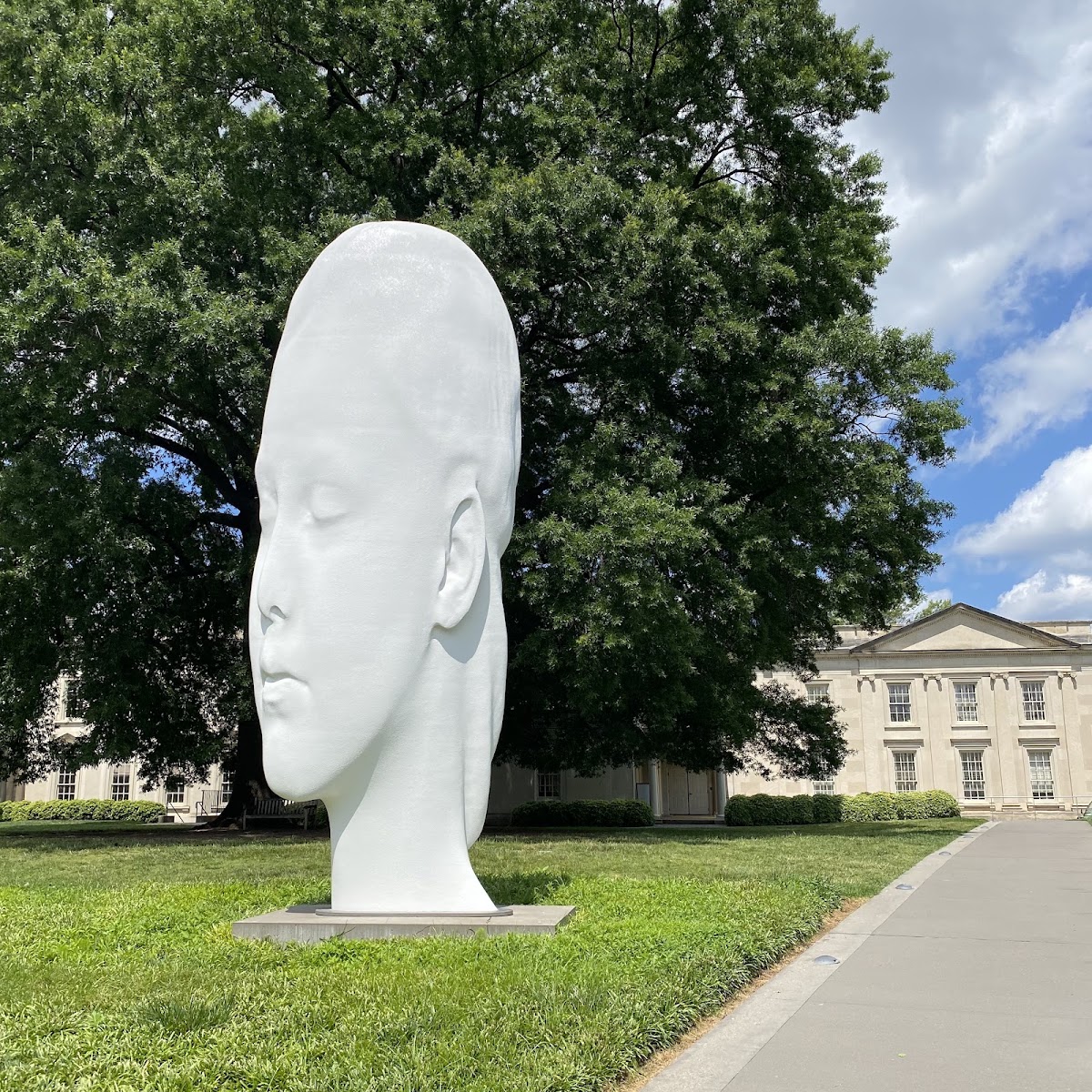
After a long indoor route, the E. Claiborne and Lora Robins Sculpture Garden offers a different distance. Works stand among lawn, trees, water, weather, and changing shadows. From far away a sculpture joins the outline of the building; up close, surface and construction become more evident.
The garden is also a viewpoint onto VMFA's architectural history. From outside, differences between the 1936 structure and later additions are easier to read. Spaces that felt continuous from the atrium reveal themselves as parts joined over decades.
Construction may alter outdoor access and gallery routes. Check current closures and the location of a desired work before traveling. At a museum in transition, a flexible plan and sustained attention to the rooms that are open are more useful than an ambitious checklist.
How Free Admission Changes the Pace
VMFA currently opens from 10 a.m. to 5 p.m. Saturday through Tuesday and until 9 p.m. Wednesday through Friday. It operates 365 days a year. The permanent collection is free, while some special exhibitions and programs require separate or timed tickets. Hours, tickets, and construction closures should be checked on the official site before departure.
Free entry changes more than the price. It makes a short family visit, a return to one object, or an hour after work feel complete rather than insufficient. Daily opening and late weekdays allow the museum to function as part of ordinary Richmond life as well as a travel destination.
Outside on Arthur Ashe Boulevard, the most lasting image may not be a jeweled egg. It may be a student drawing on the floor, neighbors talking in the garden, or a visitor returning to a familiar room. The museum that grew from Payne's fifty-one paintings remains public not simply because of the number of works it owns, but because access can be repeated.
Visit Info
- Address: 200 N Arthur Ashe Blvd, Richmond, VA 23220, United States
- Hours: Saturday-Tuesday 10:00-17:00; Wednesday-Friday 10:00-21:00. Open 365 days; check current gallery closures during construction and exhibition changes
- Fee: General admission to the permanent collection is free. Some special exhibitions and programs require paid or timed tickets
- Transport: Reachable by Richmond GRTC bus, bicycle, or car. Check the museum for current stops and parking conditions before departure
- Time needed: Allow 2-3 hours for collection highlights or half a day with a special exhibition and the sculpture garden
- Website: https://vmfa.museum/
Visitor Info
| Address | 200 N Arthur Ashe Blvd, Richmond, VA 23220, United States |
| Hours | Translating |
| Admission | Translating |
| Getting There | Translating |
| Duration | Translating |
| Translating | https://vmfa.museum/ |