The Yellow House in Berlin's Woods, Where Banned Art Returned
The Yellow House in Berlin's Woods, Where Banned Art Returned
Approaching the Yellow House in Berlin-Zehlendorf
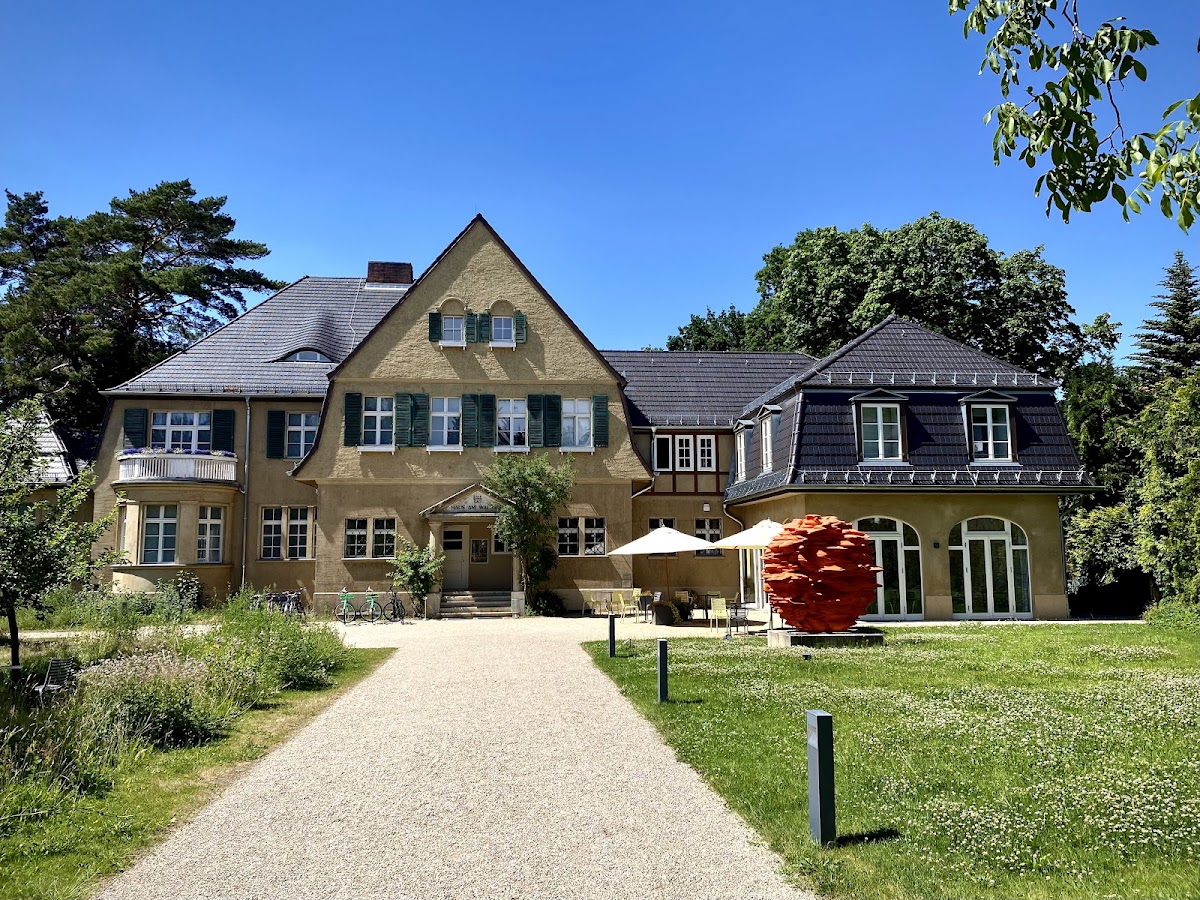
Ride the U3 southwest from central Berlin toward its terminus at Krumme Lanke and the city changes character. Shops and apartment blocks give way to trees and lower houses. A walk along Argentinische Allee brings a yellow two-storey villa into view behind a fence. Haus am Waldsee begins not in a monumental cultural district, but between a residential neighborhood, woods, and water.
Its name means the house by the Waldsee. Lawn, mature trees, the lake, and a 10,000-square-metre sculpture park belong to the institution as much as the indoor rooms. Outdoor works are visible before entry, then appear again through windows. Exhibition, villa, and landscape continually enter one another's frame.
The program now concentrates on international contemporary artists working in Berlin, yet the building was not designed as a museum. It was a Jewish businessman's family home, later occupied by a senior Nazi official and then Soviet soldiers. The attractive yellow facade carries successive and conflicting chapters of the city's history.
How a Marsh Became the Waldsee
The western part of Zehlendorf was planned for development in the early twentieth century. Banker Adolf Gradenwitz and Prince Guido Henckel von Donnersmarck acquired land, and a 1903 plan laid out 663 plots and nineteen streets. A bog was excavated to form the Waldsee. The apparently natural lake is also a work of urban design.
Between Krumme Lanke and Schlachtensee, surrounded by an exceptional density of trees, the district became a suburban home for prosperous Berlin residents. The extension of the underground railway to Krumme Lanke in 1929 compressed the journey to the center. Today's museum trip retraces the infrastructure that made the neighborhood possible.
Looking from the garden toward the water, it is useful not to treat the scene as untouched nature. Shoreline, roads, property boundaries, and villas were planned together, then changed through war, division, and reunification. Contemporary sculpture is another temporary layer in that constructed landscape.
Max Werner's House for Hermann Knobloch
Architect Max Werner designed the villa in 1922 for the textile entrepreneur Hermann Knobloch. The family moved in during 1923. Its asymmetrical roof, bright facade, and garden-facing rooms drew on the English country-house ideal, combining upper-middle-class domestic life with the promise of suburban nature.
The original property contained a private filling station, boathouse, greenhouse, pigsty, chicken coop, staff quarters, orchard, and vegetable plots. What now appears as a cultural garden was once an operating domestic estate, supporting food, transport, labor, and family recreation.
Financial difficulty forced the Knoblochs to sell in 1926. The Jewish family moved to Uruguay in the early 1930s and escaped Nazi persecution. By 1945 the villa had changed ownership eight times. The museum's history therefore includes the first residents by name and does not let their departure disappear behind the beauty of the house.
Mozart, Haydn, and Grieg in the Garden of 1945
Near the end of the war, the house was occupied by Karl Melzer, a senior Nazi official. He fled to southern Germany in March 1945. Ten Soviet soldiers moved into the building in May. A private villa passed from a representative of the regime to an occupying army while Berlin searched for civic order amid destruction.
In June, musicians from the Berlin Philharmonic gave what was only their second concert after the war in the garden. The program included Mozart, Haydn, and Grieg. Before the site had formal galleries, its outdoor space allowed people to gather around culture again.
The episode should not be polished into a simple rebirth. The displacement of the Knobloch family, the Nazi resident, and military occupation were all still present. The concert marked an attempt to resume public life within unresolved memories, not a clean removal of the past.
The 1946 Exhibition with Kathe Kollwitz
After the district passed into the American sector, the villa became a municipal cultural center. In January 1946 its first exhibition, organized by Ewald Vetter, included sculpture by Kathe Kollwitz. Her work on poverty, war, death, and grief established a serious first language for rooms that had only recently housed political power.
Karl Ludwig Skutsch became the first artistic director later that year. He concentrated on progressive artists who had been excluded, condemned, or prevented from exhibiting under National Socialism. Before searching for the newest fashion, the institution restored public visibility to work that dictatorship had pushed away.
The villa was no neutral white cube for a visitor in 1946. Looking at suppressed art in rooms recently used by a Nazi official reversed the meaning of the building. Haus am Waldsee demonstrates how a change of use can produce a historical memory as powerful as the preservation of walls.
Schmidt-Rottluff, Picasso, and Four Centuries of Chinese Painting
Early exhibitions repaired broken lines in German modernism. The program presented sculptor Hermann Blumenthal and organized a Karl Schmidt-Rottluff retrospective in 1948. A 1949 Berliner Neue Gruppe exhibition included Max Pechstein, Karl Hofer, Renee Sintenis, Hans Uhlmann, Werner Heldt, and Alexander Camaro.
Picasso prints followed in 1949, opening the program further toward international art. In 1950, an exhibition of Chinese painting across four centuries attracted nearly 9,000 visitors in six weeks. That audience at a villa far from central Berlin suggests the postwar appetite for visual worlds that had long been inaccessible.
The 1950s brought exhibitions involving Henry Moore, Max Ernst, Ernst Ludwig Kirchner, Joan Miro, Georges Braque, and others. Read today, the list can look like an established Western canon. In Berlin at the time, it represented the difficult renewal of international cultural conversation.
When Heftige Malerei Gave a Generation a Name
Haus am Waldsee did not remain dedicated only to recovery. The 1980 exhibition Heftige Malerei, or vehement painting, brought young Berlin painters together around forceful color and gesture. Participants would be associated with the Neue Wilde and broader Neo-Expressionist currents.
Their canvases returned figures, urban experience, desire, and anxiety to painting after the dominance of conceptual and minimalist approaches. Large, unruly works inside former domestic rooms must have intensified the confrontation between salon architecture and an emerging present.
The exhibition matters because the work appeared together before its art-historical label became settled. Haus am Waldsee was not simply confirming the reputation of established artists. It helped make a new movement visible at close range, a role continued by exhibitions attentive to the conditions of contemporary Berlin.
How Domestic Rooms Change the Scale of Art
A villa never offers a neutral wall. Doorframes, windows, former fireplaces, low ceilings, stairs, and corridors divide the view. A large installation can nearly consume a room, while a small drawing gains intimacy. The next work is often first encountered through an open doorway rather than head-on.
Visitors choose directions in corridors, repeat the same staircase, and remember exhibitions through domestic orientation. When a garden appears behind an artwork, the actual season enters the image. Curators and artists use these conditions instead of concealing them, which helps explain the frequency of site-responsive commissions.
A quick photograph of each wall loses the most important proportions. Step back to include the door or window, move into the next room, and look behind. At Haus am Waldsee, where and from what distance an object was seen become part of what the object means.
A Sculpture Park in Permanent Transition
Behind the villa, a sculpture park of roughly 10,000 square metres descends toward the lake. Works by artists including Tony Cragg, Wilhelm Mundt, Michael Beutler, Michael Sailstorfer, and Thomas Rentmeister have entered relationships with the garden. Grass, soil, bark, water, and weather replace the white pedestal as surrounding material.
The institution describes the park as being in permanent transition. Outdoor works weather, vegetation grows, and installations enter, move, or leave with changing programs. Even permanence does not mean a fixed view. Dense summer foliage and bare winter branches give the same sculpture a different outline.
Do not let the lake reduce the art to landscape decoration. Notice whether a material resembles or resists its setting, and whether a work blocks or redirects the walking path. After circling the park, look back toward the villa. The historic building begins to appear as another object placed within the garden.
Renovation and the Program under Anna Gritz
The organizational structure changed repeatedly. A supporting association became the legal operator in 2004 with assistance from Berlin and the borough. Under director Katja Blomberg from 2005 to 2021, the institution sharpened its focus on international artists based in Berlin and developed the outdoor sculpture program.
A renovation in 2017 and 2018 modernized technical and exhibition conditions while maintaining the historic proportions of the rooms. The park was subsequently redesigned under heritage principles through 2022. Preserving an old house did not mean refusing every practical or curatorial change.
Anna Gritz became director in 2022. Her program connects current work to the political history of the site and to its surrounding landscape. In its eightieth anniversary year in 2026, Haus am Waldsee can treat commemoration not as a closed list of achievements, but as a question about how this charged place should be used next.
Combining an Exhibition with a Lakeside Walk
Haus am Waldsee currently opens Tuesday through Sunday from 11 a.m. to 6 p.m. and closes on Monday. Regular admission is EUR 9, reduced admission EUR 6, a family ticket EUR 12, and visitors under eighteen enter free. Public holidays and exhibition changes create exceptions, so consult the official calendar before traveling.
The villa alone may take a little over an hour, but the sculpture park slows the route. Rain changes the lawn and soil, while winter daylight ends early. Comfortable shoes and clothing for moving between rooms and garden are sensible. Visitors requiring support should ask the institution about current access conditions in the historic building and park.
Continue toward Krumme Lanke or Schlachtensee after the exhibition and the museum becomes clearer within Berlin's geography. This is a different day from Museum Island. Beyond any single artwork, the lasting subject may be the site's change in direction: a private home and a seat of power transformed into a public place where banned art could return.
Visit Info
- Address: Argentinische Allee 30, 14163 Berlin, Germany
- Hours: Tuesday-Sunday 11:00-18:00; closed Monday. Open on public holidays except 24, 25, and 31 December; check exhibition-change closures
- Fee: Regular EUR 9, reduced EUR 6, family EUR 12, and free for visitors under 18. Check current program conditions
- Transport: Walk from U3 Krumme Lanke station. Consult the official directions for bus connections and the precise route from your starting point
- Time needed: Allow 1-1.5 hours for the villa and at least 2 hours with the sculpture park and a lakeside walk
- Website: https://hausamwaldsee.de/en/
Visitor Info
| Address | Argentinische Allee 30, 14163 Berlin, Germany |
| Hours | Translating |
| Admission | Translating |
| Getting There | Translating |
| Duration | Translating |
| Translating | https://hausamwaldsee.de/en/ |