Wellington's Black Wedge, When a Campus Stair Became a Gallery
Wellington's Black Wedge, When a Campus Stair Became a Gallery
Finding a Black Wedge on a Wellington Hill
From the Wellington Cable Car's University stop, walk toward Kelburn Parade and a black zinc form appears between red-brick Gothic Revival buildings. Te Pātaka Toi Adam Art Gallery does not stand alone on a civic plaza. It occupies a steep interval between Old Kirk, Hunter, and the Student Union, linking upper and lower parts of the campus.
Inside, three levels remain visually connected. Long walls, platforms, railings, and tall voids move the eye vertically through only 350 square metres of exhibition space. The building turns a compact gallery into a sequence of changing distances.
Ian Athfield and Aotearoa’s First Purpose-Built University Gallery
The gallery is Aotearoa New Zealand's first purpose-built university art gallery. Sir Ian Athfield and Athfield Architects treated the hillside difference as the subject of the design. Their proposal reused the seldom-used Culliford Stair between existing campus buildings.
Concrete columns from Ian Reynolds's 1960s stair remain central among triple-height walls and intersecting rooms. The black zinc wedge contrasts with Hunter Building's red brick. What once moved students up and down the hill became a route for art, performance, and public gathering.
A First Painting for the Staff Common Room
The collection preceded the gallery. In 1947 university staff set aside funds to buy original New Zealand art for their common room. Sam Cairncross's 1946 painting Daffodils became the first purchase, placing art in the daily life of work rather than in a dedicated museum store.
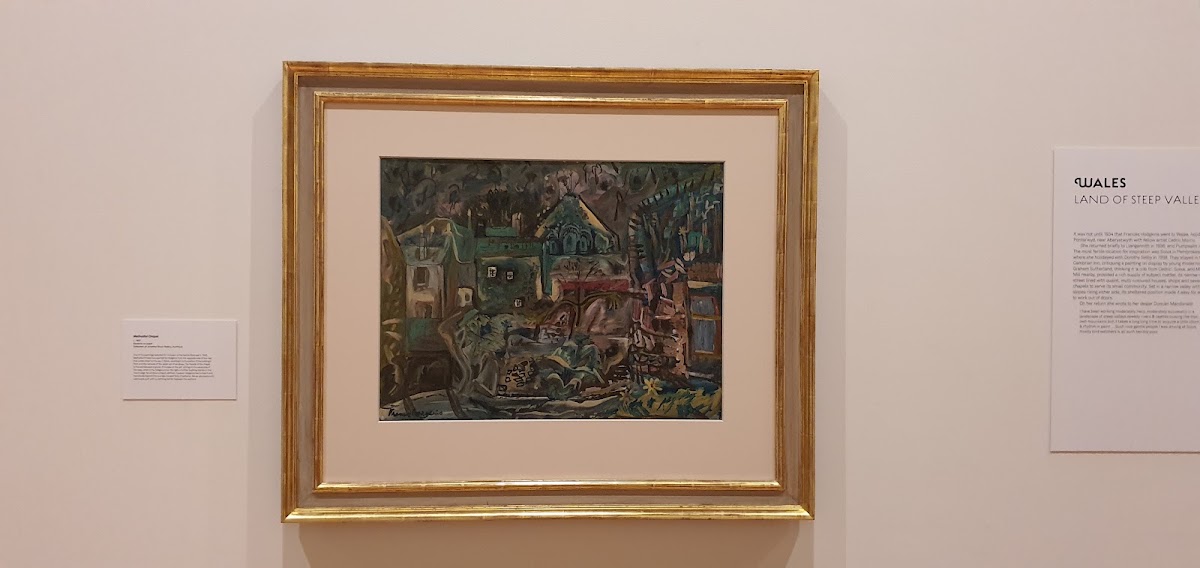
A bold 1955 purchase of Frances Hodgkins's Kimmeridge Foreshore helped establish a twentieth-century direction. In 1958 the University Council provided an annual £100 grant for a collection intended to become a historical record of graphic art in New Zealand.
Tim Beaglehole with a Hammer and Ladder
Historian Tim Beaglehole joined the purchase committee in 1963 and drove acquisitions for three decades. With an annual budget that never exceeded NZD 10,000, he added more than 160 works by emerging and established artists including Don Binney, Gordon Walters, Milan Mrkusich, Richard Killeen, and Pat Hanly.
He was remembered carrying a hammer and ladder to hang works across campus. A hesitant academic might live beside a picture long enough to become attached to it. Colin McCahon's 1970 painting Gate III was among Beaglehole's most important acquisitions, but everyday proximity remained as important as canonical status.
A 1996 Proposal for a Museum-Laboratory
Art historians Jenny Harper and Christina Barton proposed a dedicated university gallery in 1996. Their museum-laboratory would combine historical exhibitions, contemporary projects, seminars, discussion, interdisciplinary teaching, and professional care of the art collection.
The university adopted the gallery as a centennial project. In 1997 Denis and Verna Adam supplied a NZD 1 million foundation grant through the Adam Foundation. The donor name remains, but the institution is a free public gallery within Te Herenga Waka, Victoria University of Wellington.
An $80,000 Shortfall and the Sale of Storm Warning
Near the end of construction, fundraising remained NZD 80,000 short. The steering group sold Colin McCahon's 1980–81 painting Storm Warning. The sale covered the gap and established a trust for future acquisitions, but staff and students protested that a work given to avoid private disappearance had been removed from the public collection.
The dispute shadowed the September 1999 opening. For Manufacturing Meaning, ten guest curators each built a small exhibition around a collection work. Wellington filmmaker and writer Stuart McKenzie borrowed Storm Warning back, placing the contested painting inside the first show rather than hiding the argument.
Exhibiting across Three Interconnected Levels
A floor-plan sequence is not enough here. An installation may first appear from a railing, then change scale when approached below. Sound travels upward, natural light divides one wall from a dark projection space, and a work can address several viewing platforms at once.
Take one circuit to understand the building and a second to stay with individual works. Projects by artists including Joseph Kosuth, Gavin Hipkins, Simon Denny, Ruth Buchanan, Luke Willis Thompson, and Kate Newby have used the whole building or its open vertical relationships.
Ngā Puhipuhi o Te Herenga Waka
The gallery manages Ngā Puhipuhi o Te Herenga Waka, a collection of more than 600 modern and contemporary works from Aotearoa New Zealand. Painting and drawing expanded into photography, moving image, installation, and conceptual work. Many objects remain visible in public spaces across university campuses.
A 2009 transfer added 174 works from the Wellington College of Education, while the New Zealand Art Archive came under gallery care in 2020. The Māori name, gifted in 2022, compares the collection to feathers that adorn a waka and enhance mana. Care and sharing become part of the name itself.
When Research Becomes an Exhibition
Te Pātaka Toi Adam Art Gallery has used research to make overlooked practices visible. Exhibitions have examined Marcel Duchamp's influence in New Zealand, surveyed Vivian Lynn and Kim Pieters, and placed Aotearoa within Asia-Pacific conversations. The gallery is a platform where disciplines and cultural contexts meet around objects.
Current exhibitions and on-campus displays should be checked together. A collection work may appear at Kelburn, Pipitea, or another university site. Following art beyond the purpose-built gallery returns the collection to its 1947 origin in shared working space.
Entering through Gate 3
The gallery currently opens Tuesday through Sunday from 11 a.m. to 5 p.m. and admission is free. From the cable car's University stop, walk via Salamanca Road and Kelburn Parade to Gate 3. Check Metlink for buses and the gallery site for exhibition-change closures.
A lift reaches every gallery level, with accessible toilets and portable stools available. Outside again, the black wedge reads less like an isolated object than a connector between red buildings. The story of the gallery rests not only on what the university owns, but on how it displays, disputes, and keeps learning from art.
Visit Info
- Address: Gate 3, Kelburn Parade, Te Herenga Waka—Victoria University of Wellington, Wellington 6012, New Zealand
- Hours: Tuesday-Sunday 11:00-17:00; closed Monday. Check exhibition-change and university-calendar closures
- Fee: Free admission
- Transport: From the Wellington Cable Car University stop, walk via Salamanca Road and Kelburn Parade to Gate 3. Check current Metlink schedules for buses
- Time needed: Allow 1-1.5 hours for the building and exhibitions or more than 2 hours with collection works across campus
- Website: https://www.adamartgallery.nz/
Visitor Info
| Address | Gate 3, Kelburn Parade, Te Herenga Waka—Victoria University of Wellington, Wellington 6012, New Zealand |
| Hours | Translating |
| Admission | Free |
| Getting There | Translating |
| Duration | Translating |
| Translating | https://www.adamartgallery.nz/ |