Pretoria's Bridge Gallery, Carrying a Golden History across Campus
Pretoria's Bridge Gallery, Carrying a Golden History across Campus
A Gallery Suspended above Lynnwood Road
Lynnwood Road is a fast boundary between the University of Pretoria and the city. Above it, the Bridge Gallery of Javett Art Centre-UP carries exhibitions and pedestrians between Hatfield and South campuses. Entering an art space and crossing the university happen inside the same structure.
Perforated cladding casts shifting shadows reminiscent of shweshwe cloth onto road and walkways. The bridge is functional, not only symbolic. Yet architecture alone cannot complete a public connection; the histories selected for display and the people invited to interpret them determine how open that bridge becomes.
A Partnership Opened on Heritage Day 2019
Javett-UP is a partnership between the University of Pretoria and the Javett Foundation. The foundation supported construction through its interests in education, skills, and art, while the university connected collections, research, teaching, and public engagement.
The center officially opened on South Africa's Heritage Day, 24 September 2019. Its inaugural displays brought modern South African art from the Javett Collection, works from public and private collections, and Mapungubwe heritage into distinct but connected spaces. Ancient material and contemporary art were not forced into a simple line of progress.
Pieter Mathews, a Bridge, and a Gold Tower
Pieter Mathews and Associates designed a complex of galleries, a 117-seat auditorium, outdoor spaces, a student gallery, and conservation facilities. The Bridge Gallery crosses Lynnwood Road and descends toward an art square at the historic end of Tukkie Laan.
The sculptural Gold of Africa Tower was conceived for Mapungubwe heritage. Its concrete mass evokes hill and vault, with controlled light slowing attention around fragile gold foil and small objects. The building places an open route and a protective enclosure in productive tension.
What the Gold of Mapungubwe Establishes
Mapungubwe developed near the confluence of the Shashe and Limpopo rivers, where the later borders of South Africa, Botswana, and Zimbabwe meet. Archaeological material dating broadly from CE 1000 to 1300 records a stratified society, skilled production, and extensive trade connected to the Indian Ocean world.
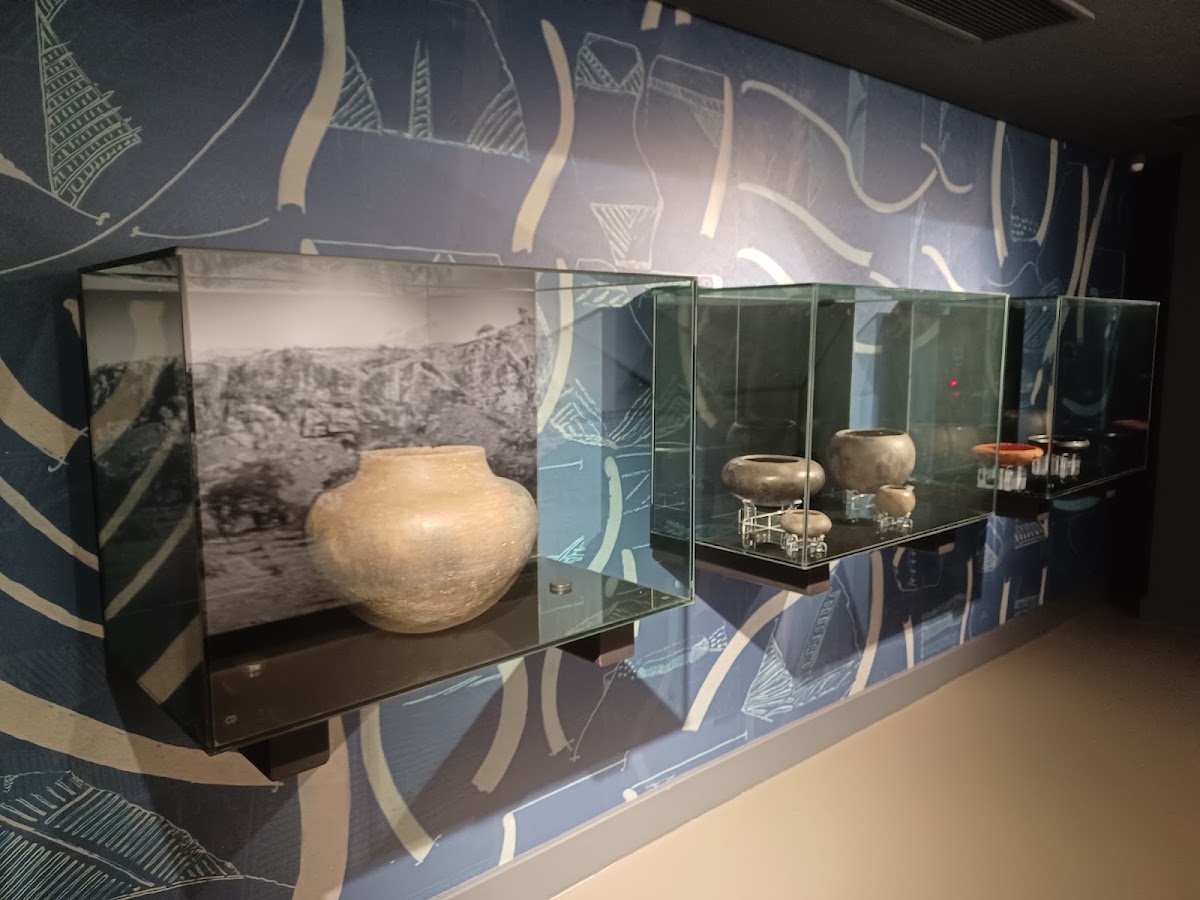
Excavations on Mapungubwe Hill in 1933 revealed a gold-foil rhinoceros, vessels, a sceptre, jewelry, ceramics, and beads. These objects challenge colonial accounts that treated southern Africa as peripheral to complex states and international exchange.
The University of Pretoria has cared for the collection since the 1930s. Questions of excavation, sacred place, custody, and community relationship must accompany admiration for the gold. Javett-UP's National Treasures exhibition displayed the material from 2019 to 2025; visitors should verify its current location and the status of gallery redevelopment before traveling.
Looking at Technique before Treasure
The inaugural Gold of Africa display also placed Mapungubwe material near the AngloGold Ashanti Barbier-Mueller collection of West African gold. Different regions and periods complicated the idea of African gold as one universal symbol of wealth.
Tiny nail holes, folded edges, and hammered foil direct attention toward technique. A vessel or rhinoceros was made as a joined surface, often over a core, rather than found as a solid golden form. The controlled tower emphasized concentration over monumental scale.
A Century of South African Art in 101 Conversations
The 2019 exhibition 101 Collecting Conversations: Signature Works of a Century asked public and private collections to nominate significant works. More than 300 suggestions were narrowed to 101 works spanning 1920 to 2020. Selection was presented as conversation rather than a definitive ranking.
Themes included politics, religion, tradition, urbanization, landscape, and identity. Gerard Sekoto's Song of the Pick, William Kentridge's Felix in Exile, photography by Zanele Muholi, and works by Helen Sebidi and Jackson Hlungwani created crossings between generations and media.
Writing Individual Artists Back into History
Decolonial inquiry is central to Javett-UP's stated mission. The institution has examined how work by Black artists, especially wood sculpture and objects made in local materials, was often classified as anonymous craft rather than as individual artistic practice.
The 2020 exhibition Shaping the Grain and related discussion addressed the phrase unknown artist. The task is not to invent biographies where evidence is absent, but to recover names, techniques, intellectual contexts, and community knowledge obscured by colonial and apartheid categories.
Why the Student Gallery and Conservation Lab Matter
The student gallery supports visual art, architecture, and interdisciplinary activity. An auditorium, performance spaces, and outdoor areas extend the center beyond exhibition walls. Students, researchers, school groups, artists, and first-time museum visitors can occupy the same complex.
Conservation facilities connect display with the labor of care. Collaboration with heritage conservation study at the University of Pretoria asks how objects should be examined, stabilized, repaired, and documented. Preservation becomes a field of teaching rather than an invisible service behind the gallery.
A Route That Begins on the Bridge
Begin by crossing the Bridge Gallery and locating the art center between campuses and city. Then separate temporary exhibitions from collection displays before returning to works seen from upper railings. This reduces the tendency to flatten ancient heritage, modern art, and contemporary projects into one story.
Check the current exhibition list if Mapungubwe material or a specific Javett Collection work is the reason for visiting. Long-running and inaugural exhibitions can close or be reconfigured, and university access may change. Photography rules also depend on loans and conservation conditions.
The Bridge That Remains after the Gold
Current stored hours list Tuesday through Saturday from 10 a.m. to 4 p.m., with Monday and Sunday closed. The University of Pretoria's 2026 guide lists adults at R80, pensioners and visitors under eighteen at R50, and free entry for tertiary students and UP staff. Confirm the exact visit date, price, and exhibition status with official channels.
Javett-UP is more than a destination for the gold rhinoceros. It asks who owns heritage, who writes South African art history, and how a university shares knowledge with a city. Back on Lynnwood Road, traffic passes below while students and visitors walk through art above. A protective tower and an open bridge hold care and public debate inside the same building.
Visit Info
- Address: University of Pretoria, 23 Lynnwood Road, Hatfield, Pretoria 0002, South Africa
- Hours: Currently listed Tuesday-Saturday 10:00-16:00, closed Monday and Sunday. Confirm university-calendar, exhibition-change, and event variations
- Fee: The University of Pretoria 2026 guide lists adults R80, pensioners and under 18 R50, and free entry for under 6, tertiary students, and UP staff. Check current prices
- Transport: Enter from Lynnwood Road at the University of Pretoria South Campus. The Bridge Gallery connects to Hatfield Campus; verify current access and parking routes
- Time needed: Allow 2 hours for architecture and exhibitions or more than 3 hours with collection and education programs
- Website: https://javettup.art/
Visitor Info
| Address | University of Pretoria, 23 Lynnwood Road, Hatfield, Pretoria 0002, South Africa |
| Hours | Translating |
| Admission | Translating |
| Getting There | Translating |
| Duration | Translating |
| Translating | https://javettup.art/ |