Frankfurt’s Red House on the Bridge, Where Exhibitions Rewrite the Building
Frankfurt’s Red House on the Bridge, Where Exhibitions Rewrite the Building
Crossing Frankfurt’s Alte Brücke to Portikus
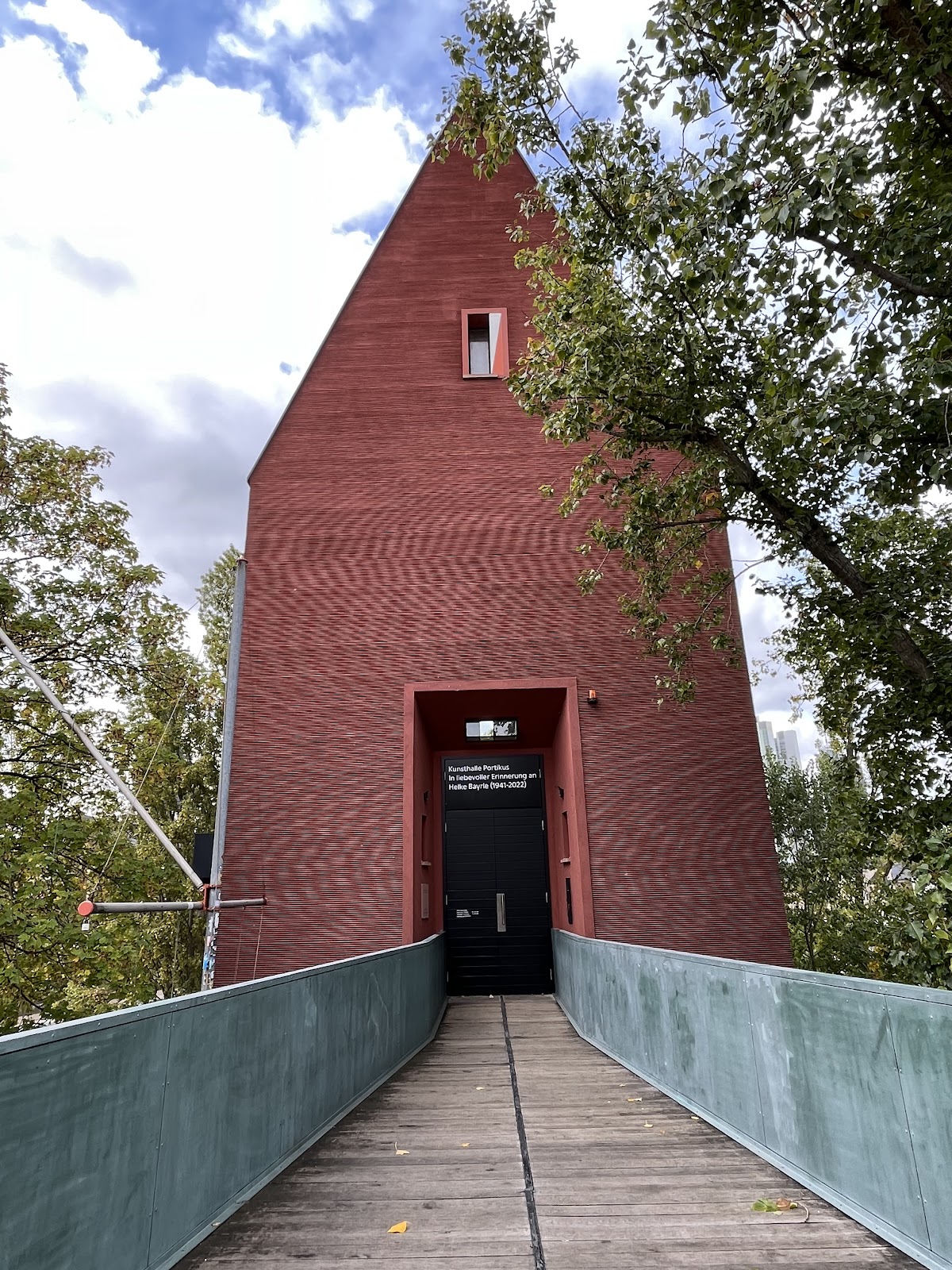
Portikus is not entered directly from a museum boulevard. Visitors leave the Alte Brücke for a narrow footpath on a small Main River island, where a steep red house appears between traffic, trees, and water. The short detour changes the pace before the exhibition begins.
This is the contemporary art institution of the Städelschule, Frankfurt’s academy of fine arts. Since 1987 it has exhibited, published, and discussed work by emerging and established artists. It does not build identity through a permanent collection; each exhibition can empty and remake the building.
A Temporary White Room behind Six Surviving Columns
The name Portikus predates the present red building. Frankfurt’s neoclassical city library, built in 1825, was destroyed during the Second World War, leaving a portico of six Corinthian columns. In 1987 the city placed a small temporary exhibition hall behind this surviving facade.
Marie-Theres Deutsch and Klaus Dreißigacker designed a precise white box whose metal skin earned it the nickname container. A radical temporary room and a war-damaged classical front stood together. Portikus inherited its name from the fragment rather than inventing a polished museum brand.
Kasper König, the Städelschule, and Art Made for a Room
Kasper König led Portikus from 1987 to 2001 while directing the Städelschule. The program favored new production and site-responsive projects over the acquisition of finished works. A modest room, fast decisions, and the academy’s international exchange became its working model.
Students participate in installation and art handling, while Curatorial Studies students may lead tours and work with visitors. The exhibition is therefore also a professional classroom: transport, lighting, interpretation, and dismantling become visible parts of artistic practice.
Opening with More Than Two Hundred Books by Dieter Roth
Portikus opened on 10 October 1987 with Dieter Roth’s Published and Unpublished Works. More than two hundred books from 1953 to 1987, publishing projects, and studio material filled the first exhibition. During the show, visitors contributed to the copied book Frankfurter Bilderbogen.
The choice resonated with the ruined library facade and Frankfurt Book Fair without treating books as secondary documentation. Later presentations involving Ilya Kabakov, Lawrence Weiner, and Sol LeWitt continued to examine the artist’s book as an autonomous form that could move beyond the gallery.
When an Exhibition Uses the Entire White Cube
From the beginning, Portikus invited artists to treat walls, floors, and circulation as material. The early sequence included Thomas Struth, Siah Armajani, Franz West, Nam June Paik’s One Candle, and Gerhard Richter’s 18 October 1977. In 1988 Erik Bulatov received his first solo exhibition before a broader audience there.
These names did not become a permanent display. What remained was a succession of different ways to occupy one difficult room. The exhibition number matters more than an ownership label: a work belonged to a particular encounter between artist, site, institution, and date.
Helke Bayrle’s Record of Installations That Disappeared
Site-specific exhibitions vanish when the walls are restored. Beginning in late 1992, Helke Bayrle independently filmed Portikus installations and exhibitions. Her camera followed artists and crews as they unpacked, positioned, debated, adjusted, and eventually completed a show.
The publication Portikus Under Construction 1992–2016 assembled an exhibition index and more than one thousand film stills. The archive preserves labor and uncertainty that polished installation photographs omit. It also teaches visitors to imagine the construction hidden behind the current room.
Moving into the Leinwandhaus in 2003
Reconstruction of the former city library forced Portikus to leave its first site in 2003. Louise Lawler’s Probably Not in the Show was the final regular exhibition there. The interim home was the historic Leinwandhaus near Frankfurt Cathedral.
Tobias Rehberger inserted boxes and platforms for a gallery, office, storage, and reading area into the rough ground floor. Ólafur Elíasson developed the lighting with Zumtobel. The modular design did not disguise displacement; it made a temporarily migrating institution legible.
Christoph Mäckler’s Red House on the Main Island
The current building by Christoph Mäckler was completed in 2006 with financing from Stiftung Giersch. Its red brick and steep gable refer typologically to medieval Frankfurt bridge houses, while a separate footbridge brings visitors from the Alte Brücke into a tall, compact exhibition volume.
The main gallery has ground-level access, but the lower gallery is reached only by stairs. Accessible toilets and assistance dogs are accommodated. The difference between the building’s visual openness and its uneven physical access is important to check when planning a visit.
Ólafur Elíasson’s Light above the River
Ólafur Elíasson’s permanent Light lab (1/12) occupies the glass north gable. Conceived as a series of twelve changing spectra from 2006 to 2008, it now emits a deep yellow tone. At dusk, the luminous arc reflects in the Main like a low sun.
Restored in 2021, the work belongs to the collection of MUSEUM MMK FÜR MODERNE KUNST. It remains visible to pedestrians after exhibitions close, joining Elíasson’s interest in light and perception to an everyday public route.
Remembering the Next Exhibition Instead of a Collection
Portikus currently opens Tuesday through Friday from noon to 7 p.m. and Saturday and Sunday from 11 a.m. to 7 p.m.; Monday is closed and admission is free. Installation periods can close the building between exhibitions, so consult the current program before crossing the bridge.
There is no on-site parking. On a first circuit, read the exhibition and architecture together; on a second, ask why a work occupies its exact wall, height, or light. Back on the Alte Brücke, the red house becomes a small mark on the island. Its sites have changed, but the commitment to giving artists a room and recording what they do with it has endured.
Visit Info
- Address: Alte Brücke 2 / Maininsel, 60594 Frankfurt am Main, Germany
- Hours: Tuesday-Friday 12:00-19:00; Saturday-Sunday 11:00-19:00; closed Monday. Check exhibition-change and holiday closures
- Fee: Free admission
- Transport: Enter the Main Island footpath from the Alte Brücke. Walk from Konstablerwache or Schweizer Platz U-Bahn, or the Schöne Aussicht and Elisabethenstraße bus stops
- Time needed: Allow 1-1.5 hours for the exhibition and building or more than 2 hours with a Main river walk and the Städelschule area
- Website: https://www.portikus.de/
Visitor Info
| Address | Alte Brücke 2 / Maininsel, 60594 Frankfurt am Main, Germany |
| Hours | Translating |
| Admission | Free |
| Getting There | Translating |
| Duration | Translating |
| Translating | https://www.portikus.de/ |