The Black-Eyed Bull of Nukus, Why Forbidden Paintings Survived in the Desert
The Black-Eyed Bull of Nukus, Why Forbidden Paintings Survived in the Desert
Standing before Vasily Lysenko’s Bull in Nukus
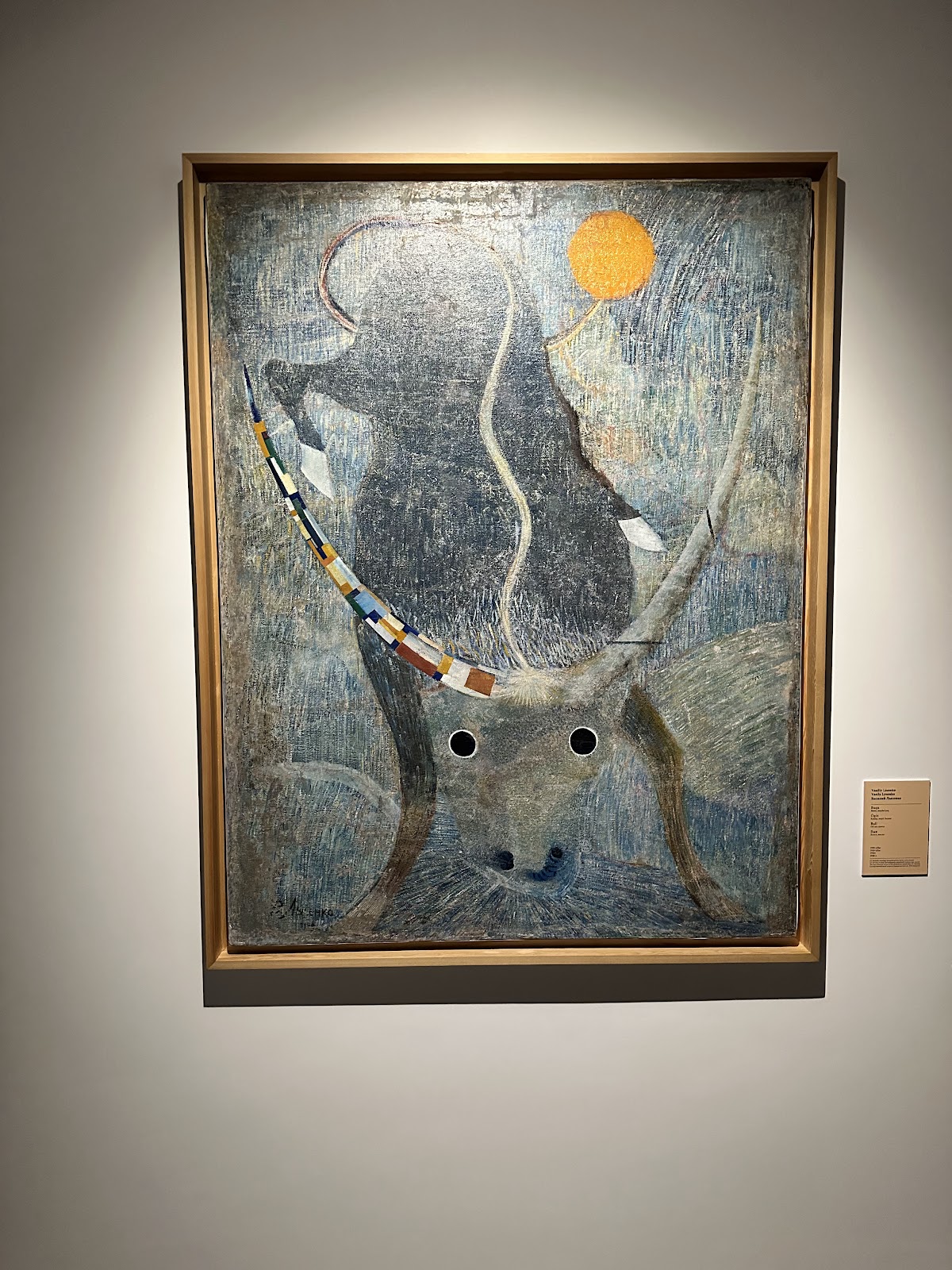
At the Savitsky Museum, Vasily Lysenko’s Bull fixes the visitor with two black circular eyes. A pale mass and orange sun hover above the animal, while a striped form cuts across its horn. The image is too uneasy to settle into animal portraiture and too bodily to dissolve into abstraction.
Uzbekistan’s official tourism material identifies the painting as an emblem of the museum and records an interpretation connecting the eyes to fascism and approaching war. That reading is not the only possible one. Little is known about Lysenko, and the museum’s story is filled with artists whose biographies and works survived unevenly.
Four Millennia Gathered in Nukus
Nukus is the capital of Karakalpakstan in northwestern Uzbekistan, near the Amu Darya delta and south of the Aral Sea. The Savitsky Museum brings together archaeology, applied art, and modern painting rather than using the desert as an exotic backdrop for Russian art.
Public institutional material describes approximately 100,000 holdings spanning more than four thousand years. Only a small portion can be displayed at once. Russian avant-garde fame should not conceal the foundations of the museum in ancient Khorezm and Karakalpak material culture.
Igor Savitsky from Kyiv to the Khorezm Expedition
Igor Vitalyevich Savitsky was born in Kyiv in 1915 and worked as an artist, restorer, ethnographer, and art historian. He first encountered Central Asia after evacuation to Samarkand in 1942. In 1950 he joined the Khorezm archaeological and ethnographic expedition led by Sergei Tolstov.
Savitsky documented excavations and studied landscape and local life before moving his work toward Nukus. He collected archaeological and applied-art material and developed the structure that became a public museum. The achievement should not erase the local makers, researchers, and museum workers who also built and cared for the collection.
Karakalpak Making before the Avant-Garde
Savitsky’s early collecting centered on Karakalpak applied art: yurt bands, embroidered textiles, wooden doors and furniture, metal jewelry, clothing, and ceremonial objects. These were not anonymous preliminaries to painting. They carried technical knowledge about dye, weaving, storage, insulation, mobility, family, and ritual.
A helmet-like bridal headdress, silver amulets, red-and-black woven bands, and the organization of a yurt make a strong route through the galleries. Seen first, they complicate later modern paintings whose color and pattern respond to Central Asian life. Similarity should prompt comparison, not a simple claim of influence.
A Longer History from Ancient Khorezm
The archaeological section grew from the Khorezm expedition. Ceramics, bronze objects, terracotta figures, and Zoroastrian ossuaries connect the museum to ancient and medieval settlements of the Amu Darya region. Some materials preserve traces of writing and ritual across changing religions and trade routes.
These galleries are not merely an introduction before modern art. They establish a region with long visual and material histories before twentieth-century painters arrived. Moving back and forth between pottery, textiles, and paintings is often more revealing than following a single chronological corridor.
A State Art Museum Founded in 1966
The Karakalpakstan State Museum of Art opened in Nukus in 1966 on Savitsky’s initiative. He served as its first director and continued acquiring until his death in 1984. Archaeology and Karakalpak art were joined by Uzbek modernism, Russian avant-garde and post-avant-garde work, and later unofficial Moscow art.
Many artists had been criticized as formalist or denied exhibition opportunities under the dominance of Socialist Realism. Savitsky traveled to locate works held by artists and families and brought them into a public collection. The routes varied; a dramatic story of secret rescue should not replace careful provenance research.
Russian Avant-Garde and Unofficial Soviet Art
The collection includes Russian avant-garde, experimental work of the 1920s and 1930s, and nonconformist art from the Moscow underground of the 1960s and 1970s. Abstraction, private symbolism, and formal experimentation often lacked official institutional support.
Names such as Wassily Kandinsky, Lyubov Popova, Alexander Rodchenko, Olga Rozanova, and Alexandra Exter provide an international frame. Yet famous signatures can push lesser-known artists back into obscurity. Labels, dates, working cities, and acquisition histories deserve as much attention as a canonical checklist.
Alexander Volkov and the Turkestan Avant-Garde
Calling Savitsky a remote storehouse of Russian art would erase Central Asian modernism. Alexander Volkov, Ural Tansykbaev, Usto Mumin, Nikolai Karakhan, Mikhail Kurzin, and Viktor Ufimtsev developed different relationships among modernist form, local life, landscape, and Soviet transformation.
Official tourism material states that the museum holds more than five hundred works by Volkov. Musicians, tea drinkers, roads, and mountains become dense rhythms of color and form. The curatorial term Turkestan avant-garde remains useful only when colonial movement, local craft knowledge, and the agency of Central Asian artists are kept in view.
Not Closing the Black Eyes into One Symbol
Returning to Lysenko’s Bull, the scarcity of biography can tempt viewers to make one painting carry every story of war and censorship. The museum’s tourism material says only six surviving works by the artist are held there. That rarity should encourage close looking rather than certainty.
Study the scratched surface, layered animal and human suggestions, horn, striped band, and orange circle before adopting a historical interpretation. The picture may also rotate out for loans or conservation. If it is the reason for traveling, confirm its display status and remain ready to follow neighboring artists when it is absent.
Visiting beyond the Desert-Louvre Legend
Current stored guidance lists Tuesday through Sunday from 9 a.m. to 6 p.m. and Monday closed, but older public schedules differ by day. Confirm current hours, admission, photography fees, guide service, and gallery availability with official channels before visiting.
Allow at least two and a half to three hours for avant-garde and Karakalpak art, or half a day with archaeology and graphic collections. The popular phrase Louvre in the Desert is memorable, but it measures Nukus against a European institution. The museum matters on its own terms: it holds Karakalpak techniques, ancient Khorezm, Central Asian modernity, and censored painting within one regional public collection. The black-eyed bull is an entrance to that history, not its conclusion.
Visit Info
- Address: 52 T. Kayipbergenov Street, Nukus, Republic of Karakalpakstan, Uzbekistan
- Hours: Current stored guidance lists Tuesday-Sunday 09:00-18:00 and Monday closed. Confirm seasonal, holiday, and gallery-specific hours for the visit date
- Fee: Check official ticket information; rates may vary by residency, photography, and guide service
- Transport: On T. Kayipbergenov Street in central Nukus. Use a local taxi or the museum’s current directions from Nukus International Airport or railway station
- Time needed: Allow 2.5-3 hours for avant-garde and Karakalpak art or half a day with archaeology and graphic collections
- Website: https://museum.kr.uz/
Visitor Info
| Address | T. Kayipbergenov Street 52, Nukus, Republic of Karakalpakstan, Uzbekistan |
| Hours | Translating |
| Admission | Translating |
| Getting There | Translating |
| Duration | Translating |
| Translating | https://museum.kr.uz/ |