Birmingham’s Gallery without Walls Returns beneath a School Tower
Birmingham’s Gallery without Walls Returns beneath a School Tower
Finding Ikon’s Tower in Oozells Square
Among the offices, restaurants, and canals of Birmingham’s Brindleyplace stands a red-brick Victorian school. Pointed windows, pale stone details, and a reconstructed tower establish its age, while an external glass lift and a dark slate plinth announce a later transformation. This is the present home of Ikon Gallery.
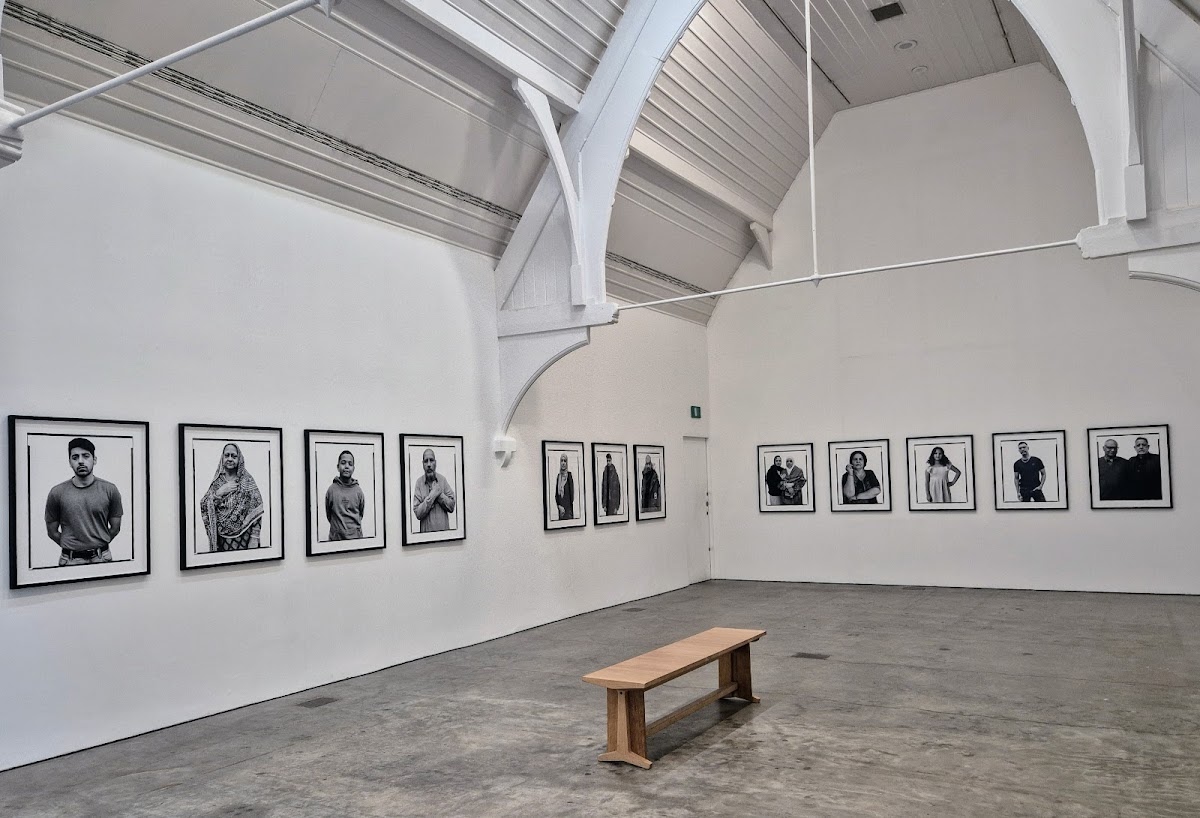
Inside, two floors of high white galleries accommodate film, sound, painting, photography, sculpture, and installation. Roof structure and arched windows remain visible without turning the building into a preserved classroom. The relationship is deliberate: contemporary exhibitions repeatedly alter a shell whose earlier educational life is still readable.
A 1964 Prospectus against Exclusive Art Establishments
The Birmingham artists who founded Ikon issued a prospectus in 1964. It proposed an accessible place where the exchange of visual ideas could become familiar reality and explicitly positioned the new organization against exclusive art establishments. Access was therefore not a later outreach policy but part of the founding aesthetic argument.
The four official founders were Jesse Bruton, Robert Groves, Sylvani Merilion, and David Prentice. Peter Berry, Trevor Denning, Dinah Prentice, John Salt, and others also helped shape the vision. Angus and Midge Skene provided vital early support, linking the artists’ idealism to the practical costs of space, printing, transport, and exhibitions.
Why Four Letters Became the Name Ikon
At a meeting to choose a name, suggestions included New Birmingham Gallery and Image. Robert Groves, interested in Russian and Greek Orthodox icons, liked Ikon as a geometrically balanced four-letter word meaning image. He also heard in it the possibility of moving images. After other proposals fell away, the initially unpopular suggestion remained.
The group was not creating a museum of religious icons. The word suited an organization that wanted art to travel beyond specialist buildings and meet local audiences. Ikon later became an institutional brand, but its origin still works like a verb: move an image, place it somewhere unexpected, and make conversation possible around it.
The 1965 Glass Kiosk and a Gallery without Walls
Ikon first imagined itself as a gallery without walls, a small headquarters for a programme that could tour to non-art venues. In 1965 it occupied an octagonal glass kiosk in Birmingham’s new Bullring precinct beside the Rotunda. Shoppers encountered exhibitions without making a formal journey into a museum.
Glass offered little of the environmental control or wall space expected in a conventional gallery, but it unsettled the boundary between exhibition and street. That experiment did not disappear when Ikon outgrew the kiosk. Projects in schools, hospitals, libraries, community centres, and public space continued to make work outside the main building central to the institution.
From New Street Station to a John Bright Street Warehouse
In 1972, under first director Simon Chapman, Ikon moved to a unit in the shopping centre above New Street Station. Its programme expanded from founder artists and colleagues toward national and international exchange, mixing painting, photography, performance, and experimental practice in the politically active industrial city of the 1970s.
A further move to a warehouse on John Bright Street followed in late 1978. The greater area supported installation and moving image, yet eventually lacked the facilities and scale required by visitors and artists. Frequent relocation was a sign of limited resources, but also a method of growth: Ikon built an audience through programmes before it possessed a landmark building.
Commissioning Cornelia Parker’s Thirty Pieces of Silver
During the 1980s, Ikon presented artists including Rasheed Araeen, Susan Hiller, Helen Chadwick, Sean Scully, and Cornelia Parker. The programme moved through painting, installation, feminist debate, and questions of cultural value rather than representing one medium or school.
In 1988 Ikon commissioned Parker’s Thirty Pieces of Silver. Silver-plated domestic objects were flattened by an industrial press, arranged in thirty groups, and suspended just above the floor. Now in Tate’s collection, the work binds preciousness, violence, labor, and industrial pressure. It also demonstrates Ikon’s role as a producer of work rather than only a temporary display venue.
Elizabeth Macgregor Joined International Art to Regional Touring
Director Elizabeth Macgregor, who led Ikon from 1989 to 1999, strengthened its focus on new work by living artists across painting, sculpture, video, installation, and photography. Exhibitions from abroad gave Birmingham audiences a wider context for British art as international exchange accelerated in the 1990s.
At the same time, touring continued through community centres, schools, hospitals, libraries, and smaller West Midlands venues. Artists in the programme included Dorothy Cross, Mark Dion, Antony Gormley, Donald Rodney, Eva Rothschild, and Yinka Shonibare. International ambition and local access operated as connected responsibilities rather than competing identities.
The Long Life of Oozells Street School
Construction of Oozells Street School began in 1877, and it opened on 28 January 1878 with room for 807 boys, girls, and infants. The building later supported teacher training, adult education, and language courses before becoming theatrical costume storage and a road-tax office in the 1960s.
Former pupils helped secure Grade II listing in 1981 as redevelopment transformed the district. By the early 1990s the school needed a viable new use while Ikon needed more space. Developer Argent offered the site at a peppercorn rent, and a £3.7 million National Lottery grant in 1995 made conversion possible.
Levitt Bernstein Put a New Gallery inside the Old Shell
Axel Burrough and Paul Clark led the conversion for Levitt Bernstein Associates. The architects preserved the Victorian exterior while placing a new steel-framed gallery within it, creating about 440 square metres of exhibition space instead of reconstructing classroom partitions. Historic fabric and contemporary environmental requirements became two legible layers.
The tower was rebuilt from old photographs. A glass lift, staircase, and lead-clad service lift were placed outside to preserve gallery area and provide accessible circulation. Artist Tania Kovats proposed the slate plinth that lifts the school visually against surrounding offices. Ikon reopened there on 21 March 1998 with free admission.
Two Floors Organized around Artists, Not a Permanent Masterpiece Route
A visit to Ikon begins with the current programme rather than a fixed list of collection highlights. Temporary exhibitions, commissions, publications, education, and off-site work determine how the rooms are used. During installation periods the same galleries may close and return with an entirely different scale, sound, and path.
The Tower Room makes the building’s vertical character especially clear. For the fiftieth anniversary in 2014, a sequence of Ikon Icons returned John Salt, Ian Emes, Cornelia Parker, Yinka Shonibare, and Julian Opie as figures associated with different decades. The format treated institutional history as a series of renewed relationships with artists.
Free Entry and a Walk through Central Birmingham
Ikon opens Tuesday through Sunday and on Bank Holiday Mondays from 11 a.m. to 5 p.m.; admission is free. Exhibition changeovers may close the galleries, so check current dates. On a first circuit, follow the media and curatorial sequence. On a second, notice where arches, roof trusses, windows, and the inserted gallery structure affect the work.
The Brindleyplace tram stop is about two minutes away, while Birmingham New Street station is roughly a twenty-minute walk through the city centre. Returning to Oozells Square, the tower can make Ikon appear permanently settled. Its education and off-site work say otherwise: the 1964 question of where art can become publicly familiar still travels beyond the school walls.
Visit Info
- Address: 1 Oozells Square, Brindleyplace, Birmingham B1 2HS, United Kingdom
- Hours: Tuesday-Sunday and Bank Holiday Mondays 11:00-17:00. Check current exhibition dates for installation closures
- Fee: Free admission; donations welcome
- Transport: About 2 minutes on foot from the Brindleyplace West Midlands Metro stop or about 20 minutes from Birmingham New Street station
- Time needed: Allow 1.5-2 hours for the exhibitions and building, or 2.5 hours with the digital guide and a Brindleyplace canal walk
- Website: https://www.ikon-gallery.org/
Visitor Info
| Address | 1 Oozells Square, Brindleyplace, Birmingham B1 2HS, United Kingdom |
| Hours | Translating |
| Admission | Translating |
| Getting There | Translating |
| Duration | Translating |
| Translating | https://www.ikon-gallery.org/ |