The Bridge above the Danube, Rebuilding a National Gallery Instead of Erasing It
The Bridge above the Danube, Rebuilding a National Gallery Instead of Erasing It
Seeing the Slovak National Gallery’s Bridge from the Danube
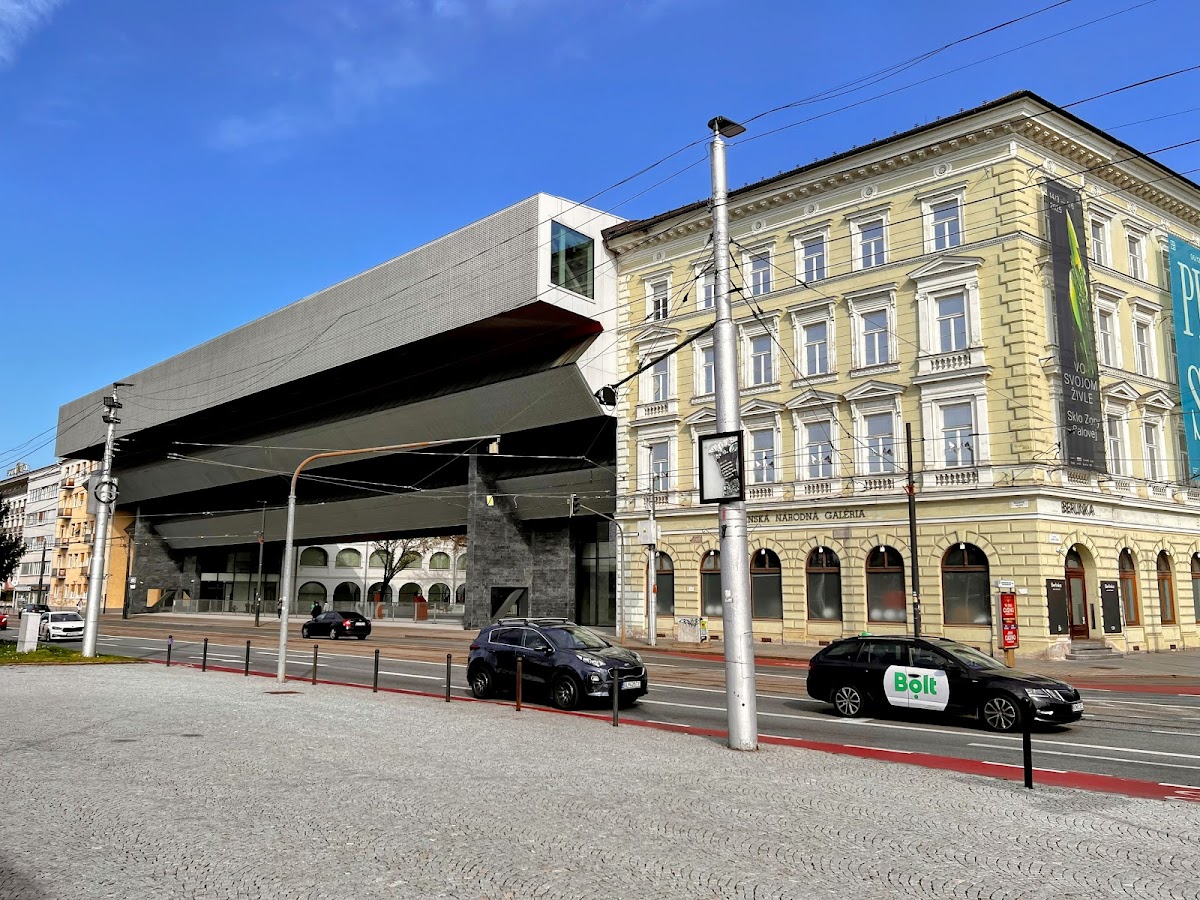
On Bratislava’s Danube embankment, the Slovak National Gallery does not resolve into one historical style. A low Baroque building, a nineteenth-century palace, metallic volumes, courtyards, and an elevated structure meet with visible friction. The most commanding element is Vladimír Dedeček’s Bridge, suspended above the former Water Barracks.
The Bridge was once closed by leaks and technical failure and later faced calls for demolition. Its present condition is the result of reconstruction rather than erasure. Before entering an exhibition, visitors encounter a national institution asking how Baroque fabric, socialist-era modernism, and twenty-first-century intervention can remain publicly legible together.
A National Gallery Established by Law in 1948
The Slovak National Gallery was established by Act No. 24 of the Slovak National Council on 29 July 1948, relatively late among European national galleries. Postwar ambitions to collect, research, and present Slovak art required a new institution, promoted in particular by poet and politician Ladislav Novomeský.
Operations began in 1950 with two employees and roughly 500 works transferred from the Slovak Museum and a former ministry. Although the earliest conception emphasized Slovak and wider European fine art, twentieth-century and contemporary culture were essential from the outset. Applied art, design, photography, stage design, architecture, and other media later widened the remit.
The Water Barracks Became the First Permanent Home in 1955
The former Water Barracks on the Danube were assigned to the gallery around 1950-51. After adaptation by František Florians, with interiors by Karel Rozmány, the building opened to the public on 9 May 1955 with a display surveying 150 years of Slovak art.
The shortage of space was immediately apparent. In 1953 only four rooms totalling 355 square metres had been available, while storage, conservation, offices, a library, and a growing national collection all made competing demands. Preserving the low historic structure while adding serious exhibition capacity became the architectural problem that shaped the complex for decades.
Vladimír Dedeček Lifted Exhibition Space above the Courtyard
A 1963 study competition for expansion ranked Vladimír Dedeček’s proposal first. After substantial revision, the design differentiated buildings and floors by mass and height. Its boldest move was to lift the riverside exhibition wing as a bridge, developed with engineers from the Mostárne Brezno works, so views into the courtyard and toward the Water Barracks remained open.
The new complex included permanent galleries in the Bridge, administration, an amphitheatre, and a library. Only part of the wider plan was built, but it monumentalized the renewed confidence of 1960s architecture. Opened on 1 March 1977, it was Slovakia’s first major modern cultural building and remains an unusually large purpose-built gallery structure in the country.
Technical Closure after Twenty-Four Years
Incomplete construction, poor materials, aging services, and unsuccessful repairs to a leaking glass roof gradually made the Bridge unsuitable for art. In March 2001, director Katarína Bajcurová closed approximately 1,800 square metres of exhibition space for technical reasons.
After the political changes of 1989, some voices also wanted the socialist-era intervention removed to reveal the Baroque barracks. Others argued that a change of regime did not justify deleting a major architectural record. The long closure made the Bridge look like institutional failure, but demolition would have removed the evidence of how postwar Slovakia imagined a public gallery.
The Reconstruction Brief Won by Kusý and Paňák
A first architectural competition in 2002 did not produce a workable result. A more precise second competition in 2005 required Dedeček’s architecture to be treated as a monument. The winning team was BKPŠ, led by Martin Kusý and Pavol Paňák.
Their task extended far beyond repairing leaks. Exhibition, storage, research, education, cinema, library, public circulation, and flood risk had to be reorganized across the Water Barracks, Bridge, Esterházy Palace, and new construction. Work on the main site entered its major building phase in 2016 after years of design, procurement, and institutional relocation.
Building a New Urban Interior between Bridge and Barracks
BKPŠ retained the Bridge while renewing its structure, envelope, floors, climate control, and lighting. New galleries, administration, basements, and courtyards were connected into a circuit rather than a set of dead ends. Historic arches, Dedeček’s muscular steel, and new concrete and metal remain distinguishable instead of being disguised as one period.
A nine-storey depository known as the Sarcophagus moved collection care away from vulnerable basement conditions. Flood protection, storage, and movement of art were as important as the visible galleries. Large courtyards and public routes also allow parts of the complex to operate as urban space, not only as rooms reached after purchasing an exhibition ticket.
Reopening the Complex in December 2022
The reconstruction and extension were completed toward the end of 2022, and the main complex reopened on 11 December. The first programme used provisional and varied collection encounters rather than pretending that every permanent display could appear at once. Residents came to inspect the Bridge, stairs, windows, and courtyards as much as the art.
That response made architecture itself a public exhibit. People who came for the building encountered the national collection; visitors focused on art moved through a debate about modern heritage. The achievement was not simply making an old structure look new, but returning a disputed and technically failed building to public judgment and practical use.
Reading the Range of Roughly 70,000 Objects
The SNG holds about 70,000 objects across Gothic and Baroque sacred art, European old masters, nineteenth-century art, Slovak modern and contemporary work, drawing, prints, photography, design, applied art, stage design, architecture, and new media. Its network extends beyond Bratislava to sites including Zvolen Castle, Strážky Mansion, and Schaubmar’s Mill.
Sacred Art reconnects Gothic and Baroque painting and sculpture to worship, altarpieces, folk piety, copying, and iconoclasm. The Modern surveys Slovak visual culture from around 1890/1900 to 1948 through painting, sculpture, prints, photography, film, and installation. Works by Mikuláš Galanda, Ľudovít Fulla, and Miloš Alexander Bazovský form part of an argument about modernity rather than a fixed patriotic checklist.
Web Umenia and the Idea of a Changeable Permanent Display
Through Web umenia, the SNG and other Slovak galleries publish collection data, high-resolution images, and thematic stories online. Digital access does not replace an encounter with material scale. It makes the limits of physical display honest: fragile paper, textiles, photographs, and thousands of stored works cannot remain on gallery walls indefinitely.
A permanent display here is not expected to stay identical forever. Conservation, new research, loans, and social questions lead curators to rotate and reinterpret works. The collection therefore resembles the reconstructed building: both preserve evidence while accepting that public meaning has to be revised rather than frozen.
A Visit That Joins the Art to the Bridge
The Bratislava gallery opens Tuesday, Wednesday, and Friday through Sunday from 10 a.m. to 6 p.m., and Thursday from noon to 8 p.m.; Monday is closed. Whole-gallery and individual exhibition prices vary, with some exhibitions listed at €3-6. Parts of the ground floor are free, but the current ticket page should guide each visit.
Trams 1 and 4 and buses 29, 50, and 70 stop at Námestie Ľudovíta Štúra. There is no public gallery car park, and the complex is accessible by wheelchair and stroller. Begin outside with the Bridge, cross the courtyard, then move from the Water Barracks into modern galleries. Art and architecture together reveal an institution preserving not only masterpieces, but the difficult choices of what a country repairs instead of removes.
Visit Info
- Address: Rázusovo nábrežie 1, 811 02 Bratislava, Slovakia
- Hours: Tuesday, Wednesday, Friday-Sunday 10:00-18:00; Thursday 12:00-20:00; closed Monday. Confirm last entry and holiday changes
- Fee: Whole-gallery and exhibition tickets vary; some individual exhibitions are €3-6. Parts of the ground floor are free. Check the current ticket page
- Transport: Use tram 1 or 4, or buses 29, 50, or 70 to Námestie Ľudovíta Štúra; the gallery is also walkable from Most SNP
- Time needed: Allow 2.5-3 hours for architecture and collection displays or half a day with temporary exhibitions and the Danube embankment
- Website: https://sng.sk/en/slovak-national-gallery
Visitor Info
| Address | Rázusovo nábrežie 1, 811 02 Bratislava, Slovakia |
| Hours | Translating |
| Admission | Translating |
| Getting There | Translating |
| Duration | Translating |
| Translating | https://sng.sk/en/slovak-national-gallery |