Two Spiral Stairs in Aarau, Joining Old and New Homes for Swiss Art
Two Spiral Stairs in Aarau, Joining Old and New Homes for Swiss Art
Finding Two Spiral Staircases before the Collection
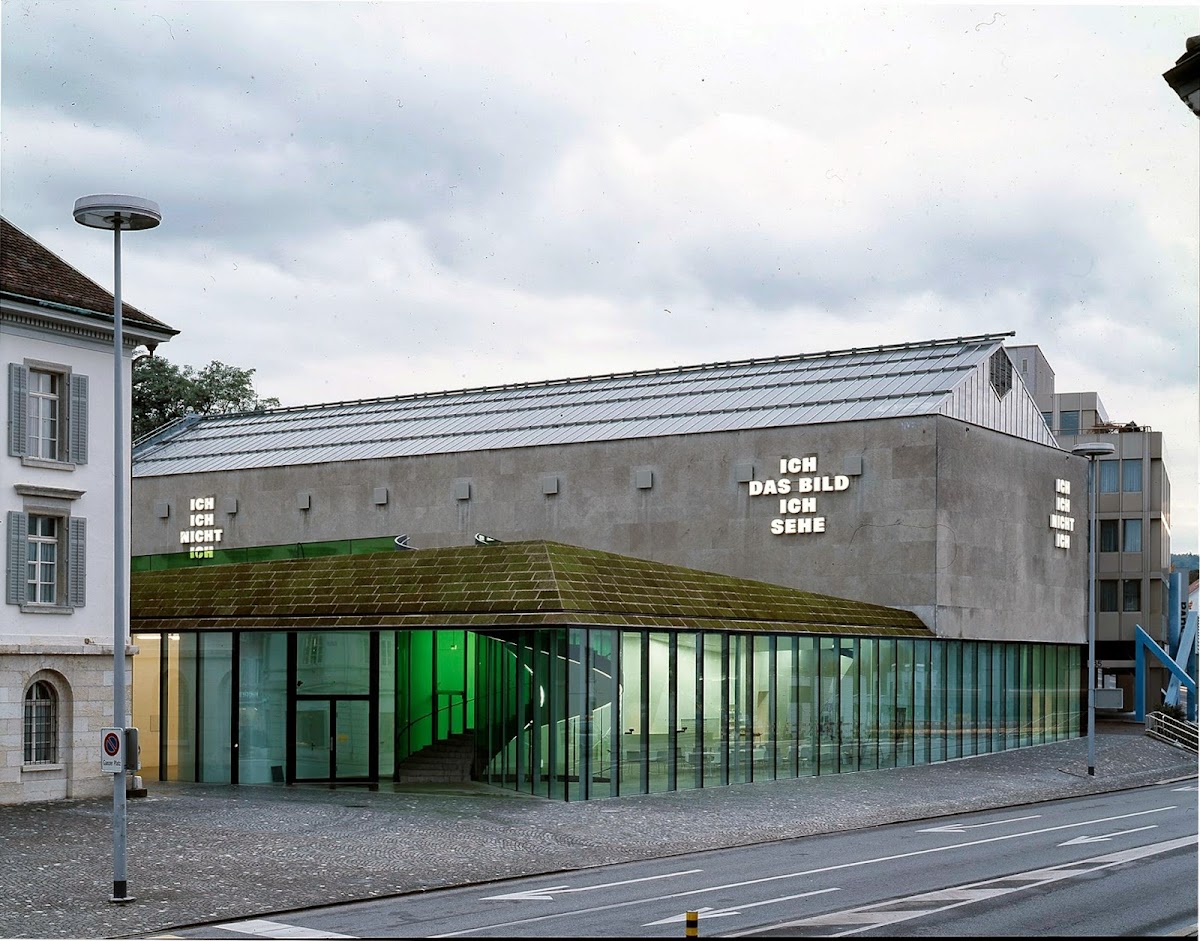
Approaching the Aargauer Kunsthaus from Aarau station, visitors first meet a low green-glass entrance beneath a grey upper wall. A spiral staircase is visible through the glass. Another waits in the 1959 building. The museum treats the pair as icons, yet they are more useful as a way to understand how two architectural periods remain distinct while sharing one route.
The older stair gathers movement inside a postwar civic building; the newer one turns against glass, street and park. Walking both is more revealing than trying to draw a hard border between old and new. Each carries the memory of one floor into the next while changing the visitor’s view of the city.
A Collection Begun by the Aargau Art Association in 1860
The Aargau Art Association was founded in 1860 as a regional section of the Swiss Art Association. A Swiss art exhibition followed in 1861 in a former coach house on the site of today’s museum. For almost a century the association collected and exhibited art while working toward a permanent home.
The present institution is sustained by an unusual public-private agreement formalised in 1962. The Canton of Aargau owns, administers and maintains the building; the association deposits its collection there and remains responsible for its growth and exhibitions. Architecture and collection therefore belong to related but not identical civic histories.
The 1959 Museum by Loepfe, Hänni and Hänggli
Local architects Loepfe, Hänni and Hänggli designed the museum that opened in Aarau’s government district in 1959. Its measured postwar modernism favoured daylight, proportion and clear circulation over monumentality. The original spiral stair concentrates that logic into a compact piece of everyday movement.
Purchases, gifts and bequests soon pressed against the limits of the building. The need for an extension was not only a storage problem. A museum claiming to represent art from Switzerland had to keep accepting contemporary practices rather than freezing its definition at the date of opening.
Herzog & de Meuron and Rémy Zaugg Extend without Erasing
The 2003 extension was designed by Herzog & de Meuron in collaboration with artist Rémy Zaugg. It reads the scale of surrounding streets, parks and government buildings rather than presenting a detached object. A low transparent foyer draws the pavement inward while larger galleries unfold behind it.
The expansion brought total exhibition space to approximately 3,000 square metres in bright, adaptable rooms. A redesigned foyer, reopened in 2023, provides places to pause alongside the café, art bookshop and education spaces. The second spiral stair turns this threshold between museum and city into a visible route.
More Than 21,000 Works of Art from Switzerland
The Aargauer Kunsthaus holds more than 21,000 works from the eighteenth century to the present and describes the collection as the most comprehensive public holding of art from Switzerland. That phrase does not indicate one national style. It includes several language regions, artists who worked across borders and changing arguments about who belongs in Swiss art history.
Historic strengths include Albert Anker, Arnold Böcklin, Johann Heinrich Füssli, Caspar Wolf and nineteenth-century landscape painting. Modern art runs through Cuno Amiet, Alice Bailly, Ferdinand Hodler, Sophie Taeuber-Arp, Ernst Ludwig Kirchner and the Zurich Concretists. Contemporary acquisitions by Omar Ba, Silvia Bächli, Julian Charrière, Sylvie Fleury, Thomas Hirschhorn and Ugo Rondinone keep the sequence open.
From Caspar Wolf’s Alps to Sophie Taeuber-Arp’s Geometry
Caspar Wolf painted glaciers and ravines before the Alps became a familiar tourist image. Their scale and geology resist the idea of landscape as a picturesque backdrop. Comparing his work with Hodler or Amiet shows how the same mountains and lakes could become rhythm, colour and national symbol in later hands.
Taeuber-Arp’s geometry crosses painting, applied art, dance and architecture. Her work also exposes the limits of categories that once placed women and decorative practice outside the centre of art history. When the museum sets such works near recent installation or photography, the connection lies less in appearance than in a shared refusal of fixed boundaries.
A Collection That Is Re-Edited rather than Permanently Fixed
The museum rotates historic holdings and recent acquisitions instead of presenting one permanent march through chronology. A particular masterpiece may not be visible on every visit. The reward is a changing set of relationships among landscape, body, abstraction, craft, migration and social questions.
Annual presentations of regional art and younger artists make the large historical collection a working context rather than a weight. Older work must not reduce the present to an appendix, while contemporary programming must not use the past as decoration. That productive tension gives the institution its character.
Planning a Route through the Two Buildings
Begin with the collection galleries to establish the changing breadth of Swiss art, then cross between the original building and the extension. Walk both spiral stairs and look back through the green-glass foyer before stepping outside to compare the low entrance with the grey upper volume and neighbouring civic buildings.
The museum is usually open Tuesday through Sunday from 10 a.m. to 5 p.m., with Thursday hours until 8 p.m., and is closed Monday. Exhibition changeovers and holiday schedules can alter access. Allow at least two hours; the short walk from Aarau station also makes it easy to continue into the old town and along the Aare without turning the museum into a rushed stop.
Visit Info
- Address: Aargauerplatz, 5001 Aarau, Switzerland
- Hours: Tuesday-Sunday 10:00-17:00, Thursday until 20:00, closed Monday. Check holiday and installation closures
- Fee: Admission varies by exhibition and concession; confirm on the official ticket page
- Transport: About an 8-10 minute walk from Aarau station toward the old town
- Time needed: Allow 2-2.5 hours for the collection and temporary exhibitions, or half a day with the old town and Aare river
- Website: https://aargauerkunsthaus.ch/en/
Visitor Info
| Address | Aargauerplatz, 5001 Aarau, Switzerland |
| Hours | Translating |
| Admission | Translating |
| Getting There | Translating |
| Duration | Translating |
| Translating | https://aargauerkunsthaus.ch/en/ |