A White Art Hall in Aarhus, Opening Questions for More Than a Century
A White Art Hall in Aarhus, Opening Questions for More Than a Century
A Low White Building beside Aarhus’s Cultural District
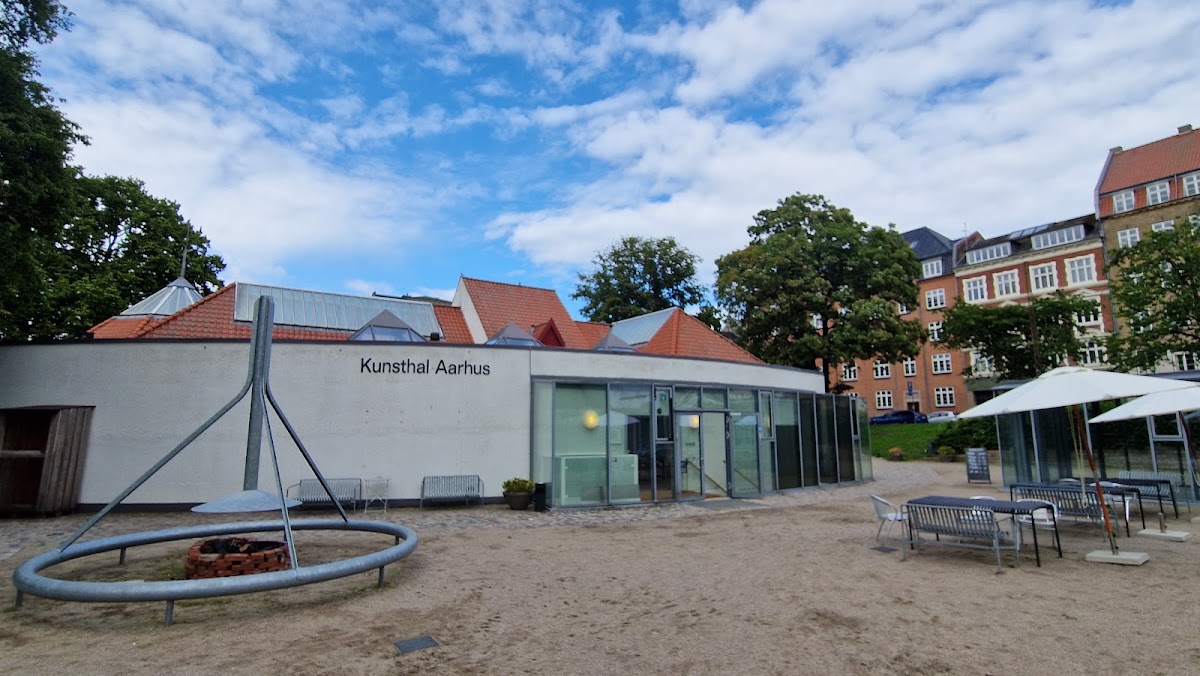
A few minutes south of ARoS, Kunsthal Aarhus appears as a low group of white walls, red tiled roofs and later additions. The word KUNST and changing posters carry more visual weight than a monumental entrance. From the courtyard, old rooflines, glass doors, outdoor sculpture and the neighbouring city overlap.
This is an art hall shaped by changing exhibitions rather than a route through a fixed permanent display. The useful first question is not which masterpiece is always present, but which artist has altered the rooms now and what kind of conversation the programme has opened.
Kunstbygningen Opens in 1917
The institution began in 1917 as Kunstbygningen, the Art Building, designed by architect Axel Høeg-Hansen. It provided a dedicated exhibition venue for artists and audiences in Aarhus and is now considered one of the oldest kunsthalles in Denmark and Europe.
Local artists played a major role in its early life. Works arrived, were discussed and departed, leaving the building ready for another argument. The institution’s continuity therefore lies less in an unchanging collection than in more than a century of installing and dismantling exhibitions.
The Red-Walled Aarhus Permanente Period
In 1955 the venue became Aarhus Permanente, run by a company that presented art alongside household objects and tools. The building was painted a festive brick red. Until 1972 it moved among the roles of exhibition hall, trade presentation and local cultural meeting place.
That mixed history is not simply an outdated prelude to contemporary art. Today’s institution still brings music, film, literature and social events into contact with exhibitions. The object categories have changed, but a willingness to cross the line between art and everyday culture remains.
Five Galleries Shaped by C.F. Møller Extensions
C.F. Møller Architects extended the building during the 1990s and 2000s. The current complex offers about 1,000 square metres across five galleries. New rooms were inserted beside and below the older roofscape rather than replacing its modest scale.
The variety matters. A large installation, a dark moving-image work and a small group of objects do not require the same white box. Galleries can be combined differently, and the shifts between daylight, basement, courtyard and sculpture park become material for each exhibition.
Becoming Kunsthal Aarhus in 2013
The current name was adopted in 2013, clarifying an organisation with professional leadership, a board and a programme linking local, Danish and international contemporary art. The change did not erase the 1917 building; it made the institution’s present role more explicit.
Solo exhibitions, thematic projects and collaborations are accompanied by performance, music, film, literature and discussion. The café and shop are not merely services at the edge of art. They help turn a first visit into a social place people can return to even when the galleries change.
KP & SPRING and the Value of a First Public Showing
The long-running KP artists’ Easter exhibition and SPRING programme create public opportunities for artists who may not yet have established names. Open submission and jury selection let visitors encounter current tendencies before they have settled into art history.
The format also deserves scrutiny: selection can create a new authority and many works must share limited attention. Its importance lies in keeping a middle ground between art school, independent practice and larger institutions, allowing emerging work to meet an audience in a serious public venue.
The Sculpture Park as a Threshold
Outside, sculpture, benches, trees and café seating share the same ground. A passer-by can pause without first committing to an exhibition. Accessibility here does not mean that every work is easy. It means that difficulty is given time, seating, conversation and educational support rather than guarded by a ceremonial entrance.
The institution has developed a strong focus on young audiences, especially upper-secondary and university students. Publicness has shifted from the promise of one correct interpretation to the provision of a place where different interpretations can be spoken and tested.
Reading a Century in One Visit
Check the current artists and exhibition dates before entering; do not expect a permanent masterpiece route. Compare how each project uses the five galleries, then step into the courtyard to read Høeg-Hansen’s roofline, the C.F. Møller additions, sculpture park and café together.
Kunsthal Aarhus is normally open Tuesday, Wednesday and Friday through Sunday from 11 a.m. to 6 p.m., and Thursday until 8 p.m.; it is closed Monday and on selected holidays. Admission is free. Allow at least ninety minutes, then carry one unresolved question into the surrounding cultural district rather than treating the building as a checklist.
Visit Info
- Address: J. M. Mørks Gade 13, 8000 Aarhus C, Denmark
- Hours: Tue/Wed/Fri-Sun 11:00-18:00, Thu 11:00-20:00, closed Monday and selected holidays. Check current notices
- Fee: Free admission
- Transport: About 15 minutes on foot from Aarhus Central Station and 5 minutes from ARoS
- Time needed: Allow 1.5-2 hours for exhibitions and the sculpture park, or 2.5 hours with the café and surrounding cultural district
- Website: https://kunsthalaarhus.dk/en
Visitor Info
| Address | J. M. Mørks Gade 13, 8000 Aarhus C, Denmark |
| Hours | Translating |
| Admission | Free |
| Getting There | Translating |
| Duration | Translating |
| Translating | https://kunsthalaarhus.dk/en |