Blue Neon on a Melbourne Campus, When the Museum Left the Classroom
Blue Neon on a Melbourne Campus, When the Museum Left the Classroom
Blue Neon on the Caulfield Campus
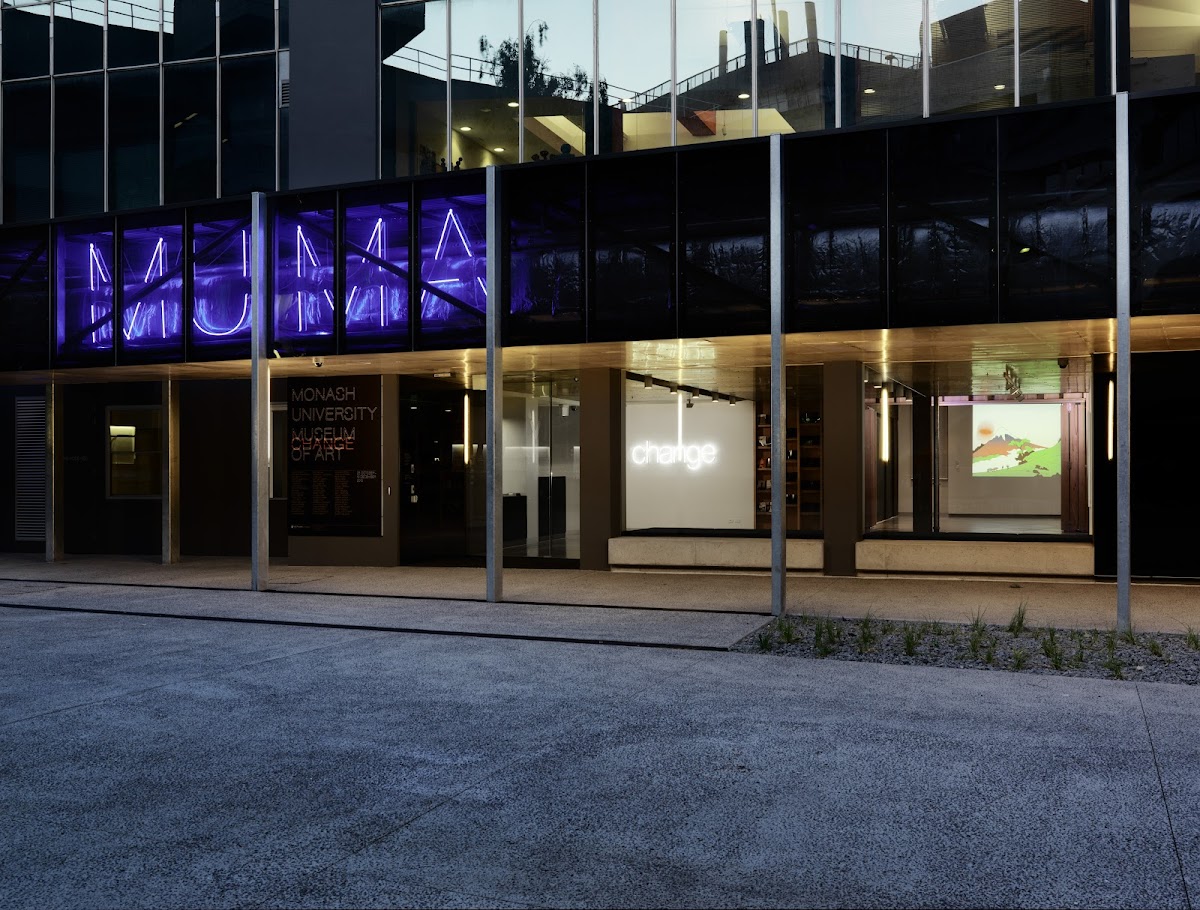
A train from central Melbourne reaches Caulfield station beside Monash University. On the ground floor of Building F, blue MUMA letters stretch across a glass facade. Galleries sit within the daily paths of studios, classrooms and commuters rather than behind a separate monumental plaza.
MUMA is the Monash University Museum of Art, but it is not limited to students. It presents free public exhibitions, commissions, research and publications in Australian and international contemporary art. The campus location repeatedly places art inside ordinary routines.
Louis Matheson Begins a University Collection in 1961
The Monash University Collection began when the university opened in 1961. Founding Vice-Chancellor Sir Louis Matheson allocated a modest sum to art, arguing that a publicly displayed collection of contemporary Australian work would provide students with a valuable educational experience.
Early acquisitions favoured living and emerging artists rather than only established historical names. Works were displayed throughout university buildings, making repeated encounters in corridors and shared spaces part of the collection’s teaching method.
From the 1975 University Gallery to MUMA
The Monash University Gallery was established in 1975 to manage the growing collection and create a professional exhibition programme. By a major 1987 collection exhibition, the holdings numbered about 650 works. Painting and sculpture expanded into photography, moving image, installation and records of performance.
Changing the institution’s name to MUMA clarified responsibilities for collecting, conservation, research, education and public access without abandoning the experimental habits of a university gallery. Its fiftieth anniversary in 2025 marked continuity from that 1975 foundation.
Kerstin Thompson Architects Opens the Current Museum in 2010
MUMA moved to its present Caulfield facilities in 2010. Kerstin Thompson Architects opened the ground floor of an existing campus building to galleries, education rooms, public circulation and the sculpture court. The transparent frontage reveals fragments of exhibitions before a visitor enters.
The inaugural exhibition, Change, took its name from a neon work by Blair Trethowan. It followed the collection from late modernism to contemporary practice and treated relocation as a chance to reconsider the museum’s position. The architecture still works through that overlap of controlled gallery space and visible campus life.
About 2,500 Works since the 1960s
The Monash University Collection now includes about 2,500 works across painting, drawing, print, sculpture, photography, video, installation, public art and performance documentation. It is nationally recognised for tracing Australian art since the 1960s as both the university and society changed.
Late modernism, pop, minimal and conceptual practice meet feminism, First Nations sovereignty, colonial history, migration, gender, environment and technology. Rather than proposing one Australian style, the collection asks who has authority to describe Australia and from which histories.
The Ian Potter Sculpture Court and Silverscreen
The Ian Potter Sculpture Court, designed by Simon Ellis Landscape Architects and Fiona Harrisson, joins sitting, walking and events to encounters with art. It received an Australian Institute of Landscape Architects urban design award in 2011.
Callum Morton’s architecturally integrated Silverscreen is another key work from the 2010 reopening. Such commissions allow the building and campus to become artistic material. Public art is not simply an outdoor checklist; it accumulates meaning through use, distraction and repeated passage.
First Languages Changes Who Speaks for the Collection
Since 2016, First Languages of the Monash University Collection has commissioned writing about works in artists’ first or ancestral languages. The project challenges the assumption that English should always be the primary language through which art in an Australian institution is interpreted.
For Aboriginal and Torres Strait Islander artists in particular, language carries relationships among culture, law, Country, spirituality and history that cannot be reduced to an English caption. The programme changes not just translation but authorship, audience and the museum’s responsibility to its own descriptions.
Continuing the Visit beyond the Galleries
Begin with the current exhibition and allow time for moving-image work and the curatorial argument. Then walk the Ian Potter Sculpture Court and use the digital public art guide to follow works across Caulfield. A separate trip can extend the route to early and recent commissions at Clayton.
MUMA is usually open Tuesday through Friday from 10 a.m. to 5 p.m. and Saturday from noon to 5 p.m.; it is closed Sunday, with Monday visits by appointment. Entry is free. Check university holidays and exhibition changeovers, and reserve time to see how artworks sit among classes and commuting rather than ending the visit at the gallery door.
Visit Info
- Address: Ground Floor, Building F, Monash University Caulfield Campus, 900 Dandenong Road, Caulfield East VIC 3145, Australia
- Hours: Tuesday-Friday 10:00-17:00, Saturday 12:00-17:00, closed Sunday; Monday by appointment. Check changeover closures
- Fee: Free admission
- Transport: Train from central Melbourne to Caulfield station, then about a 5-minute walk through campus
- Time needed: Allow 1.5 hours for exhibitions or 2.5 hours with campus public art and the Ian Potter Sculpture Court
- Website: https://www.monash.edu/muma
Visitor Info
| Address | Ground Floor, Building F, Monash University Caulfield Campus, 900 Dandenong Road, Caulfield East VIC 3145, Australia |
| Hours | Translating |
| Admission | Free |
| Getting There | Translating |
| Duration | Translating |
| Translating | https://www.monash.edu/muma |