Manchester’s Red Gallery in the Park, Where Textile Brickwork Faces the Trees
Manchester’s Red Gallery in the Park, Where Textile Brickwork Faces the Trees
Walking from Oxford Road into Whitworth Park
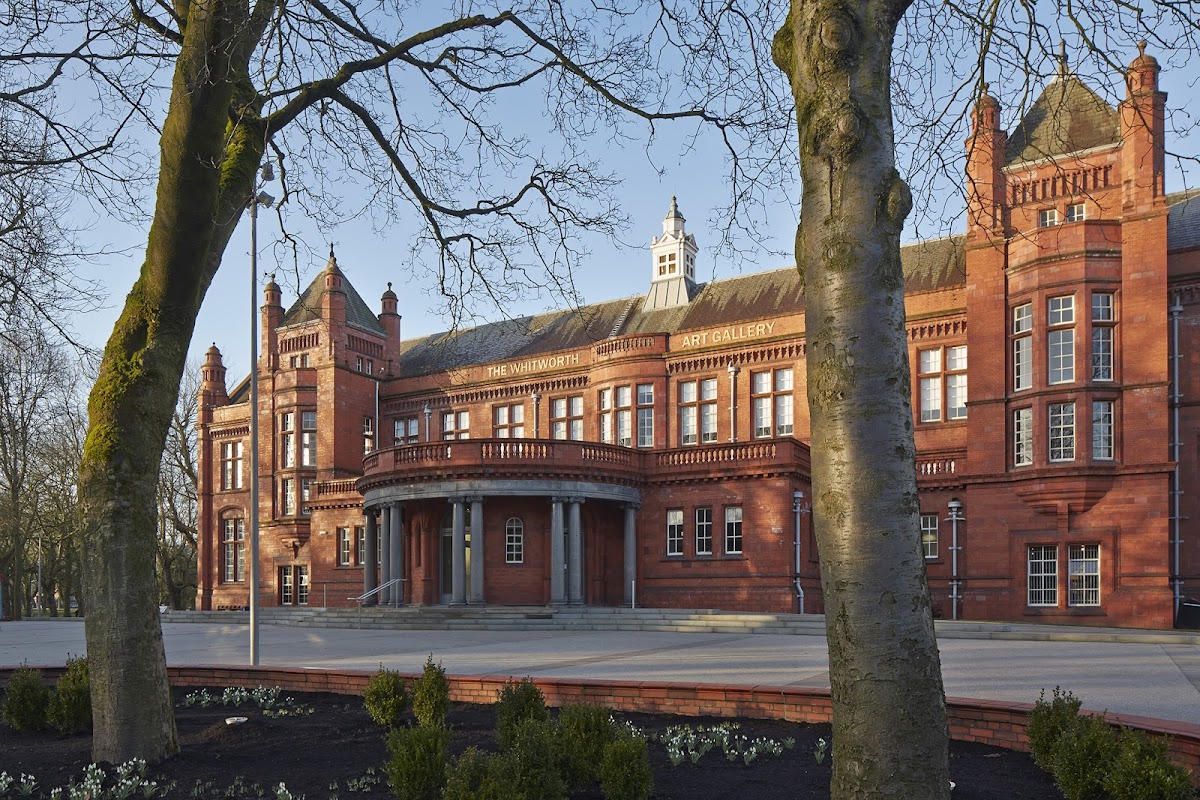
The Whitworth first appears as a long red-brick civic building among trees on Oxford Road. Its historic front still announces an art gallery. Behind it, however, glass, steel and patterned brick wings extend into the park, turning what was once the back of the museum into another public face.
One wing contains gallery and study spaces; the other carries a long transparent café at canopy height. A glazed promenade and art garden join them. Walking around the entire building reveals the central question of the recent Whitworth: how can a historic industrial-city gallery reconnect university, neighbourhood and park?
The Whitworth Institute and Park, Founded in 1889
The institution was founded in 1889 as the Whitworth Institute and Park in memory of engineer and industrialist Sir Joseph Whitworth. Its stated purpose was the perpetual gratification of the people of Manchester, joining art, education and green space as a civic response to life in a rapidly industrialising city.
The gallery became part of the University of Manchester in 1958. Research and teaching expanded, but the public mission remained. Today the Whitworth describes itself as a convening space between the university and the people of the city.
Works on Paper, Textiles and Wallpaper at the Centre
The collection contains more than 55,000 works of art, textiles and wallpaper. Prints, drawings and watercolours have been central since the beginning. Early collecting deliberately resisted fashionable oil painting by developing a strong history of English works on paper.
Textiles were equally foundational. Manchester and the surrounding Lancashire towns were global centres of cotton manufacturing, and the founders imagined a museum of industrial art that could inspire designers and makers. Wallpaper adds a history of technology, domestic taste, class and mass consumption.
Reading an Industrial World through Pattern
Beautiful fabric cannot be separated from the global systems that supplied Manchester’s cotton industry. Colonial trade, coerced labour, migration and consumption sit behind materials and patterns. The collection can therefore function as evidence of power as well as a source of visual pleasure.
Recent exhibitions have connected historic holdings with displacement, care, community and social change. Reinterpreting the collection is not a single statement of guilt or pride; it requires research into provenance, missing voices and the changing meanings objects hold for different communities.
MUMA Architects Reconnect the Gallery and Park in 2015
The Whitworth reopened in 2015 after a £17 million redevelopment by MUMA, McInnes Usher McKnight Architects. Public space doubled, with expanded galleries, a study centre, learning studio and collection-care facilities supporting the museum’s 55,000-plus objects.
Two new wings push into Whitworth Park and meet through a glass promenade. The intervention made the park an entrance, view and programme space rather than scenery behind the museum. The gallery was named Art Fund Museum of the Year in 2015 and shortlisted for the Stirling Prize.
Textile Slash Work Translated into Brick
The extension uses a special blend of British brick patterned after traditional textile slash work in the collection. It does not reproduce one fabric as a facade image. Instead, small shifts in the brick courses create changing shadows that recall woven and cut surfaces.
The material connects to the historic red building while making the new work legible. Sun, rain and moving tree shadows keep the pattern from becoming a fixed logo. The collection becomes an architectural method, though its industrial and labour histories still need to be encountered inside.
A Glass Café, Art Garden and Study Centre
The café projects among the trees, mixing conversation, tableware and park life with the museum route. Between the wings, the art garden and outdoor programme blur the boundary between exhibition visit and ordinary walk. These social spaces are central to the building’s civic ambition.
At the same time, a bookable Study Centre provides close access to vulnerable works on paper, textiles, wallpaper and smaller oils and sculptures. The Whitworth holds open public ground and carefully controlled collection care within one institution rather than treating them as opposing purposes.
Planning a Route from Red Brick to Glass
Begin at the Oxford Road front, then look for whichever works on paper, textiles or wallpaper are currently displayed; light-sensitive material rotates, so no single object should be assumed visible. Continue through the glazed promenade to the patterned brick, landscape gallery, café and art garden.
The gallery is usually open Tuesday through Sunday from 10 a.m. to 5 p.m., with Thursday hours until 9 p.m., and is closed Mondays including Bank Holiday Mondays. Admission is free. Keep two hours for art and another hour for architecture and park so the founding link between gallery and green space can be experienced rather than merely read.
Visit Info
- Address: Oxford Road, Manchester M15 6ER, United Kingdom
- Hours: Tuesday-Sunday 10:00-17:00, Thursday until 21:00; closed Mondays including Bank Holiday Mondays. Check special notices
- Fee: Free admission
- Transport: Bus or walk from Manchester Oxford Road station; frequent buses run south along Oxford Road from the city centre
- Time needed: Allow 2 hours for exhibitions and collections, or 3 hours with the park, art garden and café
- Website: https://www.whitworth.manchester.ac.uk/
Visitor Info
| Address | Oxford Road, Manchester M15 6ER, United Kingdom |
| Hours | Translating |
| Admission | Free |
| Getting There | Translating |
| Duration | Translating |
| Translating | https://www.whitworth.manchester.ac.uk/ |