A Round Roof in Seogwipo, Where Korea’s First Municipal Art Museum Resembles a Jeju Nul
A Round Roof in Seogwipo, Where Korea’s First Municipal Art Museum Resembles a Jeju Nul
A Low Round Museum near the Southern Edge of Seogwipo
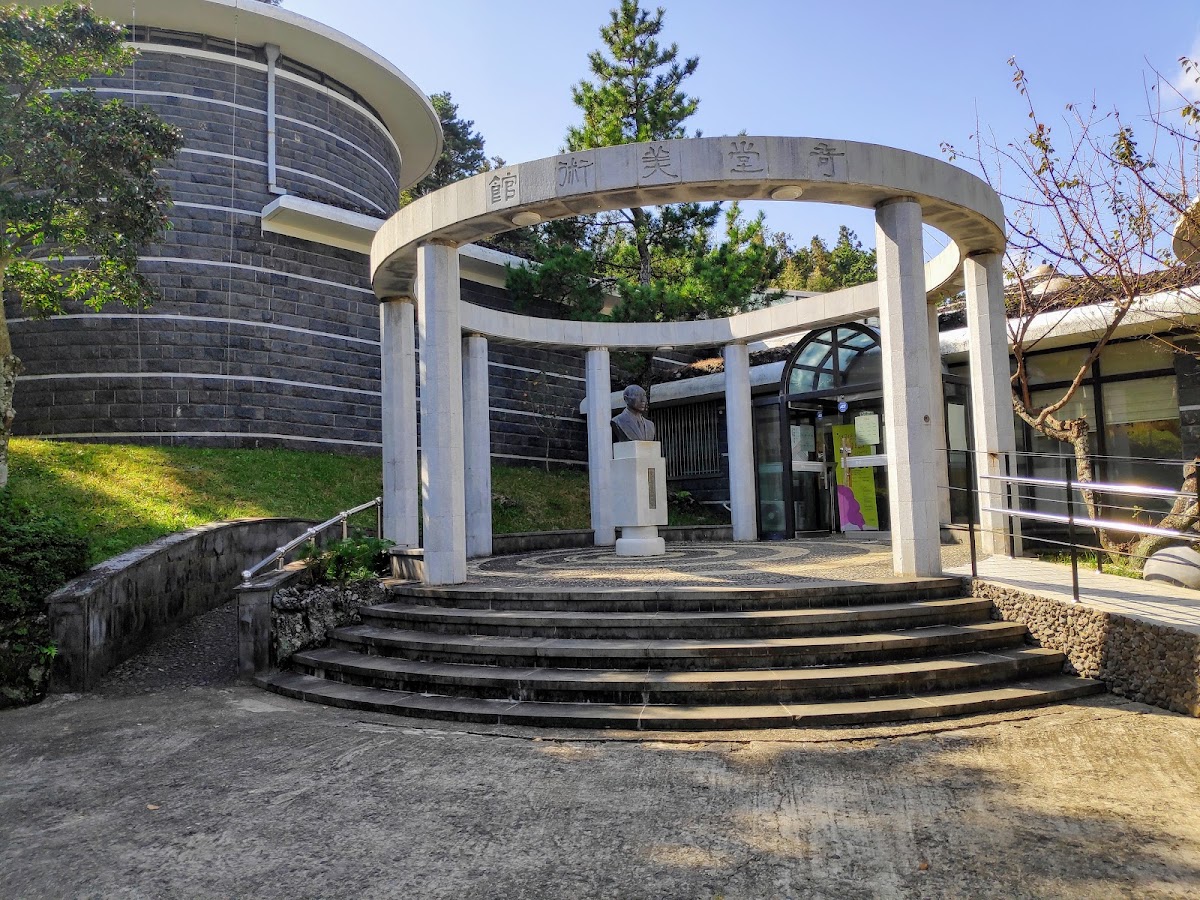
Before central Seogwipo reaches the sea, the ground begins to fall and a dark stone cylinder appears among trees. Gidang Art Museum does not announce itself through a tall facade. Black walls, white eaves and a circular entrance sit low against the slope. The shape becomes legible only as a visitor approaches and begins to walk around it.
An old sign rests above a curved colonnade, while a bust of donor Kang Gu-beom stands inside the entrance. The cylindrical wall looks almost like a storehouse from outside, yet inside it becomes a gentle route through the galleries. The name of one donor, a municipal doorway and a form borrowed from rural Jeju meet in the first few steps.
Visitors who arrive only for paintings by Byun Shi-ji may pause at the building itself. It asks what an art museum built for Jeju should look like before presenting any collection. Following its round roof leads naturally to the story of how Seogwipo acquired a municipal museum in 1987.
Kang Gu-beom’s Gift Opens Korea’s First Municipal Art Museum
Gidang Art Museum was built by Kang Gu-beom, a Jeju-born Korean entrepreneur based in Japan, and donated to the city of Seogwipo. Named after his pen name, it opened on 1 July 1987. Official city records describe it as the first purpose-built municipal art museum to open anywhere in Korea.
Two commitments meet in that origin. A person who made his life away from Jeju chose to return a cultural building to his home island, and the city chose to operate the gift as a public institution rather than a static memorial. Although the donor remains present in the name, the galleries are not confined to his biography or a single private collection.
A gift of architecture can become an empty monument if acquisition, conservation, research and education do not continue. The significance of Gidang lies not only in its founding story but in nearly four decades of municipal work that followed. A private act of return became a public collection serving artists and audiences in Seogwipo.
Architect Kim Hong-sik Translates a Jeju Nul into a Gallery
Architect Kim Hong-sik drew the form from a nul, the rounded mound made by stacking bound grain sheaves on a Jeju farm. A nul was built to withstand rain and wind while keeping a season of labour safe. The museum translates that principle into a circular body, a spiral roof and a route that gradually turns through the exhibitions.
The reference avoids treating regional identity as applied decoration. Instead of placing a replica cottage or familiar island symbol in front of a conventional gallery, the design brings the acts of stacking, enclosing and circling into its plan. The curved exterior wall becomes a device for adjusting pace inside.
Exposed rafters and carefully moderated daylight extend the idea. Light spreads across wall and ceiling rather than striking every work from the front, while the lower timber structure keeps a domestic measure within a civic building. A form once used to store crops now houses paintings, calligraphy and memories for another generation.
About 660 Works Connect Jeju with Korean Modern Art
Official visitor information describes a collection of about 660 works across painting, sculpture, craft, prints and calligraphy. It includes major figures such as Kim Ki-chang, Jang Woo-sung, Suh Se-ok, Song Soo-nam, Min Kyoung-gap, Lee Wal-chong, Park No-soo, Chang Ree-suok, Park Seo-bo, Kim Won, Lee Dai-won, Chun Kwang-young and Kang Yo-bae.
The list matters less as a checklist of famous names than as a field of comparison. Ink painting, calligraphy, abstraction and island landscapes reveal that Korean modern art cannot be reduced to one chronology written in Seoul. A regional museum is not a smaller copy of a national institution; it can redraw the map from another position.
Three or four collection and temporary exhibitions each year return stored works to new contexts. Displays therefore change, and a specific piece cannot always be promised. The collection may be stable as a number, but in the galleries it keeps being edited into different sentences.
Byun Shi-ji Gives the Wind of Jeju a Visible Force
Seogwipo-born painter Byun Shi-ji anchors the permanent presentation. He is often called the painter of ochre and the painter of storms. His brown and yellow fields do not merely imitate island soil; they bind cloud, sea, stone and human solitude into a restricted but highly active atmosphere.
In Storm from 1983, waves climb toward the sky while a cottage, pine, horse and solitary person endure the wind. Dry, urgent brushwork shakes the whole surface rather than polishing each object. The official interpretation connects the scene to nol, the Jeju word for the rough surge driven ashore by a typhoon, and to the long endurance of island life.
The small human presence does not conquer nature. It survives by returning to ordinary life after each assault. Rock and pine hold their ground without becoming heroic emblems. The image complicates the blue coastal scenery marketed to travellers, preserving beauty and hardship within the same weather.
Seogwipo Landscape and Hallasan Leave Each Figure Alone
Seogwipo Landscape from 1986 is calmer than Storm. A waterfall drops beside cliffs and open sea while a painter and horse occupy one edge. The same ochre family becomes softer, and a quieter horizon suggests the feeling of someone returning to a hometown after years away.
In Hallasan from the 1980s, mountain, sun, cottage, person, horse and crow occupy the scene with striking isolation. Byun frequently left only one of each motif. The lack of pairs creates tension but also makes room for viewers to address each figure. Landscape becomes a conversation between an immense island and a single consciousness.
Seen together, the paintings prevent Jeju landscape from settling into one climate. Violent sea, quiet waterfall and blunt mountain resemble different pressures within a remembered home. The museum offers more than a search for recognisable landmarks; it shows how emotion can make the same island move in radically different ways.
Kang Yong-beom’s Calligraphy Changes the Rhythm of Looking
Calligraphy by Kang Yong-beom forms another recurring part of the permanent display. Its material and reading rhythm differ from oil painting. In front of calligraphy, attention shifts toward the pressure at the beginning of a stroke, the speed of spreading ink and the intervals of untouched paper.
The presence of calligraphy also prevents a regional art museum from defining Jeju only through painted scenery. Writing has long been tied to education, literary culture, domestic life and public signs. Gidang places its formal energy inside the same viewing experience as modern painting rather than leaving it at the edge of fine-art history.
Long vertical sheets respond to the exposed rafters and curved walls. Beams establish a horizontal measure while each work introduces a different pulse. The dialogue confirms that the building is not simply an imported white-box model wrapped in local stone.
From Park Seo-bo to Kang Yo-bae, the Collection Widens Jeju
Park Seo-bo’s repeated gestures and Kang Yo-bae’s historically charged landscapes appear to move in distant directions. One accumulates duration through marking and pushing a surface; the other returns communal experience to the land and sea of Jeju. Their coexistence shows that a museum on the island need not collect only images with obvious local subjects.
Modern ink by Suh Se-ok and Song Soo-nam, chromatic landscapes by Lee Dai-won and hanji constructions by Chun Kwang-young create further routes among tradition, abstraction and material. Jeju becomes a coordinate for comparison rather than a fence around the collection.
Temporary exhibitions are most useful when visitors ask why particular works have been placed together. Region, material, generation and landscape can each produce a different account from the same holdings. The historic title of first municipal art museum remains meaningful only when new artists and audiences continue to enter those accounts.
SSAM Connects Three Public Art Institutions in Seogwipo
The city links Gidang Art Museum with Lee Jung Seop Art Museum and Soam Memorial Museum through SSAM, the Smart Seogwipo Art Museum platform. High-resolution images, videos and audio interpretation allow works from the three institutions to be explored before and after a physical visit. Thirty Gidang works were included among the original group of 120 digitised works.
A screen cannot replace the scale of Typhoon, the dry surface of a brushstroke or the changing density of ink. It can, however, enlarge details and place works from separate buildings side by side. Digital and physical visits function best as different instruments rather than competing substitutes.
Together the three institutions resist explaining the art of Seogwipo through one celebrated figure. Lee Jung-seop’s brief but intense residence, Byun Shi-ji’s return and ochre Jeju, and Soam Hyeon Jung-hwa’s calligraphy form separate yet connected stories of place, donation and public memory.
A Route through the Round Building and Current Visit Details
Begin outside by reading the circular wall and roof, then follow the interior curve while noticing rafters, daylight and changes in pace. Compare Byun Shi-ji’s wind with the movement of Kang Yong-beom’s strokes before entering the temporary exhibition. Looking back at the building from outside makes the reference to a stacked nul clearer than it appeared on arrival.
Official hours are Tuesday through Sunday from 09:00 to 18:00, extended to 20:00 from July through September. Last admission is 30 minutes before closing. The museum closes on Monday, 1 January, Lunar New Year and Chuseok. Adult admission is KRW 1,000, with concessions and exemptions based on age, residence and eligibility. Substitute holidays and installation changes should be confirmed on the official page.
The galleries can be covered in a little over an hour, but the museum deserves a slower visit if architecture and founding history are included. Chilsimni Park and the Cheonjiyeon area can extend the route into the actual terrain behind Byun’s cliffs, wind and water. The most durable image is not one masterpiece alone, but the transformation of a grain mound into a round civic house for art.
Visit Info
- Address: 15 Namseongjung-ro 153beon-gil, Seogwipo-si, Jeju-do, South Korea
- Hours: Tuesday-Sunday 09:00-18:00, extended to 20:00 from July through September. Last admission 30 minutes before closing. Closed Monday, 1 January, Lunar New Year and Chuseok; check substitute-holiday notices
- Fee: Adults KRW 1,000, youth and military KRW 500, children KRW 300. Check official concession and exemption conditions
- Transport: Local bus or taxi from central Seogwipo; parking is available for about 40 cars
- Time needed: Allow 1-1.5 hours for permanent and temporary displays, or 2 hours or more with Chilsimni Park and the Cheonjiyeon area
- Website: https://culture.seogwipo.go.kr/gidang/
Visitor Info
| Address | Translating |
| Hours | Translating |
| Admission | Translating |
| Getting There | Translating |
| Duration | Translating |
| Translating | https://culture.seogwipo.go.kr/gidang/ |