A Cidre-Gold Roof in Hirosaki, Where a Brick Warehouse Brews Memory
A Cidre-Gold Roof in Hirosaki, Where a Brick Warehouse Brews Memory
Red Brick before Contemporary Art
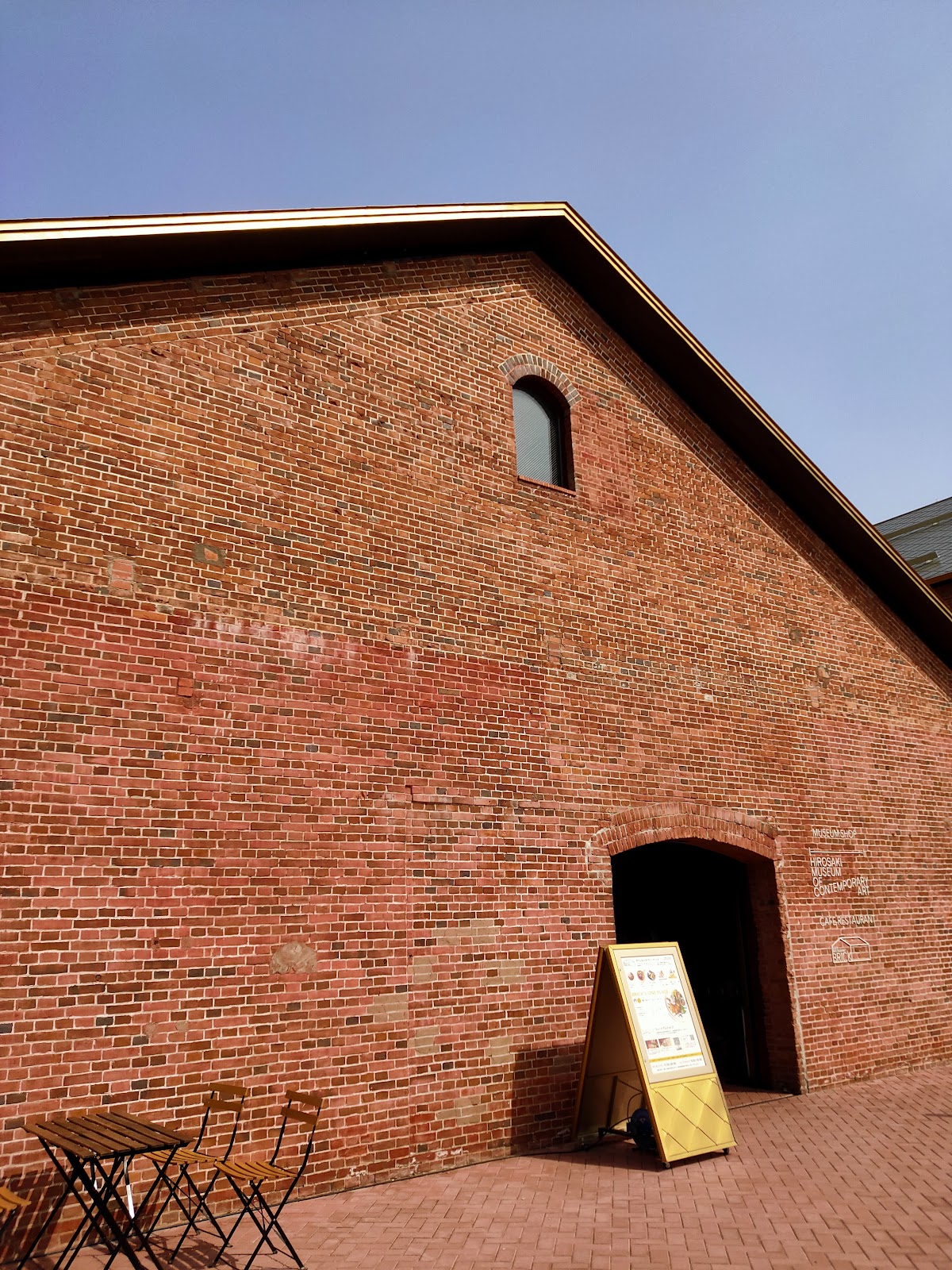
Across Yoshinocho Park in central Hirosaki, low red-brick warehouses extend behind a broad lawn. No glass monument announces a new museum. Weathered bricks, patches of mortar and lines of later reinforcement reveal several periods before a visitor reaches the door.
Above them, the roof shifts from grey to a pale metallic gold as the angle of light changes. The museum calls the colour cidre gold. It recalls the apple liquor once produced here while marking the building as a contemporary public institution without erasing its industrial body.
Fukushima Tosuke Builds for a Future beyond His Business
Entrepreneur Fukushima Tosuke developed a brewery on land once connected to an orchard of Kusumi Tojiro, a contributor to the growth of Aomori’s apple industry. During the Meiji and Taisho periods the site expanded into a major group of factory and warehouse buildings.
Official architectural history records Fukushima saying that even if his enterprise failed, the brick buildings could remain useful heritage for the future city. Whatever uncertainty belonged to that original moment, the choice gave Hirosaki a structure able to survive changing businesses and public purposes.
Japan’s First Mass-Produced Cidre in 1954
After studying apple processing in Europe, Yoshii Isamu encountered French cidre and founded Asahi Cider. In 1954 the company began what the museum identifies as the first mass production of cidre in Japan. Fruit from the surrounding region became a new industrial product inside the old brewery.
The operation passed to Nikka Whisky, which used the Hirosaki factory until 1965. After production moved away, the warehouses stored government emergency rice and other goods. Sake, apple liquor and grain occupied the same walls in succession, making storage and adaptation central to the site’s memory.
Citizen-Led Yoshitomo Nara Exhibitions Change the Possible Future
The warehouse did not become a museum immediately after industrial use ended. Hirosaki-born artist Yoshitomo Nara held three exhibitions here during the 2000s. Citizen-led committees and large groups of volunteers helped turn an unused structure into an active exhibition site.
Works responded to the rough brick and exceptional scale instead of treating the warehouse as a neutral gallery. The A to Z Memorial Dog, created to commemorate the 2006 YOSHITOMO NARA + graf A to Z project, still carries the memory of those events into the museum.
This history matters because public desire preceded the completed institution. Residents learned how to welcome art and audiences into the building, and contemporary art helped demonstrate why the warehouse should remain in civic use.
From the 2015 Acquisition to the 2020 Museum
Hirosaki City acquired the brick warehouse in 2015 and began transforming it into a centre for art and culture. The project had to strengthen seismic performance, protect artworks and support education while retaining the exterior and interior brick walls that explained the site.
The Hirosaki Museum of Contemporary Art opened in 2020 with five galleries, a citizen gallery, studios and a library of roughly 300 square metres. Different ceiling heights, exposed brick and more controlled surfaces allow each exhibition to choose a distinct relationship with the old warehouse.
Tsuyoshi Tane Designs a Succession of Memories
Architect Tsuyoshi Tane and his atelier approached the renovation through a concept translated as the succession of memories. His broader Archaeology of the Future method begins with the particular past of a site and uses it as material for architecture that can continue forward.
New structural and service elements do not pretend to belong to the original brewery. Visitors can compare old masonry with present interventions. Conservation becomes an edit that keeps different periods legible, rather than a reconstruction that freezes the building at one ideal date.
Titanium was selected for the roof because of its durability and resistance to corrosion in a cold climate. Its cidre-gold surface changes with light. The technical work of protecting the warehouse and the cultural memory of apple production meet in one visible element.
A Site-Specific and Time-Specific Collection
The museum concentrates its exhibitions and acquisitions in three areas: works that interact with the Brick Warehouse; works engaging with the nature, history and narratives of Hirosaki and Tohoku; and works that open perspectives on present and future technologies, production and exchange.
It describes this approach as both site-specific and time-specific. Works can be created for the architecture, shown for different durations and then preserved as part of a collection unique to Hirosaki. The aim is not rapid numerical growth but a dense reason for why each work belongs here.
Thank You Memory Activates the Building
The 2020 inaugural programme Thank You Memory: From Cidre to Contemporary Art treated the warehouse itself as the first subject. Eight artists approached construction, community, industry and personal memory instead of using the building as a picturesque background.
Fujii Hikaru made a moving-image installation around the renovation, Hatakeyama Naoya photographed architectural change, and other artists worked with residents and surviving materials. Yoshitomo Nara’s memorial work connected the new museum with the citizen exhibitions that had made its future imaginable.
Annual Exhibitions and Hirosaki Encounters
Since opening, the museum has generally presented two major special exhibitions each year with artists from Japan and abroad. Installations are developed in relation to the tall rooms and brick surfaces, allowing even painting to change through its contact with the warehouse.
The Hirosaki Encounters programme turns toward local subjects and creative practices, from apples and soil to regional narratives. It does not need to end in a polished tourism image. Its value lies in asking which histories are disappearing and whose knowledge has not yet entered the public record.
How to Read the Building during a Visit
Begin from Yoshinocho Park, where the full roofline can be seen, then approach slowly enough to compare old brick, repaired areas, blocked openings and new entrances. Inside, notice how sound, wall texture and ceiling height shape each artwork before continuing to the library and civic spaces.
Official hours are 09:00-17:00 from March through November and 09:30-17:00 from December through February. The museum is closed Tuesday and during year-end and New Year holidays; when Tuesday is a national holiday, it closes the following day. Exhibition fees and installation closures vary, so check the official site.
Allow at least 1.5 to 2 hours. The memorable achievement is not that an old warehouse has been made to look new. Sake, cidre, rice, citizen exhibitions and contemporary art remain layered within the same walls, where the next memory is still being brewed.
Visit Info
- Address: 2-1 Yoshino-cho, Hirosaki City, Aomori 036-8188, Japan
- Hours: March-November 09:00-17:00; December-February 09:30-17:00. Closed Tuesday and year-end/New Year holidays; when Tuesday is a national holiday, closed the following day. Check installation closures
- Fee: Admission varies by exhibition; confirm on the official ticket page
- Transport: About 20 minutes on foot or a local bus from JR Hirosaki Station, and roughly 2 minutes from Chuo-Hirosaki Station
- Time needed: Allow 1.5-2 hours for architecture and exhibitions, or 2.5 hours with Yoshinocho Park and central Hirosaki
- Website: https://www.hirosaki-moca.jp/en/
Visitor Info
| Address | 2-1 Yoshino-cho, Hirosaki City, Aomori 036-8188, Japan |
| Hours | Translating |
| Admission | Translating |
| Getting There | Translating |
| Duration | Translating |
| Translating | https://www.hirosaki-moca.jp/en/ |