An Old House by Copenhagen’s Canal, Two Centuries of Opening Art to Citizens
An Old House by Copenhagen’s Canal, Two Centuries of Opening Art to Citizens
A Red House opposite Copenhagen’s Old Fish Market
Emerging from Gammel Strand metro toward the canal, visitors meet a line of historic houses where fish sellers once worked along the water. Gammel Strand occupies a red-brick facade with repeated white windows, entered as part of the old city rather than as a detached museum monument.
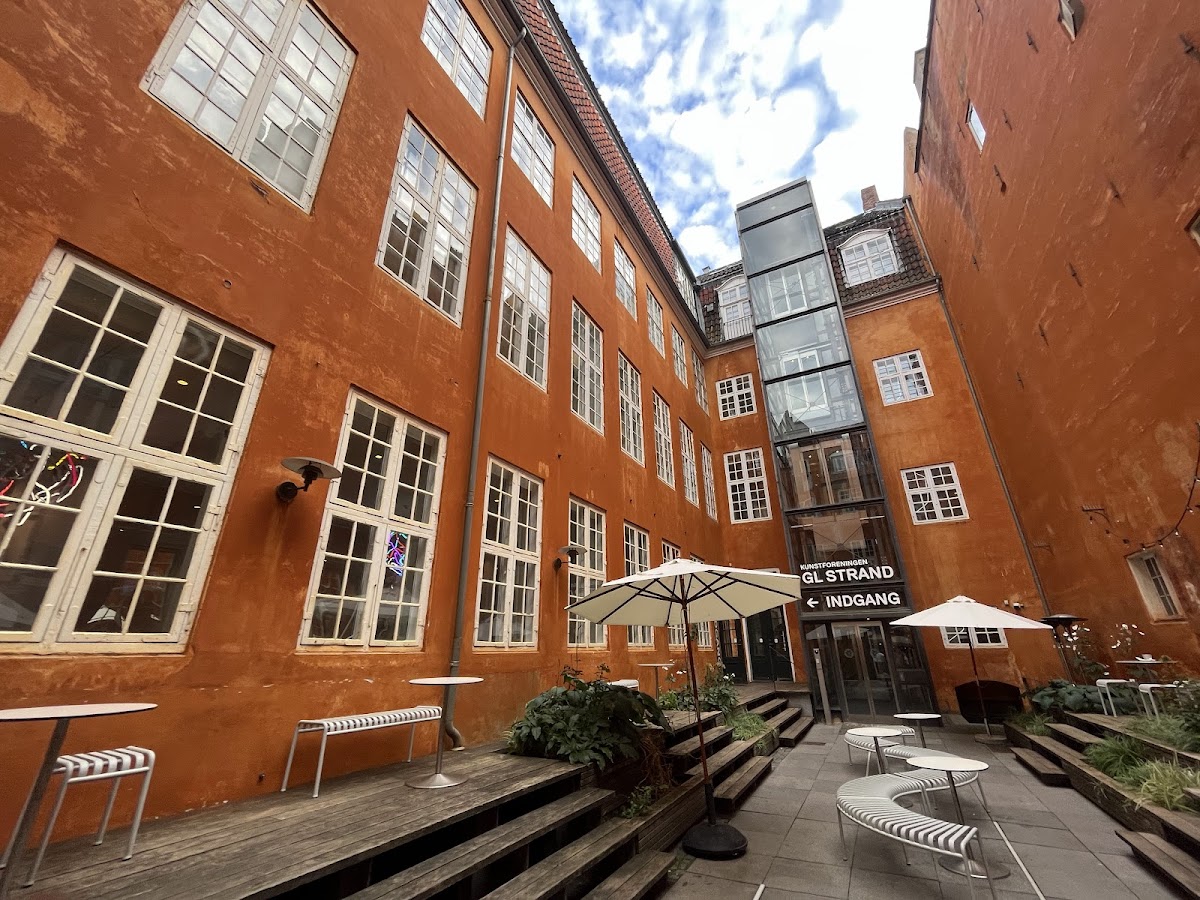
Inside, the courtyard turns a deeper orange. Windows, stairs and a glass lift from different periods overlap. Exhibition rooms retain the proportions and thresholds of an old house, requiring contemporary works to negotiate architecture that was never designed as a neutral white box.
Citizens and C.W. Eckersberg Found an Art Association in 1825
In 1825 a group of citizens, including art professor C.W. Eckersberg, founded Kunstforeningen, the Art Association, inspired by German precedents. Its purpose was to spread general knowledge of art and create a link between the elite Royal Danish Academy of Fine Arts and a broader public.
That aim was radical in a period when artistic authority and education were concentrated in academies, courts and private collections. The association became an intermediary built through members, exhibitions and discussion rather than a state museum or commercial gallery.
The word public never included everyone equally. Fees, education, gender and class affected real access. Two centuries are therefore best read as repeated negotiations over who the audience is, not as a simple line of uninterrupted progress.
A History Built through Exhibitions rather than One Collection
The life of the association accumulated through exhibitions and encounters. Danish Golden Age painting, modernism and international contemporary art passed through its rooms. Even when works departed, posters, catalogues, criticism and audience memory informed later programmes.
Eckersberg, Anna Ancher and Edvard Munch coexist in the institutional history with Louise Bourgeois, Olafur Eliasson, Kara Walker and Danh Vo. This is less a history of ownership than a record of what Copenhagen audiences were invited to see at different moments.
That structure provides flexibility but risks losing exhibitions after they close. Archives, publications and anniversary projects therefore carry unusual importance. The identity of the art hall depends on preserving the public questions it has opened.
Moving into Philip de Lange’s 1750s Building
In 1952 Kunstforeningen moved to Gammel Strand 48, a historic building designed by Philip de Lange in the 1750s. The house had already witnessed generations of commercial, residential and canal-side life before becoming an art institution.
Its windows, stairs and room sizes constantly affect exhibition design. Large installations must cross several rooms and moving-image work must negotiate daylight. In return, canal views prevent art from becoming isolated from the city surrounding it.
Protected architecture limits easy alteration but preserves the character of the place. A two-hundred-year-old organisation and a building approaching three centuries now constrain and renew one another.
The GL STRAND Name and the 2010 Renovation
GL STRAND was added to the name in 2004, bringing the address and place identity to the foreground. In 2010 Vilhelm Lauritzen Architects carried out a comprehensive renovation, improving exhibition conditions, access and circulation while respecting the historic rooms and courtyard.
The glass lift and new routes do not remove the older stairs. They add another way to move through the protected structure. Red wall, white window frame and contemporary glass remain visible in one scene, allowing the building to support public use rather than function as a preserved backdrop.
Becoming Gammel Strand in 2024
In 2024 Kunstforeningen GL STRAND adopted the name Gammel Strand, a new exhibition profile and new collaborations. The shorter place name does not erase the association; it makes the institution easier to address as a locally rooted, internationally oriented cultural meeting point.
Archival Studies reopened the ground floor through simple, sustainable interventions inspired by the protected building. A new art, magazine and bookshop now hosts launches, performance, debate and readings. People can enter and remain before committing to a full exhibition visit.
A Kunsthal Moving through Exhibitions and Conversation
Gammel Strand is a kunsthal rather than a museum organised around a permanent display. Paintings, sculpture, photography, moving image and installation occupy the rooms for a limited period, then give way to a different argument.
Talks, readings and performance are not merely explanation added after art. They continue questions from the exhibitions in other languages. Without a fixed collection, the institution can respond quickly, but must keep balancing local audiences, international artists, historical memory and current urgency.
The 200th Anniversary Wakes Institutional History
The 2025 exhibition When We Dead Awaken surveyed art that had passed through Gammel Strand from 1825 to 2025. Its title referred both to a 1998 Munch exhibition and Henrik Ibsen’s final play, asking how institutional history might become active rather than ceremonial.
Artists ranged from Eckersberg, Anna Ancher and Munch to Bourgeois, Eliasson, Walker and Danh Vo. All had previously exhibited at Gammel Strand. Gilded frames and contemporary installations shared three floors, revealing the movement from art association to present-day kunsthal.
The Courtyard Keeps Art Attached to Copenhagen
After the galleries, the orange courtyard reveals layers hidden by the street facade. Historic windows and rough walls face the glass lift. From exhibition rooms, views of the canal and city keep social, political and historical work beside ordinary urban movement.
The ground-floor shop and cafe extend the encounter. Books, magazines, prints and editions allow conversation to continue after the last gallery. They are not identical to the social and educational function of the 1825 association, but answer a related need for art to have a shared civic setting.
Reading Two Centuries in One Visit
Begin across the canal with Philip de Lange’s facade, then enter through the open ground floor and check the current artists and dates. On each level, notice how windows, thresholds and uneven rooms condition installation. Finish in the courtyard with historic walls and the post-2010 glass structure in one view.
Official hours are Tue-Wed and Fri-Sun 10:00-17:00, Thu 10:00-20:00, closed Monday. Admission is DKK 100 for adults, DKK 75 for visitors under 27 and free under 16. Check holiday and installation notices before visiting.
Allow 1.5 to 2 hours. The most important inheritance is not one permanent masterpiece, but a door repeatedly reopened between specialised artistic institutions and civic conversation for two hundred years.
Visit Info
- Address: Gammel Strand 48, 1202 Copenhagen K, Denmark
- Hours: Tue-Wed and Fri-Sun 10:00-17:00; Thu 10:00-20:00; closed Monday. Check holiday and installation notices
- Fee: Adults DKK 100; under 27 DKK 75; under 16 free. Confirm group and membership conditions
- Transport: About 2 minutes on foot from Gammel Strand metro station, or roughly 20 minutes on foot/bus from Copenhagen Central Station
- Time needed: Allow 1.5-2 hours for exhibitions and architecture, or half a day with the canal, Strøget and Christiansborg
- Website: https://gammelstrand.dk/en
Visitor Info
| Address | Gammel Strand 48, 1202 København K, Denmark |
| Hours | Translating |
| Admission | Translating |
| Getting There | Translating |
| Duration | Translating |
| Translating | https://gammelstrand.dk/en |