Murals Turned Toward Cuernavaca, Siqueiros’s Workshop Opens to the Square
Murals Turned Toward Cuernavaca, Siqueiros’s Workshop Opens to the Square
Why the Murals of SAPS La Tallera Face the Street
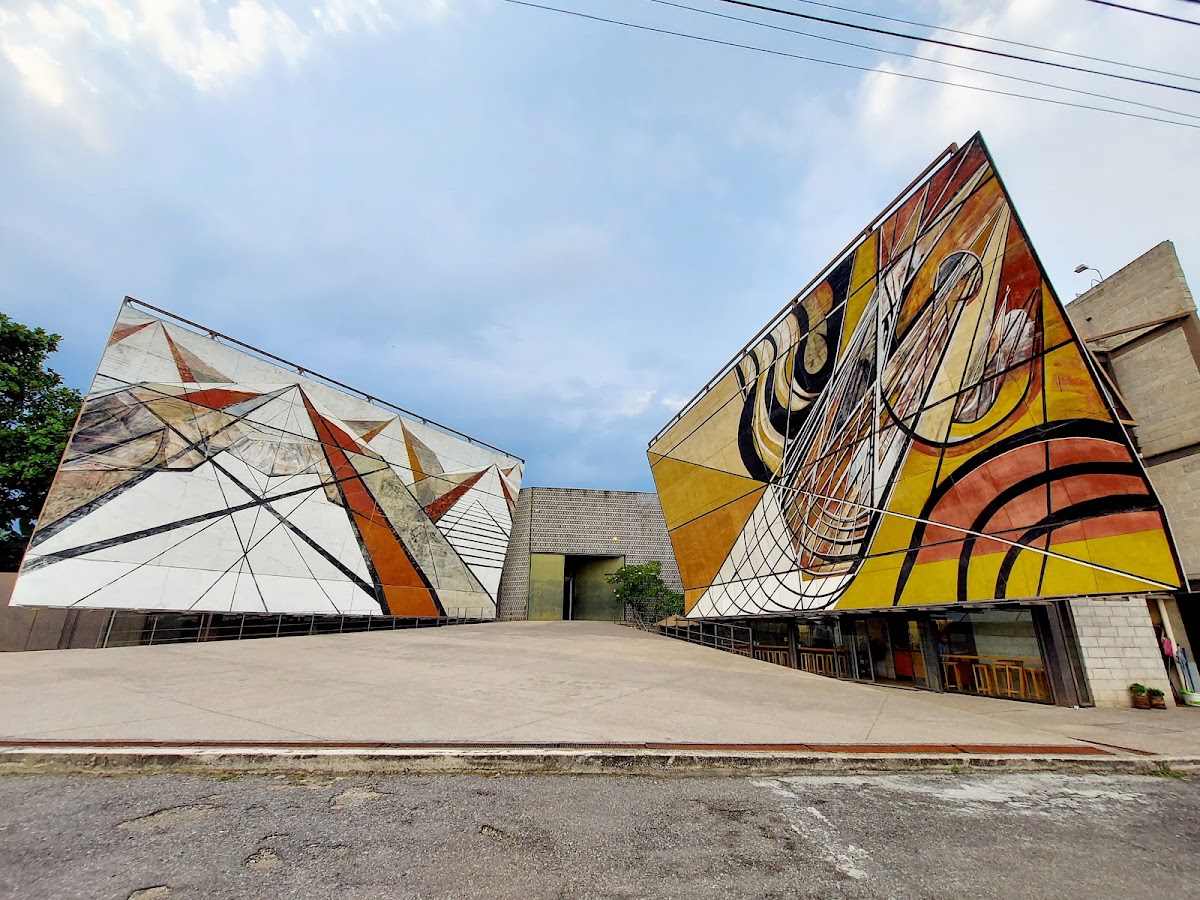
The first sight at SAPS La Tallera in Cuernavaca is not a conventional museum facade. Two monumental paintings stand at opposing angles, their black lines and red and yellow planes forming a passage between the residential street and the building.
David Alfaro Siqueiros made the panels known as Traces of Spatial Composition and Traces of Pyramidal Composition between 1971 and 1973. They once faced the workshop courtyard. During the 2012 renovation, they were rotated toward Parque Siqueiros and became the entrance itself.
That turn provides the clearest way to understand La Tallera. The murals were not withdrawn into a protected interior. They moved outward, producing a public threshold where a visitor enters both a museum and a composition made at architectural scale.
A Mural Factory Founded in 1965
Siqueiros and Angélica Arenal opened the workshop on 20 August 1965. It was created for the collective production of The March of Humanity on Earth and Toward the Cosmos, the enormous mural cycle destined for the Polyforum in Mexico City.
The artist chose the feminine name La Tallera rather than the usual Spanish word taller. Official accounts connect the name to a tribute to women as creators of life. In 1966, the site became a workshop-school that joined painting, architecture, photography, materials, and technical experimentation.
La Tallera was therefore designed around production rather than display. Assistants, technicians, students, and artists could work on the same immense surface. Collective labor was not hidden behind the name of a single muralist; it was built into the institution.
Lowering the Painting Instead of Climbing the Scaffold
The main hall used mechanical installations to lower large panels into a pit. Workers could bring each section to hand level instead of repeatedly climbing tall scaffolds. The architecture treated a mural as a movable industrial object before it became part of another building.
This system matched Siqueiros’s interest in modern materials, spray tools, photography, and prefabricated supports. The mural could be tested and produced in a workshop, then transported and joined to an architectural surface elsewhere.
Even when the original machinery is not operating, the scale of the hall preserves the logic. Its height, long floor, and monumental panels make clear that mural painting required organization, engineering, and many bodies as well as a painter’s hand.
Polyangular Painting for a Moving Viewer
Siqueiros rejected the idea that a painting should resolve perfectly from one fixed point. His polyangular compositions stretch across walls, ceilings, and corners so that lines compress or extend as the viewer moves.
The Sala Poliangular, also associated with Homage to the Procreative Woman, turns this principle into a bodily experience. No single photograph can contain the room. A visitor must turn, step sideways, and look upward to discover how one plane joins another.
The entrance murals work in the same way. Seen from the park, between the panels, and from inside the museum, they become different compositions. Frida Escobedo’s intervention expanded a theory of mobile vision into the circulation of the entire site.
Frida Escobedo Rotates the Museum Toward the Park
Frida Escobedo’s studio led the renovation from 2010 to 2012. Its decisive act was to rotate the courtyard murals by roughly 180 degrees, aiming them at Parque Siqueiros and creating a new principal entrance.
The former courtyard became a shaded public zone of breeze-block screens, trees, and filtered light. Monumental painting alternates with passages scaled for sitting and walking. The gray lattice softens the intense sun while linking old workspaces to new galleries.
The design does not merely illustrate Siqueiros’s belief in public art. It lets the murals perform a public task by framing a square, opening the institution, and directing bodies from the park into the museum.
A Workshop Bequeathed to the People of Mexico
In December 1973, shortly before his death, Siqueiros bequeathed La Tallera and his Mexico City house, now the Sala de Arte Público Siqueiros, to the Mexican people. Both sites were intended to preserve art while remaining centers for the study and experiment of future public practice.
La Tallera continued under Luis Arenal for a time and later closed. In 1988, it and the Mexico City venue became part of INBAL. The artist’s personal spaces entered a public framework for conserving artworks, archives, buildings, and educational activity.
Recent INBAL information describes an original artistic bequest of 215 works and a joint collection that now contains 356 pieces, including work by modern and contemporary artists. Paintings, prints, sketches, spatial studies, murals, and models reveal different stages of production.
Reading Process Rather Than Only Masterpieces
The most revealing objects at La Tallera are often the ones that precede a finished mural. Studies, photographs, models, and compositional exercises show how The March of Humanity developed through alternatives, corrections, technical calculations, and collective decisions.
Siqueiros used photography to test scenes and industrial paint on modern supports. Curved architecture and a moving audience altered the image. His sweeping diagonals were not simply spontaneous gestures; they belonged to a carefully organized system.
Look at panel edges, corners, support thickness, and transitions to the ceiling. These details shift the museum away from a solitary-genius memorial and toward the material history of a workshop where different trades met.
Contemporary Art Returns to Questions of Art and Politics
La Tallera is not limited to a permanent memorial display. Its official mission links modern and contemporary art through recurring questions: the relation between art and politics, the public character of images, experiments with materials, and the educational legacy of the workshop.
Temporary exhibitions, residencies, criticism programs, workshops, and talks keep the word workshop active. The institution connects artistic production in Morelos with wider international conversations without asking contemporary artists to imitate Siqueiros.
This is a more useful legacy than a fixed heroic account. The building remains a place to test whom public art addresses, how collective production works, and what political responsibility a cultural institution can carry now.
The Infrastructure Behind the Rotated Murals
The 2012 reopening included about 400 square metres of exhibition space, two art-storage rooms, a forum, an archive area, two workshop rooms, a cafe, and improved access for visitors with limited mobility.
These less spectacular additions allow the institution to work beyond the entrance image. Permanent murals, documents, and changing exhibitions occupy the same complex, keeping history and present production in direct contact.
As visitors pass from patterned screens and a planted courtyard into the high workshop hall, the spatial density repeatedly changes. The route narrows around records and opens again toward the park. That rhythm can remain as memorable as any individual object.
A Practical Route Through La Tallera
Begin in Parque Siqueiros and study the angle between the two murals from a distance. Approach through the central gap, then turn back after entering. The painted panels gradually change from pictures into walls, canopies, and guides for movement.
Continue into the old production hall, then change position several times inside the Sala Poliangular. Give the sketches and documentary materials a slower, closer look. They reset the eye after the overwhelming scale of the exterior.
Current national cultural information lists Tuesday to Sunday, 10:00 to 18:00. Holiday schedules, exhibition changes, and admission notices can vary between institutional listings, so confirm the latest information before traveling.
Opening a Workshop by Changing the Direction of Art
La Tallera’s transformation is difficult to measure by the amount of new construction. Its most consequential decision concerned the direction of two existing paintings. Once they faced the park, both the museum’s identity and the urban space in front of it changed.
Siqueiros imagined murals through moving viewers, collective labor, and industrial technology. Escobedo’s architecture did not freeze those ideas. It translated them into an entrance, a square, a screen, shade, and circulation.
Seen again from the park after a visit, the murals carry more than their painted surfaces. The machinery of the workshop, its shared labor, the bequest, closure, and reopening sit behind them. The rotated walls unfold that history toward the street.
Visit Info
- Address: Venus 52, Jardines de Cuernavaca, 62360 Cuernavaca, Morelos, Mexico
- Hours: Tue-Sun 10:00-18:00; confirm holidays and exhibition-change closures
- Fee: Check the latest official notice because institutional listings may differ
- Transport: Taxi or car from central Cuernavaca; entrance faces Parque Siqueiros
- Time needed: About 1.5 hours
- Website: https://inba.gob.mx/recinto/62
Visitor Info
| Address | Venus 52, Jardines de Cuernavaca, 62360 Cuernavaca, Morelos, Mexico |
| Hours | Translating |
| Admission | Translating |
| Getting There | Translating |
| Duration | Translating |
| Translating | https://inba.gob.mx/recinto/62 |