A Five-Storey Moominhouse in Tampere, Where Small Drawings Expand a World
A Five-Storey Moominhouse in Tampere, Where Small Drawings Expand a World
The Moomin Museum Begins with a Small Drawing
Inside Tampere Hall, the pace slows in front of sheets of paper scarcely larger than their printed pages. Tove Jansson’s original ink drawings preserve the grain of the support, changes in pressure, and corrections that disappear in reproduction.
The Moomin Museum calls itself an experiential art museum. Yet it begins not with merchandise or screen adaptations, but with twelve books, original drawings, working sketches, and three-dimensional tableaux made largely by graphic artist Tuulikki Pietilä.
Moominvalley appears here as a place assembled over time. A line, an alternative composition, a piece of wood, cloth, and wire gradually become a fictional world. Recognizing a familiar character is only the beginning.
The 1986 Donation to Tampere Art Museum
In 1986, Jansson and her partner Pietilä donated a major body of Moomin art to Tampere Art Museum. It comprised 1,009 drawings and paintings, 38 three-dimensional tableaux, other artworks, and archival material.
The collection was displayed as Moominvalley at the Metso Tampere City Library from 1987 to 2016. After that museum closed in October 2016, the works moved to purpose-built premises in Tampere Hall.
The present Moomin Museum opened on 17 June 2017. Its institutional name changed, but the collection is still formally called the Tampere Art Museum Moominvalley Collection, keeping the first donation visible within the new home.
Walking Through Twelve Books from 1945 to 1977
Twelve large book covers organize the permanent exhibition around the twelve Moomin books that Jansson wrote and illustrated between 1945 and 1977. The route moves from the great flood and a threatening comet to a floating theatre, a lighthouse, and the empty valley of Moominvalley in November.
Following the publication order reveals changes in both the characters and Jansson’s drawing. Early unease, expanding families and guests, and the quieter landscapes of the later books appear in the density of lines and use of empty space.
The oversized covers guide visitors, while the originals remain remarkably small. The exhibition asks the body to lean closer rather than enlarging every image into spectacle. Looking becomes a deliberate act of magnification.
Ink, Gouache, Watercolour, and Scratchboard
Most of the original illustrations are ink on paper or board. The collection also includes nearly fifty gouache and watercolour paintings, roughly a dozen scratchboards, and works made with ink wash and pen-and-wash.
Alternative versions, unpublished drawings, and sketches show how Jansson chose a final composition. A character shifts slightly, a tree disappears, or a few lines alter an expression. Images that feel inevitable in print emerge from repeated comparison.
Works on paper need rest from light, so the museum changes selections to protect them. A famous scene cannot be guaranteed on every visit. The more rewarding approach is to study the surface and decisions in whichever originals are currently on display.
Beyond the Moomin Books
The collection includes 207 sketches and drawings for comic strips and comic-book covers. Among them is Jansson’s first Moomin comic, published in the Swedish-language cultural periodical Nyt tid in 1947.
About five hundred illustrations and cover drawings made for the satirical magazine Garm reveal a sharper political and social observer. The same hand known for gentle Moomin scenes could produce a very different public voice.
More than two hundred illustrations for other books include work related to Lewis Carroll’s Alice’s Adventures in Wonderland and J.R.R. Tolkien’s The Hobbit. Moominvalley was part of a broad artistic and literary career, not an isolated invention.
Tuulikki Pietilä Builds the Scenes in Three Dimensions
The tableaux hold time differently from drawings. Pietilä and their friend, the physician Pentti Eistola, made rooms, woods, boats, and figures from small pieces of wood, fabric, wire, collected natural objects, and found materials.
The 1986 donation contained 38 tableaux; the collection now records 41, including two versions of the Moominhouse. Jansson participated but described herself as working largely as an assistant on these constructions.
They are interpretations rather than exact three-dimensional copies of illustrations. Pietilä’s eye, Eistola’s additions, and the behavior of materials open a second path into the books. Moving between drawing and model shows a shared world passing through different hands.
A Five-Storey Moominhouse Without a Final Answer
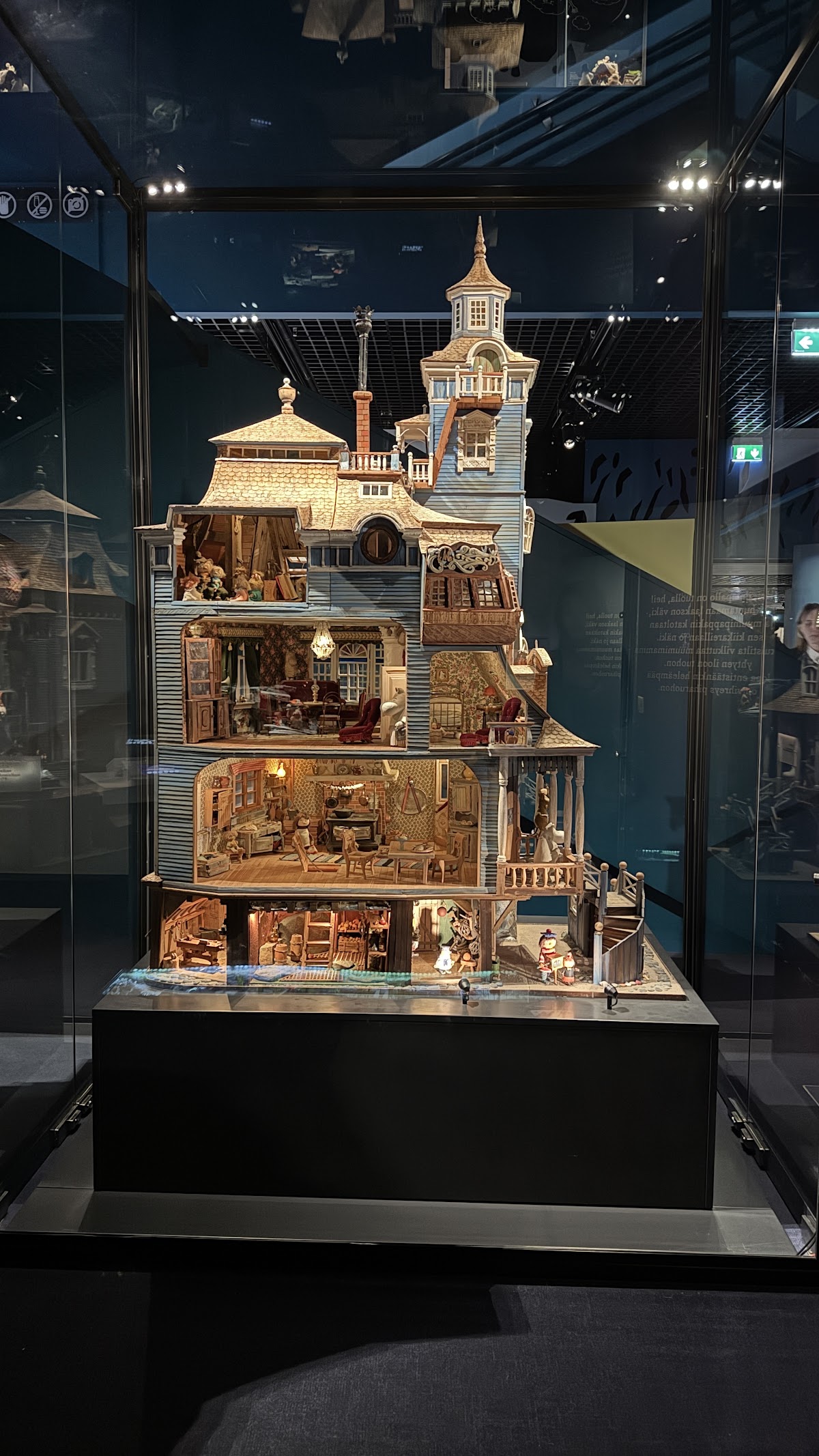
The museum’s central object is a blue Moominhouse about two metres tall and five storeys high. Secret passages, small rooms, jam jars, a sauna, and even a fuse box reward repeated circuits around its windows.
The house is not an exact model of Jansson’s drawings. It is a pastiche of architectural styles to which Jansson, Pietilä, and Eistola all contributed. Rooms and routes grew through imagination and making rather than from a definitive plan.
That uncertainty suits a house continually opened to family, visitors, wanderers, and unfamiliar beings. Its significance lies less in the number of rooms than in the relationships the rooms might accommodate.
Sixty-One Crates of Paraphernalia
In 1993, Jansson and Pietilä donated 61 crates of additional archival material they called the Paraphernalia. They associated the formal word with the Finnish kama, or junk.
The crates contained Moomin figures, tools and supplies used for tableaux, photographs, slides, and original letters. These objects stand outside a narrow definition of finished art but record how materials were gathered, tested, and shared.
A worn tool or unidentified fragment can be more informative than a polished replica. By preserving the supposed junk, the collection gives everyday creative work a place beside drawings and paintings.
Voice, Sound, and a Studio Beside the Originals
Multilingual extracts from the books can be heard near the tableaux, including Tove Jansson reading in Swedish. Sound changes the rhythm of a scene but does not replace close looking at the object.
The Studio is normally open to museum visitors from noon to 4 p.m., subject to private events. Artmaking, crafts, and community projects connect viewing with the movement of the hand.
Guidebooks, digital story summaries, and museum guides in green uniforms offer different levels of context. A quiet visitor studying drawings and a family moving between models can follow separate speeds without losing the exhibition’s structure.
Planning Two Hours in Tampere Hall
Begin chronologically with the twelve book covers and note how Jansson’s line changes. Next, compare drawings with tableaux that treat related scenes. Circle the five-storey Moominhouse slowly, then continue to the Studio or Reading Room.
Because the originals are small and displayed behind glass, details are harder to see when a group gathers. A first complete circuit followed by a return to selected works is often more comfortable than waiting at every case.
For 2026, the museum opens Tuesday to Friday from 10:00 to 18:00, Saturday and Sunday from 09:00 to 17:00, and closes Monday. Adult admission is €18, with €9 tickets for ages 7-17 and several concessions. Check listed special closure dates before travel.
When a Familiar Moomin Becomes Unfamiliar Again
Moomins are familiar through mugs, toys, and animation, but the museum does not begin from that polished surface. It returns to paper before publication, alternative sketches, tools, and a house made by hand.
Jansson’s lines and Pietilä’s models expand the same world differently. Donation, collaboration, conservation, and rotating displays all shape the Moominvalley that visitors encounter today.
After looking into the five-storey house, return once more to a small ink drawing. A handful of black marks may now feel larger. The museum expands its subject by giving modest objects enough time and space to be seen.
Visit Info
- Address: Tampere Hall, Yliopistonkatu 55, 33100 Tampere, Finland
- Hours: 2026: Tue-Fri 10:00-18:00, Sat-Sun 09:00-17:00, Mon closed; check special closures
- Fee: 2026: adult €18, ages 7-17 and concessions €9, under 7 free
- Transport: About a 10-minute walk from Tampere Central Station, inside Tampere Hall
- Time needed: About 1.5-2 hours
- Website: https://www.muumimuseo.fi/en/
Visitor Info
| Address | Tampere Hall, Yliopistonkatu 55, 33100 Tampere, Finland |
| Hours | Translating |
| Admission | Translating |
| Getting There | Translating |
| Duration | Translating |
| Translating | https://www.muumimuseo.fi/en/ |