A Sleeping June Leaves Ponce, How a Closed Museum Keeps Its Art Moving
A Sleeping June Leaves Ponce, How a Closed Museum Keeps Its Art Moving
Why a Sleeping Figure Became the Face of Ponce
Frederic Leighton’s Flaming June shows a woman curled into sleep beneath a cascade of translucent orange cloth. The Mediterranean appears only through a narrow opening behind her. The painting is visually intense, yet its subject refuses the viewer’s gaze.
Leighton completed the work in 1895 near the end of his life. Classical bodily form, Renaissance precedent, and the Aesthetic Movement’s attention to colour and line meet in an image that withholds a fixed narrative.
The museum’s collection record notes that founder Luis A. Ferré acquired the painting despite advice against it. Once dismissed as unfashionable Victorian art, it later became both a celebrated Leighton painting and the most recognizable work associated with a Caribbean museum.
A Museum Begins in a House on Calle Cristina
Luis A. Ferré established his foundation in 1957 and began buying works for an institution that did not yet have a permanent home. He was building a public collection from the outset rather than opening a private collection after the fact.
Museo de Arte de Ponce welcomed visitors on 3 January 1959 in a colonial house at 70 Calle Cristina. Its first collection consisted of seventy-one paintings. The scale was modest, but the intention to make European art available for study in Puerto Rico was already clear.
Ferré and his first wife, Lorencita Ramírez de Arellano, had imagined a museum for Puerto Rican audiences in the early 1950s. Acquiring art from abroad and building a record of Puerto Rican art developed as parts of the same civic project.
Edward Durell Stone Designs Hexagonal Galleries
The collection quickly outgrew the house. Ferré commissioned American architect Edward Durell Stone, and the present building opened on 28 December 1965. It received an American Institute of Architects Honor Award in 1967.
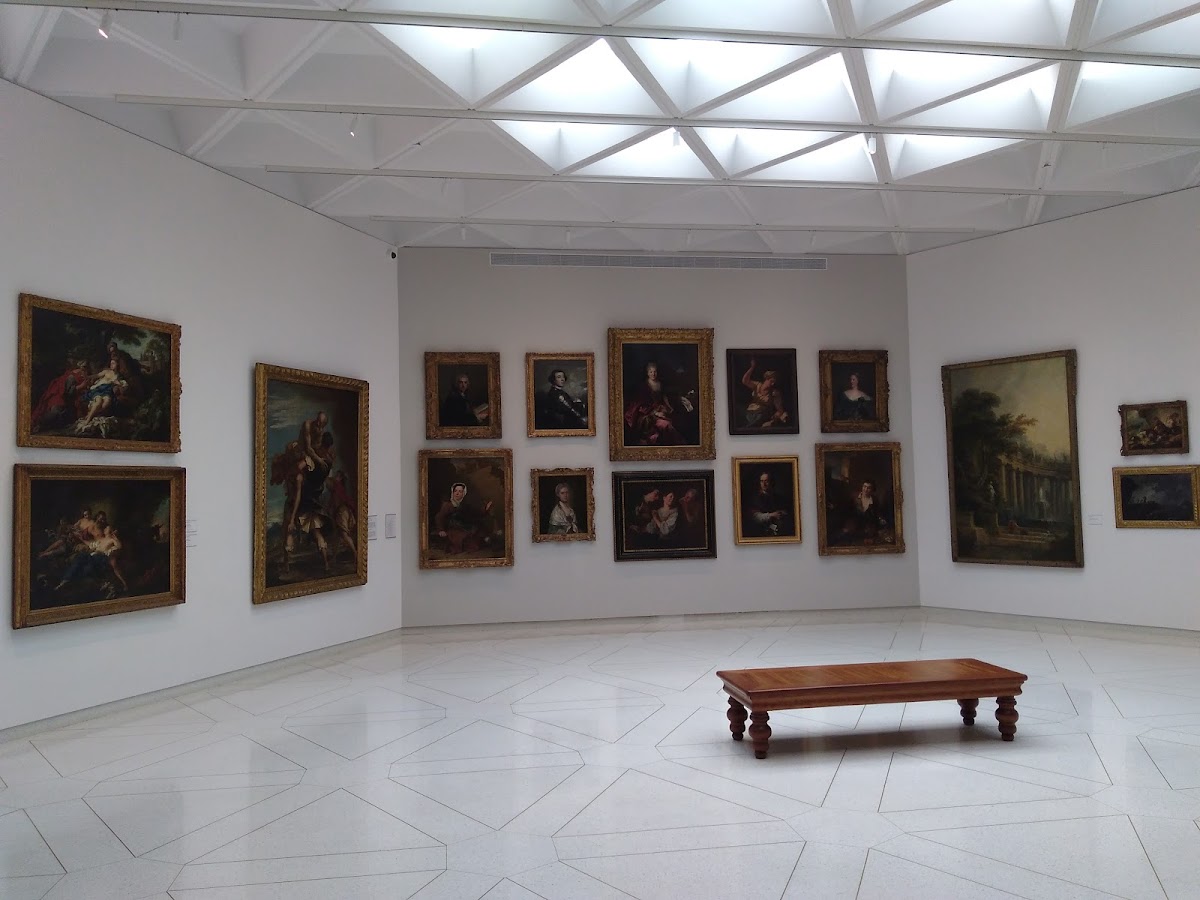
A broad roof appears to hover over a long rectangular ground floor. Slender columns and a web of triangles animate the shaded edge. Upstairs, galleries follow a hexagonal scheme, admitting natural light at their corners across a building of roughly 40,000 square feet.
Those angled rooms prevent a visitor from seeing the entire route at once. Each turn reveals another wall and asks the body to change direction. Architecture regulates looking rather than serving as a neutral container.
A Modern Landmark Becomes a Local Memory
Inside, a white staircase divides into two curves toward the upper galleries. The exterior roof, triangular lattice, hexagonal rooms, and rounded stairs establish several geometries without relying on lavish materials.
Stone is associated with projects such as the Museum of Modern Art in New York and the Kennedy Center in Washington, yet Ponce must be read within its own climate. Deep shade, gardens, and layered screens temper intense Caribbean light before it reaches the galleries.
Puerto Rican artist Enoc Pérez painted the museum in 2010 from memories of childhood visits with his father. His Museo de Ponce, Ponce, P.R. treats the facade as a portrait, evidence that the building had entered personal and collective memory.
Five Thousand Objects Across Several Art Histories
The museum’s 2026 reconstruction material describes a collection of more than five thousand objects. It includes painting, sculpture, drawings, prints, photographs, decorative arts, pre-Hispanic and African objects, Puerto Rican folk art, contemporary ceramics, video, and sound.
Baroque, Pre-Raphaelite, and Victorian painting form important European strengths. Flaming June makes more sense beside different approaches to history, portraiture, landscape, and beauty by artists including Lucas Cranach, Elisabeth Louise Vigée Le Brun, Gustave Courbet, and Edward Burne-Jones.
Puerto Rican and Latin American art is not a peripheral department. Recent official material says it accounts for nearly half of the collection. Works by José Campeche, Francisco Oller, Miguel Pou, and later artists show how an institution founded with European acquisitions also helped shape the island’s art history.
Setting Different Times in Counterpoint
After the 2010 expansion, the museum did not arrange every work as one long sequence of countries and dates. First-floor galleries such as Between Heaven and Earth and Conversations with Nature organized objects around belief, ritual, landscape, light, and ways of seeing the natural world.
In the upstairs display of fifteenth- through nineteenth-century European art, each gallery included a counterpoint from another culture or period. Portraits, myths, landscapes, and ideals of beauty could be compared after the familiar chronology had been interrupted.
The eventual post-reconstruction installation has not been announced. It will be worth seeing whether the former arrangement returns or whether traveling works are used to reshape relationships between Puerto Rican and European art. Repairing the building also offers a chance to reread the collection.
Conservation Continues Behind the Galleries
The Anton J. Konrad Conservation Center was established in 1979 and became a leader in art conservation in Puerto Rico and the Caribbean. Examination, treatment, environmental control, and loan preparation sustain every apparently effortless gallery display.
Between 2008 and 2010, the museum renovated its interior and built an Annex for offices, conservation, historical archives, a library, and community outreach. The expansion strengthened research and education as much as exhibition capacity.
After 2020, the Annex became even more important. It allowed collection care, study, and public programmes to continue while the main galleries remained inaccessible. A museum’s life proved larger than its public entrance.
The Magnitude 6.4 Earthquake Stops the Building
On 7 January 2020, a magnitude 6.4 earthquake struck southwestern Puerto Rico amid an extended seismic sequence. The Edward Durell Stone building was damaged and its principal galleries closed. An early museum statement reported damage to three sculptures while the remainder of the collection was safely stored.
Assessment eventually showed that reopening required a comprehensive seismic retrofit. The project must repair facade and interiors, modernize mechanical, electrical, and plumbing systems, and preserve Stone’s distinctive design while adding structural resilience.
For visitors, a long closure can feel like absence. A premature reopening, however, would endanger both people and collection. The closed facade is simultaneously a barrier and evidence of the slow work required to retain a modern landmark.
Sixty Paintings Travel While the Museum Is Closed
The collection did not simply disappear into storage. Loans and external projects continued, and in 2025 the museum launched The Sense of Beauty: Six Centuries of Painting from Museo de Arte de Ponce.
The touring exhibition assembles sixty European, Puerto Rican, and American paintings. Flaming June travels alongside works by José Campeche, Lucas Cranach, Courbet, and other artists, forming a compressed version of the museum in a sequence of partner venues.
Each host changes the light, order, and neighbors around the paintings. Touring keeps the collection public during reconstruction, though it also raises a local question: where can people in Ponce encounter their museum while its best-known works are away?
Reconstruction Begins in 2026
Museo de Arte de Ponce formally marked the start of reconstruction in May 2026. The programme includes facade conservation, interior refurbishment, system modernization, and structural elements designed to allow the building to withstand seismic movement.
The restoration campaign has a goal of twenty-five million dollars. Official material aims for reopening in early 2028, but construction dates can shift. Historic opening hours and admission details should not be used to plan a current visit.
For now, visitors should confirm Annex programmes, external exhibitions, and reconstruction news. The Sense of Beauty also changes location over time, so both the museum and each partner venue should be checked before travel.
Waiting for the Hexagonal Rooms to Reopen
When the main building returns, the important question will not be only whether a famous painting is back. Visitors can look for the relationship between new seismic supports and Stone’s facade, the treatment of natural light in the hexagonal rooms, and the order in which traveling works are reintroduced.
Flaming June presents sleep as stillness, yet orange folds carry motion across the canvas. The institution now occupies a similar condition. Its building pauses while conservation staff, Annex programmes, loans, and touring paintings continue to work.
Ponce demonstrates that a museum and its building are closely joined but never identical. Architecture waits for reinforcement, art crosses cities, and a community prepares for return. Reopening will gather those dispersed forms of time under one roof again.
Visit Info
- Address: 2325 Blvd. Luis A. Ferré Aguayo, Ponce, Puerto Rico 00717
- Hours: The Edward Durell Stone main galleries are closed for seismic reconstruction; check official Annex and touring schedules
- Fee: No regular main-gallery admission while closed; partner venues and Annex events set their own terms
- Transport: Taxi or car from central Ponce
- Time needed: Plan around a confirmed Annex programme or touring venue until reopening
- Website: https://museoarteponce.org/en/
Visitor Info
| Address | 2325 Blvd. Luis A. Ferré Aguayo, Ponce, Puerto Rico 00717 |
| Hours | Translating |
| Admission | Translating |
| Getting There | Translating |
| Duration | Translating |
| Translating | https://museoarteponce.org/ |