A Naval Base Beside the Caspian, YARAT Builds a New Art Centre in Baku
A Naval Base Beside the Caspian, YARAT Builds a New Art Centre in Baku
A Workshop Scale Remains Beside the Caspian
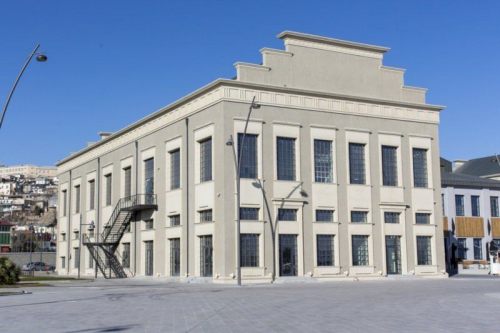
South of central Baku, the Bayil waterfront opens around a solid pale building with evenly spaced windows and a stepped central gable. Even without the name YARAT Contemporary Art Centre, it reads as an old place of work.
The structure served in the 1960s as a Soviet naval maintenance base. Its proximity to the Caspian once supported ships and equipment; since 2015, those routes have carried installations, visitors, and public programmes.
The conversion did not erase the building’s scale. High volumes, broad floors, and repeated windows still recall an industrial interior. YARAT uses that inherited proportion without turning military history into a decorative theme.
YARAT Means Create in Azerbaijani
Artist Aida Mahmudova founded the nonprofit organization in Baku in 2011. Its name means create in Azerbaijani, an active word that places production, education, and artistic conditions beside the display of finished work.
Before it had a permanent centre, YARAT organized public art, temporary exhibitions, and educational projects around the city. At the 2013 Venice Biennale, Love Me, Love Me Not brought together seventeen artists from Azerbaijan, Iran, Georgia, Turkey, and Russia.
International presentation and local audience building developed together. The organization created studios and learning programmes in Baku while establishing platforms for Azerbaijani artists abroad. A permanent building arrived after that network had begun to grow.
A Two-Thousand-Square-Metre Centre Opens in 2015
YARAT opened its first permanent contemporary art centre in March 2015. The converted naval building provides about 2,000 square metres of exhibition space across two floors for temporary projects, collection displays, and new commissions.
A library, auditorium, study areas, and education facilities support screenings, performance, talks, and workshops. A visit can shift from an installation to a film or discussion without treating those activities as secondary to the gallery.
The building overlooks the Caspian. Bright water and open ground repeatedly appear between darker exhibition spaces, placing contemporary art within a city shaped by port activity, oil, Soviet planning, and rapid redevelopment.
Fifty-Five Faces Fill Eleven-Metre Walls
The inaugural programme centered on Shirin Neshat’s newly commissioned The Home of My Eyes. During 2014, Neshat photographed more than fifty people from across Azerbaijan, ranging from two to eighty years old, and asked about cultural identity and the meaning of home.
The completed series brought together fifty-five black-and-white portraits of women and men across generations. Calligraphic versions of their responses cover faces and clothing. From a distance the group dominates; close looking separates one expression and one text from the next.
The installation occupied two full walls in a gallery eleven metres high. A volume once built for naval work held a collective portrait of a country. Baku’s position between Iran, the Caucasus, the Caspian, and several languages became present through individual faces rather than a map.
A Collection Focused on the Caucasus and Central Asia
YARAT’s collection, first presented with the new centre, focuses on artists from the Caucasus, Central Asia, and neighbouring countries. It creates a place in Baku to compare work from regions often treated as marginal within larger art histories.
Shared experiences of empire, Soviet rule, religion, and language do not make the region uniform. Independence, borders, new markets, and urban change arrived at different speeds. Artists respond through memory, personal identity, official narratives, and imagined futures.
A productive visit avoids looking for one national image per country. Ancient symbols reworked in sculpture, photographs of transitional daily life, videos that question established history, and speculative installations reveal differences more clearly than a simple regional label.
New Commissions Ask Artists to Respond to Place
The exhibition programme does more than circulate established work. YARAT invites international artists to research Baku and its surrounding histories while connecting local practices to other contexts.
After Neshat, the centre presented artists including Shilpa Gupta, Michelangelo Pistoletto, Taus Makhacheva, and Oscar Murillo. Different reputations and media meet recurring questions of language, labor, movement, collective life, and cultural identity.
High ceilings and open floors allow video, photography, and installation to establish distinct viewing distances. Empty space does not merely make the work appear grand. It gives visitors room to shift their bodies and attention between media.
ARTIM Gives Emerging Artists Room to Experiment
YARAT extends beyond its waterfront centre. ARTIM Project Space opened in Baku’s Old City, Icherisheher, in October 2015. ARTIM means progress or growth in Azerbaijani and focuses on experimental work by emerging artists.
Open calls and learning programmes lead to exhibitions, performances, and multidisciplinary projects. Artists do not need to wait until a career is established before entering a professional context. Work in development, including the possibility of failure, becomes available for public discussion.
The small Old City space and the large Bayil centre operate at different scales and attract different movement through Baku. Together they connect major international exhibitions with early local experiments.
Eleven Studios Support the Time Before Exhibition
Launched in 2014, YARAT Studios includes eleven workspaces and residential accommodation for Azerbaijani and visiting international artists. Research, material tests, and conversation continue beyond the public rhythm of exhibitions.
International residents can live and work in Baku for up to three months. Open-studio days show notes, tools, and unfinished work rather than only final displays. An ARTIM presentation may become the next stage of that process.
The centre, project space, and studios perform separate tasks. One connects regional and international art at exhibition scale, another tests new voices, and the third protects production time. The verb create becomes an institutional structure.
Revisiting Soviet-Era Painting in a Neighbouring Museum
The Museum of Azerbaijani Painting of the Twentieth and Twenty-First Centuries stands near YARAT Centre. Founded by the Heydar Aliyev Foundation and inaugurated in June 2015, it is a separate institution. Since 2018, YARAT has been commissioned to organize exhibitions from its holdings and an annual public programme.
Works come from state collections including the Azerbaijan State Art Gallery and the National Museum of Art. Artists such as Sattar Bahlulzade, Rasim Babayev, Tahir Salahov, and Javad Mirjavadov reveal distinct negotiations with official Soviet art and practices that developed beyond it.
YARAT’s first programme there, Labour, Leisure and Dreams, examined painting from the 1960s to the 1980s through subjects including work, landscape, industry, and private imagination. Pairing this museum with YARAT Centre prevents post-1991 contemporary art from appearing without a modernist and Soviet history.
A Route Through Galleries, Library, and Auditorium
Begin outside by walking around the building. Look at the central gable, repeated windows, and relationship to the Caspian before entering. The source of the interior height becomes clearer when the former working structure is understood.
Move through the two exhibition floors at different speeds and check whether the library or auditorium has a public event. A programme with several video works can require close to two hours. Installation periods may close individual areas.
Current official information lists Tuesday to Sunday opening from 12:00 to 20:00 with free admission. Confirm Monday closure, holidays, and changeovers before visiting. ARTIM and the Museum of Azerbaijani Painting are separate venues with their own schedules.
Repairing More Than Ships
It is tempting to summarize YARAT as a military building transformed by art. That line omits the slower work. A large former base did not automatically create an art community; studios preceded the centre, and education and emerging-artist programmes continued after it opened.
Connecting art from the Caucasus and Central Asia also requires more than a regional slogan. Collection building, new commissions, residencies, and project rooms create several points of entry so that one artist or nation does not stand in for all the others.
From the waterfront, the outline of the old workshop remains visible. What changed is what the building makes and whom it invites. A place once used to maintain ships now keeps adjusting the conditions in which art, conversation, and another generation of artists can move.
Visit Info
- Address: National Flag Square, Bayil District, Baku, Azerbaijan AZ1003
- Hours: Tue-Sun 12:00-20:00, closed Monday; confirm holidays and installation periods
- Fee: Free; confirm registration for individual events and programmes
- Transport: Taxi or bus from central Baku toward Bayil and National Flag Square
- Time needed: About 1.5-2 hours
- Website: https://www.yarat.az/?lang=en
Visitor Info
| Address | National Flag Square, Bayil District, Baku, Azerbaijan AZ1003 |
| Hours | Translating |
| Admission | Translating |
| Getting There | Translating |
| Duration | Translating |
| Translating | https://www.yarat.az/ |