A Folded Wall in Stratford Asks How East London Makes
A Folded Wall in Stratford Asks How East London Makes
Read the Museum’s Direction in Its Folded Walls
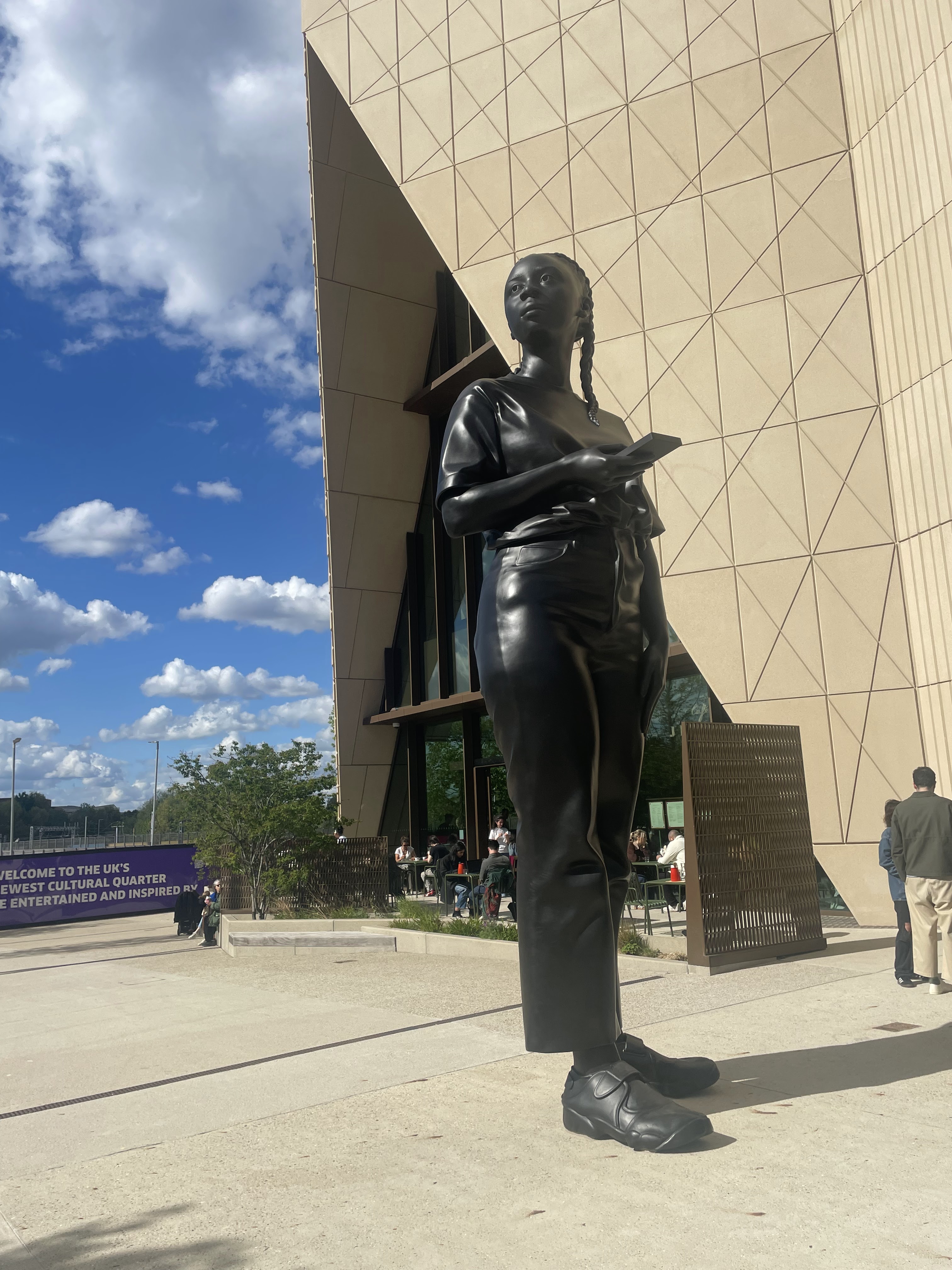
Inside Queen Elizabeth Olympic Park, a pale building rises in planes that seem folded rather than stacked. It avoids the stable front and central doorway of a classical museum. Its outline changes as visitors approach from different sides of East Bank.
Fine scores and uneven ridges cross the concrete. From a distance the volume appears solid; nearby it breaks into many smaller surfaces. An institution devoted to design begins by exposing decisions about material, structure, and fabrication in its own skin.
The sculpture outside, people crossing the park, and movement behind the glass keep the building from becoming a sealed monument. Walking around one corner before entering reveals how gaps between the folds turn into windows, thresholds, and terraces.
From an Olympic Site to a Cultural District
This ground formed part of the central landscape of the London 2012 Olympic and Paralympic Games. After the events, East London faced a larger question: how could sporting infrastructure and public investment become part of daily urban life?
East Bank is one answer, bringing museums, performance, education, and production into the park. The V&A did not create a single enormous outpost. It divided its eastern project between V&A East Museum in Stratford and V&A East Storehouse in Hackney Wick.
The Museum assembles objects through themes and stories. The Storehouse opens storage, conservation, and research processes to view. Together they expand the familiar equation of a museum with galleries alone and avoid simply reproducing South Kensington.
An X-Ray of a Dress Becomes a 42.5-Metre Building
Architects O’Donnell + Tuomey drew one point of departure from Nick Veasey’s X-ray of a 1950s Cristóbal Balenciaga silk taffeta dress. Light reveals seams, supports, and layered construction beneath a smooth garment. The museum likewise lets outer form and internal movement explain each other.
The Japanese idea of ma offered another reference: not an object alone, but the interval that establishes a relationship. Stairs, voids, and long views between floors make visitors aware of other bodies and of the building’s height between galleries.
The structure reaches 42.5 metres and was assembled from 2,051 steel elements. Its exterior uses 425 precast concrete panels in a warm tone closer to Portland stone than grey concrete. Their peaks and grooves respond to the steel geometry behind them.
Five Hundred Objects Ask Why We Make
Two free permanent galleries called Why We Make form the centre of the Museum. More than five hundred V&A objects span art, architecture, design, performance, and fashion. They are arranged around human motives and consequences rather than as separate departments.
Molly Goddard’s Daria dress can be encountered near a copy of a sixteenth-century Sofonisba Anguissola self-portrait and Maud Sulter’s 1988 photographic portrait of Lubaina Himid. Different ways of making a body visible meet across centuries and media.
A seventeenth-century gown by East London textile designer Anna Maria Garthwaite enters a conversation with Vivienne Westwood’s 1990 Cut, Slash & Pull ensemble and Althea McNish’s textiles. Labour, identity, and invention create neighbours that chronology alone would separate.
Design Returns to Everyday and Political Life
Why We Make includes wellbeing, creative communities, social justice, and environmental action. Form is never the only subject. Visitors are asked what an object was made for, who could use it, and what resources and labour its production required.
Garments by design studio and environmental campaigners VIN + OMI include eco-textiles made from materials such as stinging nettles. Sustainability appears as a physical difference that can be compared, not only as a slogan attached to fashion.
These questions meet the young and linguistically diverse communities of Newham. The Museum’s test is not whether it claims to represent East London, but whether existing local practices of making, dressing, listening, and organizing can alter how the national collection is read.
Black British Music Opens the Temporary Programme
The inaugural major exhibition, The Music Is Black: A British Story, examines how Black British music has shaped British culture from 1900 to the present and influenced audiences around the world. Sound is connected to fashion, photography, technology, performance, and community.
Joan Armatrading’s childhood guitar appeared publicly for the first time alongside clothing worn by Little Simz and photographs by Jennie Baptiste, Dennis Morris, Eddie Otchere, and others. Instruments, clothes, and cameras preserve social scenes after performances end.
A partnership with BBC Music and programmes with other East Bank organizations extended the exhibition beyond one gallery. Music made in clubs, homes, streets, and migrant communities was approached through many hosts rather than treated as property newly discovered by a museum.
New Commissions Keep the Building Unfinished
A six-monthly programme called New Work commissions contemporary artists, designers, and community collaborators. Historic objects are not left to rest in a stable display; new work can challenge the assumptions through which the collection has been organized.
The commissions are not filler for empty architecture. They ask how current makers respond to ecology, politics, and ordinary life. Older objects acquire new questions beside them, while contemporary work tests its claims against a longer history of design.
This rhythm means no single visit can define V&A East. Permanent questions remain while commissions, exhibitions, performances, and conversations change. Difference over time is treated as an operating method rather than a failure to achieve a final form.
Young People Enter as Makers, Not a Target Group
Newham is among the youngest and most linguistically diverse boroughs in the country. The Museum involved young people and local creative practitioners during the development of galleries and programmes instead of waiting until construction ended to invite them inside.
The result must be judged in language, access, workshops, performance, and decision-making rather than in a promise that everyone is welcome. Specialist design knowledge becomes useful when it can return to choices in clothing, music, housing, work, and public space.
A new cultural district cannot solve rising costs or uneven development by itself. To avoid using East London as an attractive backdrop, the institution must keep showing who uses its spaces and who shapes what comes next. Opening marks the beginning of that relationship.
Walking to the Storehouse Reveals a Second Museum
V&A East Storehouse is reachable through the Olympic Park and the Lea landscape. Visiting both locations compares a finished narrative display with the less visible lives of objects in storage, conservation, and study. They can also be separated across two days.
The Museum selects roughly five hundred objects for thematic relationships. The Storehouse contains vastly more material waiting on shelves and within technical systems. What is foregrounded, and what remains temporarily unseen, emerges as a curatorial decision in itself.
The walk from Stratford station also matters. Shopping, sports venues, universities, housing, and water accompany visitors to the entrance. The pace and scale of this newer district differ sharply from the established museum quarter around South Kensington.
A Folded Wall Sends the Question Outside
After the galleries, the facade’s lines no longer look purely decorative. They recall dress seams, steel connections, moulded panels, and the many hands required to assemble the building. The architecture has been answering the question why we make from the start.
V&A East matters for more than the relocation of celebrated objects. Its editorial choices place Black British music, environmental action, local production, and unexpected relationships across periods within the centre of design history.
A productive visit does not require remembering every label. It can begin by asking why two objects share a room, whose labour and experience are missing, and what one might make differently in the city outside. Stratford’s folded wall carries those questions back into East London.
Visit Info
- Address: East Bank, 107 Carpenters Rd, Queen Elizabeth Olympic Park, Stratford, London E20 2AR
- Hours: Daily 10:00-18:00; Thursday and Saturday 10:00-22:00. Confirm holiday and exhibition-specific last entry
- Fee: Free permanent galleries; selected temporary exhibitions and events may require a paid or timed ticket
- Transport: Walk from Stratford station’s Montfichet Road exit toward Queen Elizabeth Olympic Park and East Bank
- Time needed: About 1.5-2 hours for the permanent galleries; longer with a temporary exhibition
- Website: https://www.vam.ac.uk/east
Visitor Info
| Address | East Bank, 107 Carpenters Rd, Queen Elizabeth Olympic Park, Stratford, London E20 2AR |
| Hours | Translating |
| Admission | Translating |
| Getting There | Translating |
| Duration | Translating |
| Translating | https://www.vam.ac.uk/east |