A Stair on Harlem’s 125th Street Turns a Studio into a Museum
A Stair on Harlem’s 125th Street Turns a Studio into a Museum
Reading a Museum Between ME and WE
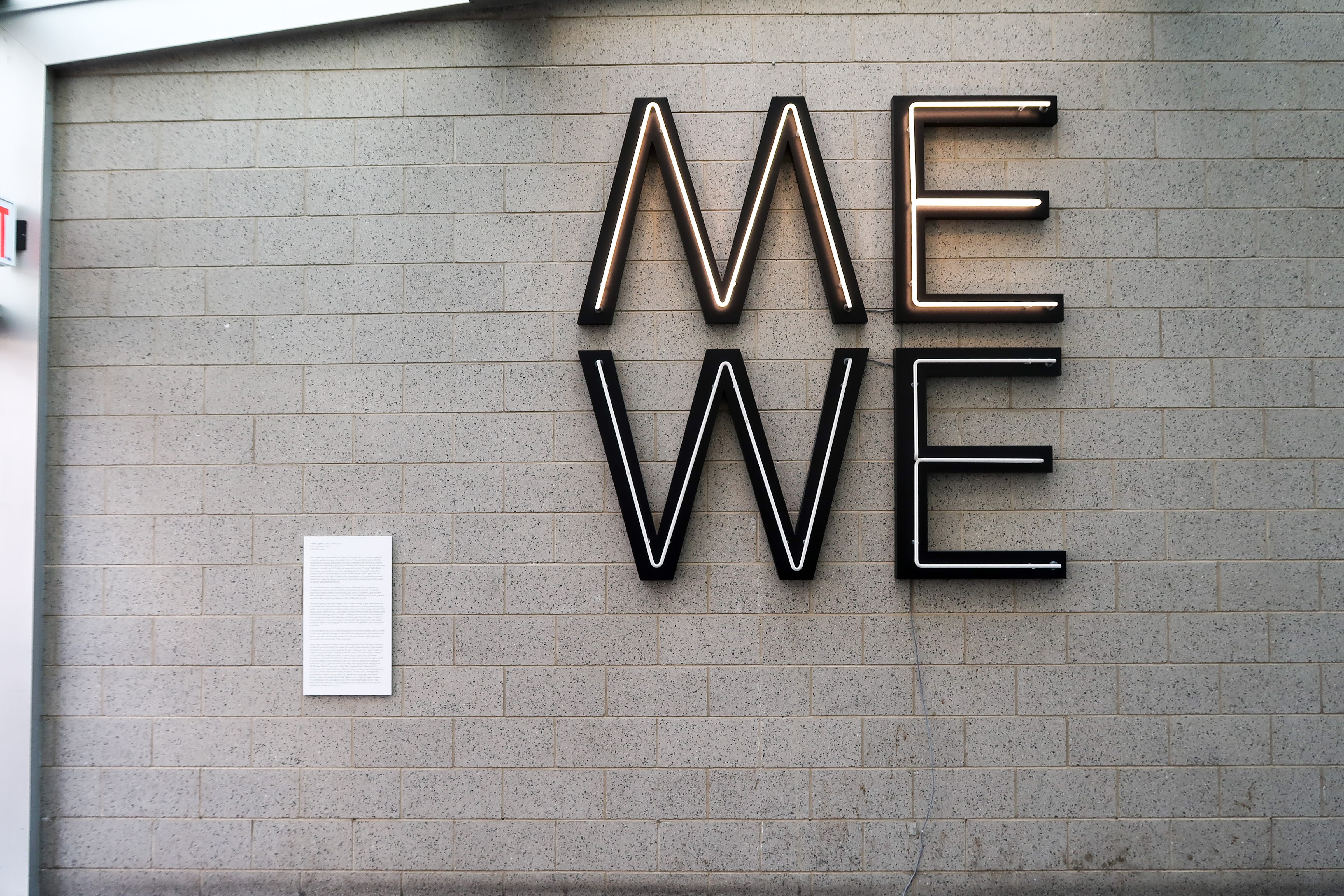
Inside the new Studio Museum in Harlem, black linear letters spell ME and WE against a grey wall. A single letter separates the individual from the collective. The installation seems to condense an institutional history built between private work and public encounter.
Studio is not a decorative word here. It promises attention to research, making, uncertainty, and failure before a finished object reaches a gallery. Residencies, workspaces, and open programmes therefore stand beside exhibitions and collecting at the centre of the Museum.
Beyond the doors on 125th Street, this relation becomes architecture. Stairs support movement but also gathering. Galleries hold completed work while studios prepare what comes next. The distance from ME to WE is measured again throughout the building.
A Museum for Black Artists Opens in 1968
The Studio Museum opened in Harlem in 1968 when mainstream American institutions offered little sustained space for Black artists. It became a nexus for artists of African descent and for work inspired and influenced by Black culture.
Founders included artist Betty Blayton-Taylor, lawyer Eleanor Holmes Norton, journalist and activist Charles E. Inniss, and others from different fields. Their collaboration framed the Museum as a civic site for exchange about art and society rather than a repository alone.
Its inaugural exhibition presented Tom Lloyd, an artist working with electric light and electronic technology. Choosing such work in 1968 refused to confine Black art to a single recognizable style. It asked how an artist could use the materials of a changing city.
The Residency Becomes a Founding Structure
Proposed in 1968 and launched in 1969, the Artist-in-Residence programme became one of the Museum’s defining initiatives. Artist William T. Williams imagined an intimate community of artists working and learning from one another.
The current programme offers three artists an eleven-month period with studios, a stipend, research support, professional guidance, and a concluding exhibition and publication. It invests in the duration of a practice rather than acquiring one finished result.
Many alumni later entered broader histories of contemporary art. The deeper achievement is not simply that the Museum identified future prominence. It provided space and critical conversation while artistic languages were still uncertain and allowed alumni across generations to form a continuing context.
Harlem’s Cultural Production Came First
The Museum did not invent Harlem as a symbol of Black culture. Music, literature, politics, photography, and performance already flourished through its streets, homes, churches, and clubs. The institution assumed a responsibility to connect and preserve without claiming ownership of that production.
Its relationship to the neighbourhood cannot be measured by exhibition themes alone. School partnerships, family programmes, street events, and repeated artist conversations matter because they allow local audiences to return rather than appear once as subjects.
No museum can declare itself the voice of a community. It must keep examining who is invited, which records survive, and who participates beyond the gallery. The phrase in Harlem is sustained through a relationship, not secured by an address.
Nearly Nine Thousand Works Span Two Centuries
At the opening of the new building, the permanent collection held nearly nine thousand works. It reaches from the nineteenth century to the present and includes art by people of African descent and work shaped by Black culture across painting, sculpture, photography, paper, and new media.
Treating the collection as proof of one identity would erase its differences. Artists shaped by the American South, the Caribbean, Africa, Europe, migration, and city life approach history, the body, abstraction, and technology in sharply distinct ways.
The new home allows multiple collection installations to appear at the same time. Works recently acquired, conserved, or unseen for decades can rotate into view. A permanent collection becomes active through changing relationships rather than a fixed list of masterpieces.
After Fifty-Seven Years, a Purpose-Built Home
On 15 November 2025, the Museum opened at 144 West 125th Street. The seven-floor, 82,000-square-foot building is the first in its history designed expressly for the institution and its communities.
Adjaye Associates developed the design, with Cooper Robertson serving as executive architect. The project is better understood through programme than signature. Studios, education, galleries, and public stairs show what the Museum needed its architecture to do.
Exhibition and Artist-in-Residence space more than doubled, while indoor and outdoor public space for education and programmes increased by almost seventy percent. Growth matters because viewers, makers, and learners can now occupy the institution at the same time.
Brownstone Windows, Churches, and the Stoop
Windows of different sizes across the facade echo the masonry-framed openings of Harlem apartment buildings and brownstones. Instead of one continuous glass wall, solid surfaces and openings continue the varied rhythm of the street.
A tall, top-lit gallery refers to neighbourhood churches. Large walls accept ambitious installations while daylight is controlled from above. The height associated with religious gathering is adapted for secular exhibition and exchange.
The lobby’s Stoop and Grand Staircase draw on the steps between a New York home and its sidewalk. A stoop is neither fully private nor entirely public. Inside the Museum, the stair becomes a place to sit, watch, meet, and host programmes rather than a route alone.
Tom Lloyd Connects the First and New Openings
The inaugural season returned to Tom Lloyd, the artist, educator, and activist whose work formed the Museum’s first exhibition in 1968. Born in 1929, Lloyd used electric light and electronic systems before his death in 1996.
Reintroducing his work linked the new building to the institution’s earliest public act. New scholarship and intensive conservation reconsidered his contribution to the relationship between art and technology rather than simply restaging a historic display.
Commemoration could have frozen the first exhibition as an origin myth. Research does something harder: it studies fragile components, incomplete records, and the future that electronic art once proposed to its original audience.
One Hundred Alumni Meet Across Generations
The opening programme included new works on paper by more than one hundred Artist-in-Residence alumni. Participants differed greatly in generation, medium, and career. A shared material made their differences easier to see rather than forcing a common style.
Archival photographs and ephemera traced nearly sixty years of exhibitions, events, and public programmes. Family gatherings, street activities, and artists at work showed that institutional history was made beyond celebrated gallery installations.
New site-specific commissions by Camille Norment, Christopher Myers, and Kapwani Kiwanga joined long-term works by David Hammons, Glenn Ligon, and Houston E. Conwill. History appeared as overlapping voices rather than one continuous line.
Waiting for the Next Studio on 125th Street
The Museum opens Wednesday through Sunday, with extended evening hours on Friday and Saturday. It uses suggested admission and offers free Sundays. Current timed tickets, concessions, events, and installation closures should be confirmed before travel.
A visit can include time on the Stoop, in the lobby, or at an open-studio event rather than only a circuit of exhibitions. The rooftop terrace shifts the view toward 125th Street, while landscape design by Harlem-based Studio Zewde connects building and neighbourhood.
The new home is not a reward marking the end of fifty-seven years. It is a tool for the work ahead. The distance between ME and WE remains productive: protecting one artist’s concentration while opening a door through which a community can look, question, and return.
Visit Info
- Address: 144 W 125th Street, New York, NY 10027
- Hours: Wed-Thu and Sun 11:00-18:00; Fri-Sat 11:00-21:00; closed Mon-Tue. Confirm holiday and installation closures
- Fee: Suggested admission, with free Sundays; confirm current timed-ticket and concession details
- Transport: Walk from the 2/3 trains at 125 St or from Metro-North Harlem-125th Street
- Time needed: About 1.5-2 hours; allow longer for programmes and events
- Website: https://www.studiomuseum.org/visit
Visitor Info
| Address | 144 W 125th Street, New York, NY 10027 |
| Hours | Translating |
| Admission | Translating |
| Getting There | Translating |
| Duration | Translating |
| Translating | https://www.studiomuseum.org/visit |